How does B2B marketing differ from B2C marketing?

B2B marketing has to win a buying group over months. B2C marketing usually wins one person, often in a single session. That one difference changes the message, the channels and above all the metrics. Some B2C methods carry over well, like brand building, video and smooth self-service. Others break, like countdown offers and short attribution windows.
This page is about the marketing. The business side, from buying decisions to prices and consumer law, is covered in the difference between B2B and B2C. Here you'll find which B2C methods work in B2B, which ones fail with buying groups and long cycles, a worked example on measurement and a decision table for borrowing from B2C.
A disclosure: I work in B2B only, never in B2C. Read the B2C side of this page as the view of someone looking across the fence. For the full B2B system, see the guide to B2B marketing.
How does B2B marketing differ from B2C marketing?
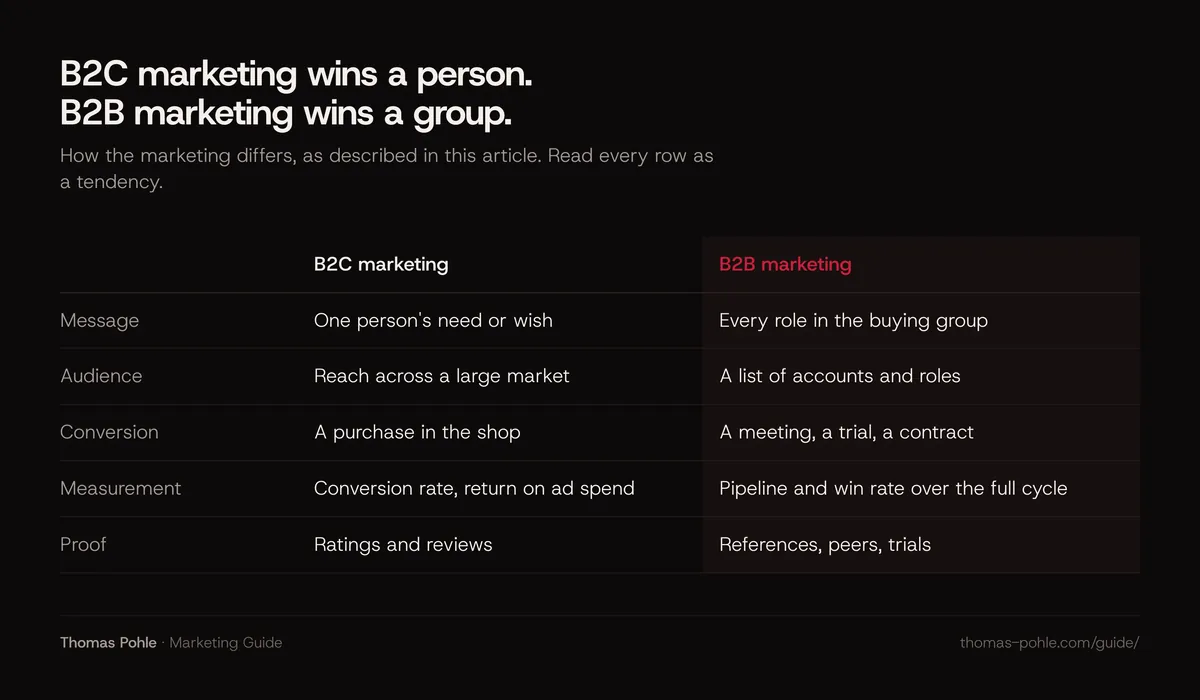
B2B marketing differs from B2C marketing in five places: whom the message has to convince, how many people you can reach, how long a decision takes, what counts as a conversion and what proof buyers need. B2C optimizes for one person and fast feedback. B2B plans for a group, slow feedback and buyers who check everything.
| Marketing element | B2C marketing | B2B marketing |
|---|---|---|
| Message | One person's need or wish | Every role in a group, from user to procurement |
| Audience | Reach across a large market | A list of accounts and the roles inside them |
| Time to decision | Minutes to weeks | Months, with long silent stretches |
| Conversion | A purchase in the shop | A meeting, a trial, an opportunity, a contract |
| Measurement | Conversion rate, return on ad spend | Pipeline, win rate, accounts reached over the full cycle |
| Proof | Ratings and reviews | References, case studies, peers, trials |
Forrester's State of Business Buying 2026, published in January 2026, shows the scale on the B2B side. A typical buying decision involves 13 internal stakeholders and nine external influencers, and procurement is a decision-maker in 53 % of buying cycles. No consumer funnel is built for 22 people.
Which B2C methods work in B2B?
Four B2C methods work well in B2B: brand building that people remember, a buying experience people can run on their own, simple and human creative, and proof from other people. They work because business buyers are still people, and because most of them research alone long before they talk to a seller.
- Brand building. Most of your buyers aren't in the market today, so memory does the work until they are. Les Binet and Peter Field found for the LinkedIn B2B Institute that emotional messaging is more effective in the long term in B2B too. The pillar guide explains the out-of-market arithmetic and the split between brand and demand.
- Self-service. Gartner reported in March and May 2026, from its survey of B2B buyers in August and September 2025, that 67 % prefer a rep-free experience and 70 % a completely digital, self-service buying experience. Pricing logic, product tours and a clear next step on the website are consumer habits B2B needs.
- Human creative. My view: on LinkedIn, real and slightly rough visuals such as a phone photo or a screenshot often beat polished graphics, because they feel like a real moment. That's a consumer social media habit, and it works with business buyers too.
- Proof from others. Ratings drive many consumer purchases. In B2B the equivalent is peers and experts. LinkedIn's 2026 Global B2B Marketing Outlook, published in March 2026, reports that 56 % of B2B buyers who use creators rely on their input in the final stage of buying. LinkedIn sells creator ads, so treat that number as a signal.
The common thread: each method helps a buyer who isn't talking to you yet. That's most of the B2B buying process.
Which B2C methods fail with buying groups and long cycles?
B2C methods fail in B2B when they assume one person can decide now. Countdown offers, a single persona, mass reach without an account list, lead volume as the main target and short attribution windows all rest on that assumption. With a buying group and a cycle of months, each of them creates activity that doesn't turn into revenue.
- Countdown offers. A discount that ends on Friday pushes one person. It can't push a group that needs a budget approval and a procurement review. In my view, it also tells procurement your price is negotiable.
- One persona. A consumer campaign can target the runner. A B2B campaign that only targets the CTO ignores the other internal stakeholders and the external people who advise them.
- Reach without a list. Broad reach makes sense when anyone can buy. In B2B most of it lands with people who never will. Start from the accounts you can name, as in account-based marketing.
- Lead volume as the goal. A consumer sign-up is close to a sale. A B2B form fill from a student or a competitor is noise. My rule: count meetings and pipeline instead of forms.
- Short attribution windows. The default settings of the big ad and analytics tools look back 30 to 90 days. That fits most consumer purchases. The worked example below shows what it does to a B2B cycle.
How does the message change when a group decides?
When a group decides, your message has to work for every role, including people who check you without ever meeting you. Keep one core claim and tell it in the language of each role: the user wants it to work, finance wants a return, IT wants it safe, and procurement wants terms it can compare.
Procurement deserves its own attention. Forrester analyst Barbara Winters writes that procurement now engages from the start and evaluates features, specifications and price. In my view, most B2B websites have nothing for that reader. One page with pricing logic, contract terms, security and references closes the gap.
The nine external influencers in Forrester's count have no real equivalent in consumer marketing. Consultants, peers and analysts give advice without ever appearing in your CRM. They read your public material and what AI answers say about you. The guide to AI SEO covers how to become the source those answers cite.
Keep the story identical across roles. Gartner's buyers used an average of seven information sources during a recent purchase. Seven sources that agree build trust. Seven that contradict each other give the group a reason to wait.
Why do B2C metrics mislead in B2B marketing?
B2C metrics mislead in B2B because they measure short windows and single conversions. Google Analytics 4 looks back 90 days by default for most key events, and Google Ads applies a 30-day default conversion window that you can raise to 90 days. When your sales cycle runs nine months, most of the touches that started a deal fall outside those windows.
A worked example with hypothetical numbers. A software company closes a deal nine months after the first contact. Along the way the buying group has six touches with the company before the contract:
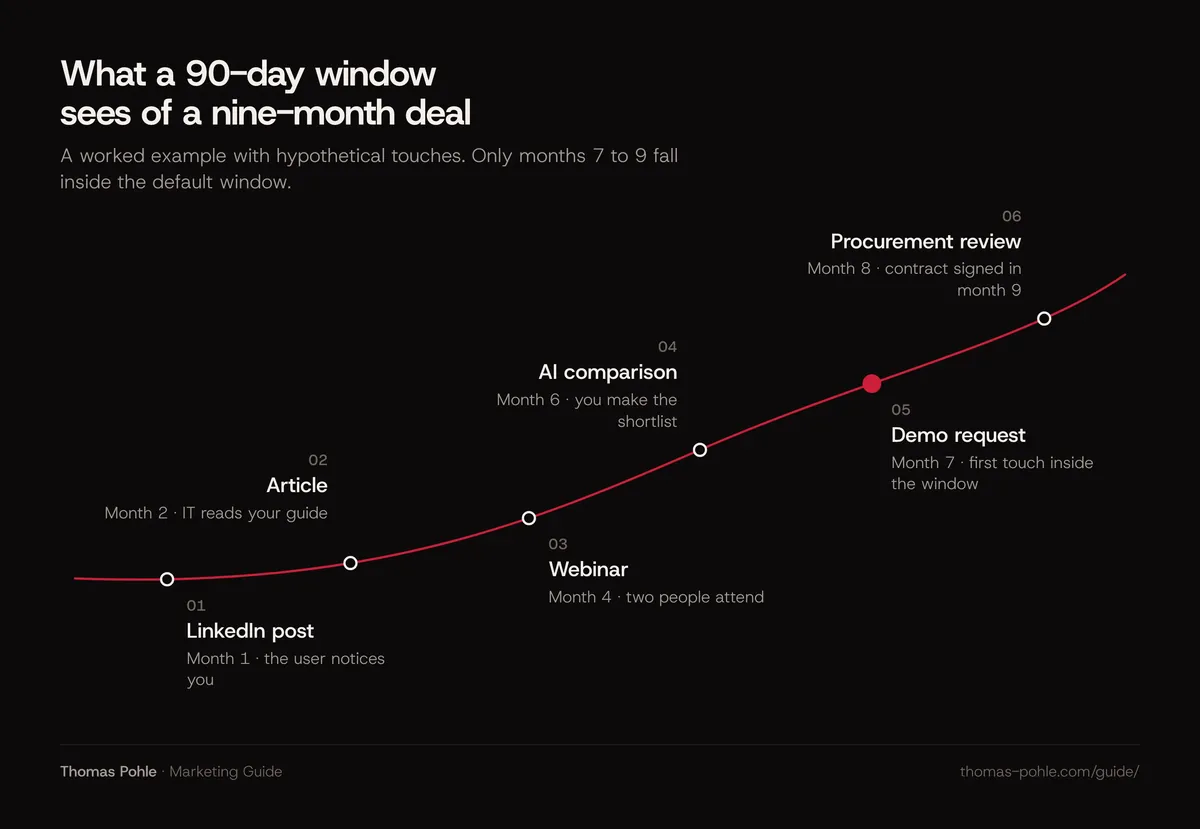
A tool with a 90-day window can only credit what happens in months 7 to 9: the demo request and the procurement review. That's two of six touches. The LinkedIn post, the article, the webinar and the AI comparison that put the company on the shortlist get no credit. A consumer-style report would tell you to cut exactly those.
What to measure instead: pipeline created per quarter, win rate, sales cycle length and how many of your target accounts engage over the full cycle. The guide to marketing measurement covers these metrics. Also ask every new customer how they first heard of you. A self-reported answer is rough, and it sees what a 90-day window can't.
When should a B2B company copy B2C marketing?
Copy a B2C method when the step it serves is one a single person takes alone: discovering you, trying the product, starting a small self-serve purchase. Don't copy it for steps the whole group takes, such as approval and procurement. The decision table below sorts common B2C methods by that rule. The conditions are my rule of thumb.
| B2C method | Use in B2B? | Condition |
|---|---|---|
| Emotional brand advertising | Yes | Steady over years, aimed at the whole category |
| Self-service checkout | Partly | For orders one person may approve alone |
| Visible prices | Partly | At least a price logic or a starting price on the website |
| Free trial | Partly | Software where a user sees value within 14 days |
| Influencers and creators | Partly | Experts your buyers already follow, judged over 6 months or more |
| Countdown discounts | No | Never for orders that need an approval |
| Last-click attribution | No | Only next to a full-cycle view of pipeline |
The rule behind the table: B2C methods are built for individuals. In B2B they work for the steps an individual takes and fail at the steps a group takes.
If you sell to businesses and consumers at the same time, first split the plan with the decision table in the B2B and B2C comparison. Then use this table for each audience.
What to do this week
One week is enough to find the B2C habits in your B2B marketing. Look at your offers, your personas, your reach, your lead targets and your attribution settings. Each one either fits a buying group or quietly works against it. Fix the cheapest one first and the rest in order of cost.
- Check the attribution and conversion windows in GA4 and your ad accounts. Write down how many days they cover.
- Measure your real sales cycle: the average days from first contact to signed contract for your last ten deals.
- List the roles in your last five deals. Mark the ones your website has nothing for.
- Remove countdown offers from anything that needs an approval to buy.
- Replace lead volume with meetings or pipeline as the monthly target.
- Write a procurement section: pricing logic, contract terms, security, references.
- Add the question "How did you first hear about us?" to your onboarding.
If the list shows a plan built for consumers, a one-day Momentum Workshop sets positioning, ideal customer and the first channel for your buying group. Your team leaves with a plan it can run on Monday.
Borrow from B2C where one person acts. Plan for the group everywhere else.
Frequently asked questions
What is the main difference between B2B and B2C marketing?
B2B marketing has to convince a buying group over months, B2C marketing usually one person in a short time. Forrester counts 13 internal stakeholders and nine external influencers in a typical B2B decision. That is why B2B marketing works with account lists, content for each role and pipeline metrics, while B2C marketing works with reach, conversion rates and fast tests.
Can B2C marketing tactics work for B2B?
Yes, for the steps one person takes alone. Brand building, self-service, human creative and proof from other people transfer well. Gartner reported in May 2026 that 70 % of B2B buyers prefer a completely digital, self-service buying experience. Tactics built for an instant decision, like countdown discounts and last-click attribution, fail when a group has to approve the purchase.
What is B2C marketing?
B2C marketing is marketing by a company to private consumers who buy for themselves or their household. It typically reaches a large, anonymous audience, aims for a purchase by one person and measures success with reach, conversion rate and return on ad spend. Its counterpart, B2B marketing, sells to organizations that decide in groups.
Why is B2B marketing harder to measure than B2C marketing?
Because the cycle is longer than the tools look back. Google Analytics 4 uses a 90-day default lookback for most key events, and Google Ads conversion windows go up to 90 days. A B2B deal that takes nine months started long before that. Measure pipeline, win rate and cycle length, and ask customers how they first heard of you.
Should B2B ads be emotional or rational?
Both, for different jobs. Les Binet and Peter Field analyzed IPA Effectiveness Awards cases for the LinkedIn B2B Institute and found that in B2B, too, emotional messaging works better in the long term, while rational messaging works better for short-term activation. Use emotion to stay remembered by buyers who aren't in the market yet, and specific proof for the group evaluating you now.
Sources
- Forrester: The State of Business Buying, 2026 (press release, January 21, 2026)
- Barbara Winters, Forrester: The State Of Business Buying, Risk-Averse Buyers Demand Proof, Not Promises (January 21, 2026)
- Gartner: Survey Finds 69% of B2B Buyers Turn to Sales Reps to Validate AI-Generated Insights (May 20, 2026)
- Gartner: Sales Survey Finds 67% of B2B Buyers Prefer a Rep-Free Experience (March 9, 2026)
- LinkedIn: How LinkedIn is helping B2B marketers reach audiences at scale with creators and video (March 18, 2026)
- Les Binet and Peter Field, LinkedIn B2B Institute: The 5 Principles of Growth in B2B Marketing
- LinkedIn Marketing Blog: Why B2B marketing needs emotion (Binet and Field, IPA data)
- Google Analytics Help: Select attribution settings (lookback windows)
- Google Ads Help: About conversion windows

Thomas PohleB2B marketing advisor in Zurich. More than ten years in B2B marketing at Link11, Beekeeper and smino, most recently as Head of Marketing. CEO and co-founder of TEISENDA. Researched and drafted with AI tools, checked against the sources listed above. More about Thomas