Where is B2B e-commerce heading?
B2B e-commerce is heading toward several digital ordering channels at once: customer portals with contract prices, self-service reordering, marketplaces, punchout from the buyer's procurement system and, slowly, AI agents. In Germany, manufacturers and wholesalers sold €549 billion through online shops and marketplaces in 2025. For marketing, the question shifts from traffic to rules: which customer sees which price where.
This guide is for founders and sales and marketing leads of manufacturers and wholesalers who sell through reps, distributors or a web shop. The wider system is in the pillar on how B2B marketing works, the trends outside commerce are in which B2B marketing trends really matter. This article stays with the ordering channels.
Where is B2B e-commerce heading in 2026?
B2B e-commerce is splitting into channels. The open web shop is only one way a business customer orders digitally today. Next to it sit the customer portal, self-service reordering, marketplaces and punchout from the buyer's procurement system. AI agents are the newest and still the smallest. Each channel serves a different buyer and changes prices and sales roles differently.
- Germany. The B2B-Marktmonitor 2026 by ECC KÖLN, published on October 5, 2026, puts the 2025 revenue of manufacturers and wholesalers through online shops and marketplaces at €549 billion, up 7.9 % on 2024. That's 13.3 % of their total revenue. Including EDI, about 30 % of B2B revenue is now generated digitally. Caveat: Intershop and CGI, who sell commerce software and services, co-produced it, and the release names no sample size.
- Global. McKinsey's 2026 B2B Pulse, published in May 2026 and based on nearly 4,000 decision-makers in 13 countries, found that 71 % of B2B companies offer e-commerce. Among them, roughly one-third of revenue flows through digital channels.
- Buyers. In a Gartner survey of 645 B2B buyers, fielded in August and September 2025 and released in May 2026, 67 % preferred a rep-free experience. 69 % preferred to validate AI-generated insights with a sales rep.
Buyers want to order without a rep and still check with one. In the ECC KÖLN survey, 82 % of executives expect field sales to become an advisory role.
| Channel | Who orders there | What changes for marketing | What changes for sales and pricing |
|---|---|---|---|
| Open web shop | New and small customers | Traffic, product pages, search | List prices become public |
| Customer portal | Existing customers, logged in | Onboarding, cross-sell, portal content | Contract prices online, reps stop typing orders |
| Self-service reordering | Repeat buyers of consumables | Reminders, reorder lists | Fewer small orders by phone and email |
| Marketplace | Buyers who compare on specs and price | Product data, ratings, listing rules | Your price sits next to competitors |
| Punchout and e-procurement | Procurement teams of large customers | Catalog content, supplier listing | Contract prices inside the buyer's system |
| AI agent | Software acting for a buyer, still rare | Machine-readable facts and prices | Price rules must be written down |
What does a customer portal change for marketing and sales?
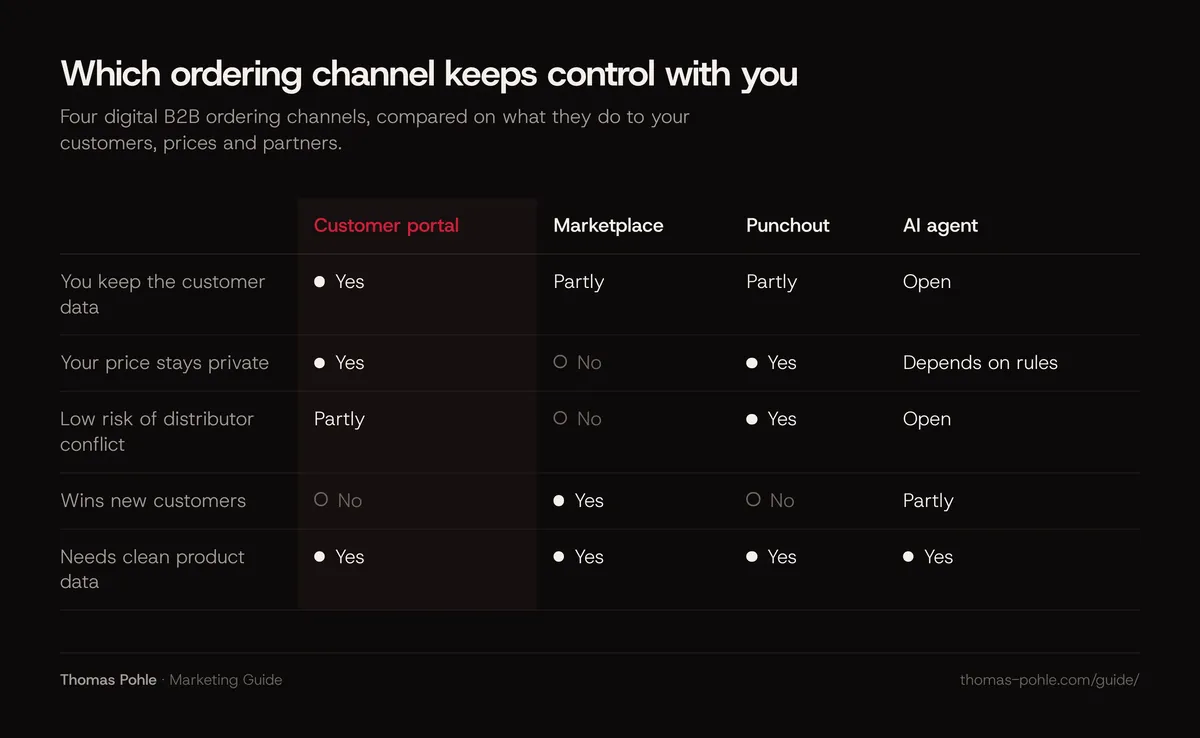
A customer portal is a logged-in ordering area for existing customers: their contract prices, their order history, their documents and reorder in two clicks. It moves routine orders away from email and phone. For marketing, it opens the most underused channel in B2B: a place where active customers log in on their own, every week.
Self-service reordering belongs here: saved order lists, scheduled deliveries and scan-to-order for consumables.
What changes for marketing:
- Adoption is the campaign. A portal nobody logs into is a cost. The launch is an onboarding program for existing customers: who gets access, who shows them, what they gain on day one.
- Product content becomes infrastructure. Nobody calls to ask anymore, so specs and documents must be complete.
- Cross-sell gets a basis. Order history shows what a customer doesn't buy from you yet.
What changes for sales: reps stop typing orders and get time back for advice. The risk is the commission plan. If portal orders don't count for the rep who owns the account, the rep keeps steering customers to email. My rule of thumb: credit portal orders to the account owner for at least the first year.
In a previous role I moved a company's CRM from Pipedrive to HubSpot to get full-funnel targets and reliable forecast reporting. Portal data needs the same care. If portal orders don't land in the CRM next to the rep's pipeline, nobody sees which customers moved online and which went quiet. The guide on marketing automation covers the connection.
When does a B2B marketplace make sense?
A B2B marketplace makes sense when your buyers already search there for products like yours and your product can be compared on specs and price. According to ECC KÖLN, marketplaces handle about a quarter of B2B online trade in Germany. Their share stopped growing in 2025, after an average annual growth of 26.1 % from 2018 to 2025.
A marketplace buys reach and costs you three things.
- Price transparency. Your price stands next to your competitor's, and your distributors see it too.
- Rules you don't set. The platform decides on listing, fees and data access. Read the seller terms before you list a single item.
- Content work. Weak product data loses the comparison before the buyer sees your brand.
My take: test a marketplace with the part of your range that is standardized and price-comparable anyway. Keep configured products, project business and anything that needs advice in your own channels.
Why should marketing care about punchout and e-procurement?
Punchout connects your catalog to the buyer's procurement system. The buyer starts in their own purchasing software, jumps into your catalog, fills a cart, and the cart returns to their system for approval. The order never passes through your website's marketing funnel, yet your catalog decides whether you get picked.
The common standard is cXML, which lists PunchOut among its features (version 1.2.071, August 2026). What matters for marketing:
- The buyer is procurement. The user who needs the part and the person who approves the supplier are different people. Your content has to work for both.
- Getting listed is the conversion. Approved supplier status often matters more than any campaign. It needs documents, certificates and references.
- Punchout accounts disappear from analytics. Their orders don't show up as website conversions. Mark these accounts in the CRM, or your reporting will say your best customers went quiet.
Will AI agents order from your company?
Some will, first for standard reorders and comparisons. In 2026 the evidence is mostly forecasts and surveys. Forrester predicted in October 2026 that AI agents will influence 75 % of B2B purchase decisions. Influence isn't ordering, though, and the agent checkout described below is built for shopping on Google, not for procurement.
Google's help page on checkout through the Universal Commerce Protocol, an open standard for agentic commerce, limits the feature to select merchants and to products eligible in the United States, Canada and Australia. It doesn't mention B2B. A DACH manufacturer can't use this checkout today.
The ECC KÖLN survey shows where companies expect agents on the seller's side: 65 % would welcome AI agents that calculate and answer price inquiries on their own, and 61 % see a use for agents in complex B2B price and condition logic. Keep in mind that the co-publisher Intershop sells agentic commerce software.
My verdict: don't build an agent channel yet. Build what every agent will need and your other channels need today: clean product data and written price rules. The guide on AI search shows how to make your pages readable for AI systems.
One rule for content: AI can draft product texts from your data for thousands of items. The pages that explain why a buyer should pick you come from your own customer conversations. Write them yourself, or at least give your own input. An agent can't find that anywhere else.
How do you handle price transparency and customer-specific prices?
Digital channels make prices visible. A list price on a marketplace is seen by competitors, distributors and customers with better contracts at the same time. The answer is a price architecture in layers: a public list price, channel prices, contract prices shown only after login, and project quotes that stay with sales.
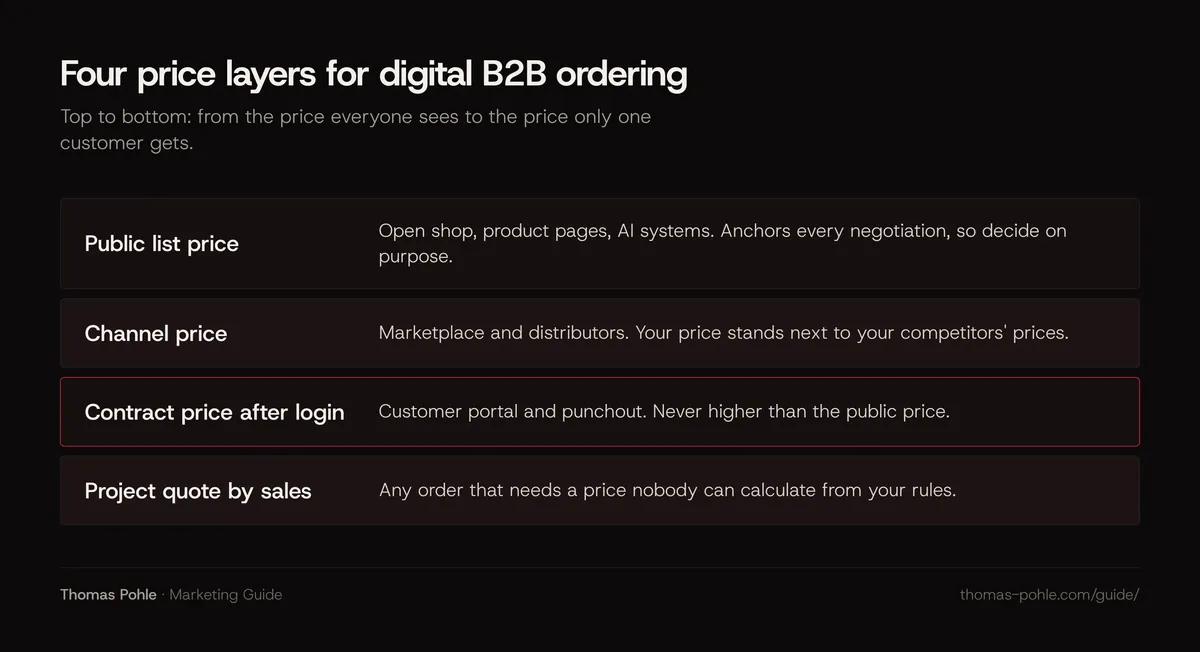
In the ECC KÖLN survey, 60 % of executives see customer-specific prices and 61 % see channel-specific assortments as helpful against cannibalization between channels. Both are rules you write down before launch.
- No portal customer pays more than the public price. If they do, they'll find out and call.
- Decide whether the list price is public. It helps new customers and AI systems and anchors every negotiation.
- Quotes above a threshold go to sales. My rule of thumb: if an order needs a price nobody can calculate from your rules, it belongs to a person.
For prices to distributors in the EU, competition law sets limits. The European Commission's 2022 revision of the Vertical Block Exemption Regulation, in force since June 1, 2022, now exempts charging the same distributor different wholesale prices for products sold online and offline, provided all other conditions of the exemption are met. This is no legal advice; check your contracts with a competition lawyer.
How do you avoid channel conflict with your distributors?
Channel conflict starts when your own shop sells to a distributor's customers at a lower price. You avoid it with rules written before launch: which customers and products each channel serves, how distributor accounts are credited, and which prices are visible where. Talk to your biggest distributors before you build. If they discover your shop on their own, trust is gone.
The legal side got stricter. The same 2022 revision narrowed the safe harbor for dual distribution, where a supplier sells through independent distributors and directly to end customers. According to the Commission, certain aspects of dual distribution and certain parity obligations now need an individual assessment under Article 101 TFEU.
Four models I would consider:
- Split by assortment. Your portal sells the range the distributors don't stock.
- Split by customer. Key accounts order directly, everyone else through distributors.
- Distributor fulfils. Orders from your portal are passed to the customer's distributor, who delivers and invoices.
- Portal for distributors. The first portal serves the distributors themselves, with stock levels, prices and documents.
In my view, founders should stay close to customers and sales. Here that means the CEO calls the three biggest distributors personally before the portal goes live.
Which ordering channel should you build first?
Build first the channel your existing customers already ask for. For most B2B companies that's a customer portal with reordering, because the buyers, the products and the prices already exist. Marketplaces and agent readiness come later. Punchout jumps the queue when large customers make it a condition for ordering.
| Your situation | Build first | Why | Marketing's first job |
|---|---|---|---|
| Many repeat customers order by email or phone | Customer portal with reordering | Frees sales time, creates order data | Onboard 20 to 30 accounts first |
| Large customers require it in tenders | Punchout catalog | No punchout, no listing | Catalog content and supplier documents |
| Standard products, you want new customers | Marketplace test with part of the range | Reach where buyers already compare | Product data and a price rule |
| Distributors serve most customers | Portal for distributors | Digital without channel conflict | Co-marketing material for partners |
| Every price is a project quote | No shop yet, written price rules | Nothing standard to order online | Content for the buying group |
Start with a pilot of 20 to 30 accounts that order often. It shows quickly whether customers use the channel and which data is missing.
A consumer shop wants new buyers. A B2B ordering channel mostly serves the customers you already have, which changes your metrics, as the guide on how B2B marketing differs from B2C explains.
What to do this week
- List how your customers order today: share of email, phone, rep, shop, EDI and punchout, by revenue.
- Ask sales which ten customers order the same items most often. They are your portal pilot candidates.
- Check whether your top five customers use a procurement system that requires punchout.
- Write down your price layers: list price, channel price, contract price, quote. Mark which one is visible where today.
- Count the products with complete data. That share limits every channel.
- Book a call with your biggest distributor about digital ordering before you build anything.
- Make sure portal and punchout orders show up in your CRM next to the account owner.
My outlook: ordering in B2B will be mostly digital, and selling will stay personal. Set your rules for prices and channels now, while mistakes are still cheap.
If you want to decide which channel comes first and what marketing does around it, that's a good topic for a one-day Momentum Workshop.
Frequently asked questions
What is the difference between B2B e-commerce and EDI?
EDI is the automated exchange of orders and invoices between the IT systems of two companies. B2B e-commerce in the narrow sense means ordering through online shops, portals and marketplaces. ECC KÖLN counts both when it says about 30 % of B2B revenue in Germany is now generated digitally.
Do I need a B2B web shop if all my customers order through sales reps?
Not necessarily an open shop. If your customers reorder the same items, a logged-in customer portal with reordering usually helps more, because it frees your reps from typing orders. If every order is a project quote, start with written price rules and good content for the buying group, and leave the shop for later.
Should B2B prices be public online?
List prices can be public when your products are standardized and buyers compare anyway. Contract prices belong behind the login. Decide it per layer: a public list price helps new customers and AI systems find you, and it also anchors every negotiation. Whatever you choose, no portal customer should ever pay more than the public price.
How do you measure whether a customer portal works?
Track the share of active customers who logged in and ordered in the last 90 days, the share of repeat orders placed in the portal, and the time reps spent on order entry before and after. Revenue alone hides the effect, because these customers would have ordered anyway.
Sources
- IFH KÖLN / ECC KÖLN: B2B-Internethandel von Herstellern und Großhändlern wächst 2025 auf 549 Milliarden Euro (October 5, 2026)
- EQS-News, Intershop: B2B-Marktmonitor 2026, Hersteller und Großhändler sehen konkreten Bedarf für KI-Agenten im B2B-E-Commerce (October 5, 2026)
- McKinsey: The surprising economics of B2B growth, the new survival threshold and what it takes to thrive (May 2026)
- Gartner: Survey Finds 69% of B2B Buyers Turn to Sales Reps to Validate AI-Generated Insights (May 20, 2026)
- Forrester: 2027 B2B Go-To-Market Predictions, AI agents will influence 75% of B2B purchase decisions (October 21, 2026)
- Google Merchant Center Help: About the Universal Commerce Protocol (UCP) and UCP-powered checkout feature on Google
- European Commission: Antitrust, Commission adopts new Vertical Block Exemption Regulation and Vertical Guidelines (IP/22/2844, May 10, 2022)
- cXML: Commerce XML Resources (version 1.2.071, August 2026)

Thomas PohleB2B marketing advisor in Zurich. More than ten years in B2B marketing at Link11, Beekeeper and smino, most recently as Head of Marketing. CEO and co-founder of TEISENDA. Researched and drafted with AI tools, checked against the sources listed above. More about Thomas