Should you outsource B2B appointment setting?

Outsource B2B appointment setting only as a time-boxed supplement. Book your first meetings yourself, as founder or with one own salesperson, until you know which pitch works. Then an external setter can add volume for 8 to 12 weeks, paid for meetings that were held and accepted by sales, with acceptance criteria and the legal rules written into the contract.
This guide is for founders and sales or marketing leads with an empty sales calendar and an agency offer on the table. How outbound fits into the whole system is covered in the guide to B2B marketing.
What are your options for B2B appointment setting?
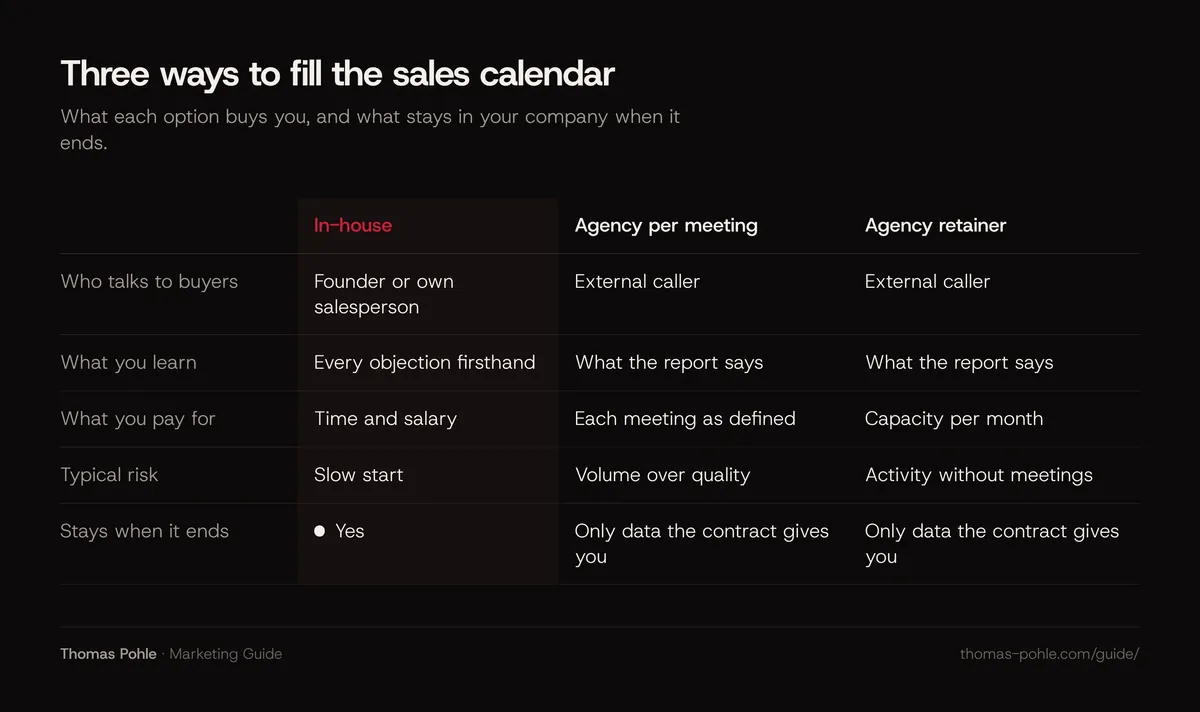
B2B appointment setting means someone contacts target accounts by phone, email or LinkedIn and books a first meeting for a seller. You have four options: the founder books meetings personally, an own salesperson or SDR does it, an agency gets paid per meeting, or an agency works on a monthly retainer.
The options differ most in who owns the conversation. When your own people call, every objection lands in your company. When an agency calls, it lands in a report, if at all. Early on, that learning is worth more than the meetings.
| Option | What you pay for | What stays with you |
|---|---|---|
| Founder books meetings | Time of the most expensive person | Every objection, the pitch, the relationships |
| Own salesperson or SDR | Salary, tools, ramp-up time | Pitch, lists, call notes, a person who stays |
| Agency, pay per meeting | Each meeting that meets the contract definition | The meetings, the data the contract gives you |
| Agency, retainer | Capacity per month, results not guaranteed | Reports and whatever the contract hands over |
When does it make sense to outsource appointment setting?
Outsourcing appointment setting makes sense when your pitch already works and you lack capacity for a limited time: a new segment to test, a follow-up after a trade fair, or a gap until your own hire starts. It rarely works while you still search for the message, because the agency then repeats an unproven pitch.
Outbound is one of the areas I've worked in, and I talk about it in pipeline, meetings and revenue. Then the question is simple: who produces meetings that turn into pipeline, and what do you keep when the contract ends? My preference: founder or one own salesperson first, an external setter only as a supplement with an end date.
| Your situation | My pick | Why |
|---|---|---|
| No proven pitch, first 10 customers | Founder books meetings | You need to hear the objections yourself |
| Pitch works, founder has no time | Hire one own salesperson | Knowledge and relationships stay in the company |
| Short peak, for example after a trade fair | Agency for 8 to 12 weeks | Capacity for a fixed window, paid per accepted meeting |
| Test a new segment before hiring | Agency pilot with 20 to 30 accounts | Cheap signal on whether the segment answers |
| Agency meetings rarely become opportunities | Stop and bring it in-house | Volume does not fix a targeting or pitch problem |
What separates a qualified meeting from an empty calendar entry?
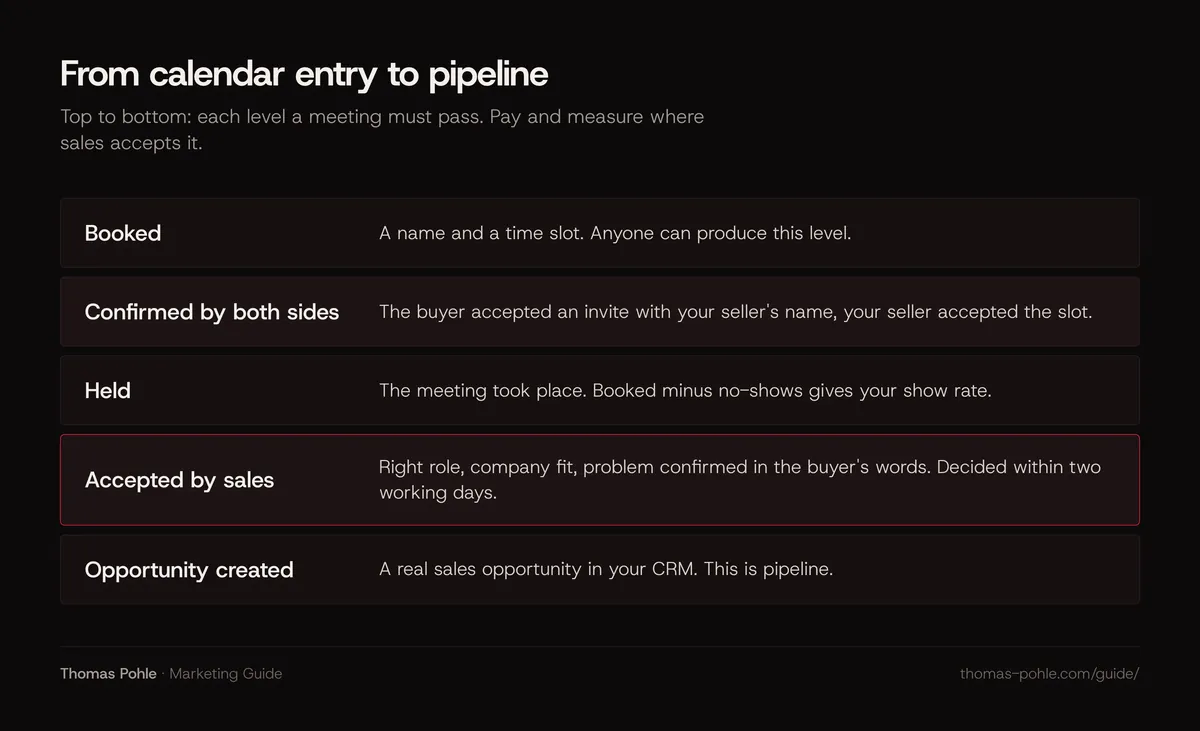
A qualified meeting has five things: the right role, a company that fits your ideal customer profile, a problem the buyer confirmed in their own words, an invitation both sides confirmed, and a meeting that actually took place. An empty calendar entry has a time slot and a name. Most disputes with agencies start because nobody wrote down the difference.
- Role. The person decides or shapes the decision. Name the job titles that count.
- Company fit. Industry, size, region, and exclusions such as existing customers.
- Confirmed problem. The buyer said, in their words, that the problem exists. The setter writes that sentence into the handover note.
- Both sides confirmed. The buyer accepted a calendar invite with your seller's name, and your seller accepted the slot.
- Held and accepted. The meeting took place and your seller confirmed within two working days that it met the criteria.
Which acceptance criteria belong in the contract?
Write the definition of a qualified meeting into the contract, plus who decides whether a meeting counts, the show rate you expect, what happens with no-shows, who owns the data and how the agency must contact people. Without that, you pay for whatever the agency calls a meeting, and you argue about it every month.
- Definition of a qualified meeting. The five criteria above, with job titles, company size and exclusions.
- Acceptance by sales. Your seller decides within two working days after the meeting. Only accepted meetings are billed.
- Show rate. The share of booked meetings that take place. Agree a minimum and what happens below it.
- No-shows and replacement. A meeting that doesn't happen is rebooked or replaced, not billed.
- Script and sender approval. You approve every script, email and profile used. The agency always names your company and its own role.
- Data. Contacts, call notes and objections go into your CRM, and you keep them after the contract ends.
- Legal compliance. The agency follows the rules on calls, email and LinkedIn in each country and documents consent where it's required. Add a data processing agreement where the agency works on your behalf.
If the agency processes personal data on your behalf, Article 28 GDPR requires a processing contract, and Article 9 of the Swiss FADP has its own processor rules. Article 14 GDPR sets out what to tell people whose data you didn't collect from them. No legal advice.
Should you pay per meeting, a retainer or a hybrid?
Pay per meeting rewards the agency for volume, a retainer rewards it for staying, and a hybrid of a small base plus a fee per accepted meeting comes closest to what you want. Whatever the model, tie the variable part to meetings held and accepted by sales. Never to meetings booked. That single clause decides most of the quality.
Each model has a typical failure. Pay per booked meeting pushes the setter to book anyone who says yes to a slot. A pure retainer pays for activity reports while the calendar stays empty.
I found no primary source for agency prices in DACH, so this guide gives none. Ask each agency for the price per accepted meeting, the minimum term and what you get back when you stop.
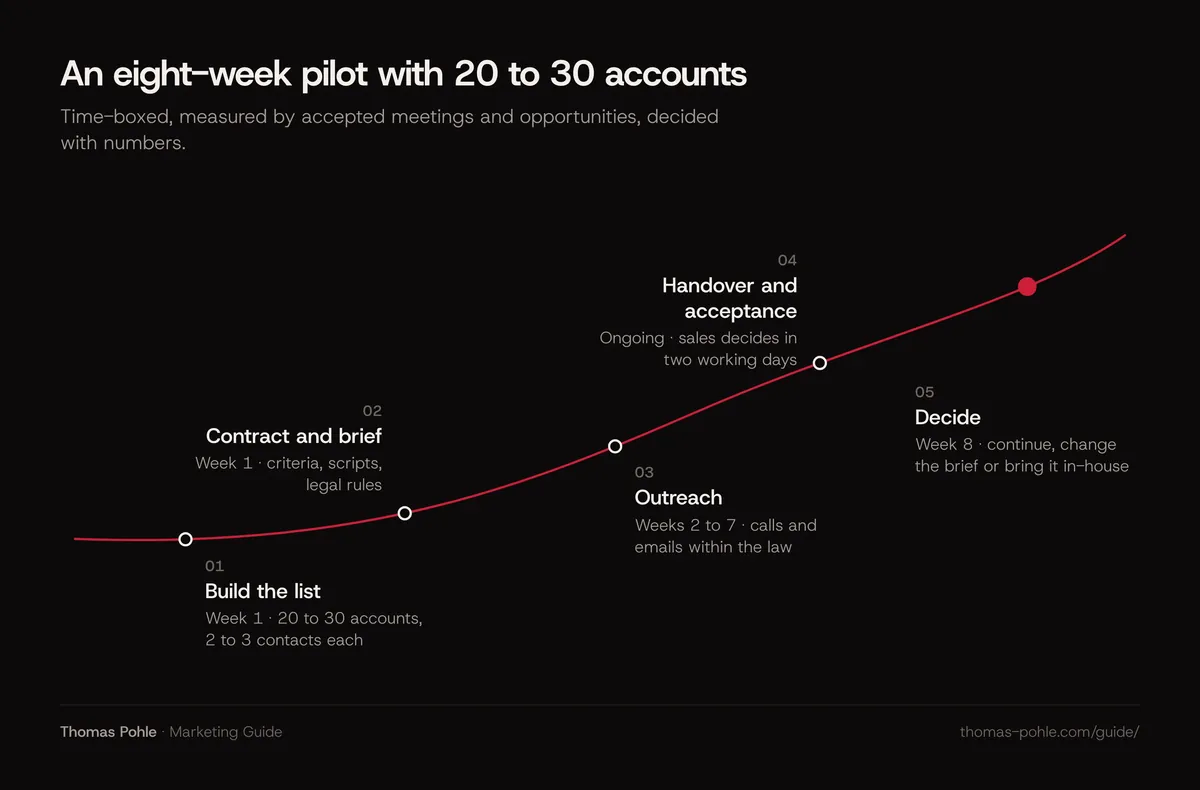
How do you run a 20 to 30 account pilot?
Run the pilot on a named list of 20 to 30 accounts that fit your ideal customer profile, with two or three contacts per account, for six to eight weeks. Measure meetings booked, held, accepted by sales and opportunities created. Decide at the end with numbers whether you continue, change the brief or bring the work in-house.
A typical scenario, with numbers made up to show the arithmetic: a company gives an agency 25 accounts with three contacts each, so 75 people. After six weeks the agency reports 12 booked meetings. 9 took place, a show rate of 75 percent. Sales accepted 6 of them. 3 turned into opportunities in the CRM.
| Stage | Example count | What it tells you |
|---|---|---|
| Meetings booked | 12 | Activity of the setter |
| Meetings held | 9 (75 % show rate) | Whether buyers really agreed |
| Accepted by sales | 6 | Whether the targeting and criteria work |
| Opportunities created | 3 | Whether it produces pipeline |
Now the billing. Paid per booked meeting, you pay for 12. Paid per held and accepted meeting, you pay for 6 at the same price. Same pilot, half the bill. The definition matters more than the price list.
My rule of thumb for the decision: if sales accepts fewer than half of the held meetings, the problem is the list or the brief, and more volume won't fix it. If accepted meetings turn into opportunities at a rate your own salesperson would be happy with, the setter earns a second, still time-boxed round.
Is cold calling and cold emailing to businesses legal in Germany, Switzerland and Austria?
Unsolicited advertising calls and emails are restricted in all three countries, and outsourcing doesn't move the risk away from you. In Germany, advertising calls to businesses need at least presumed consent and advertising emails need prior express consent. This is an overview of the legal texts, not legal advice.
- Germany, calls. Section 7 (2) no. 1 of the Act against Unfair Competition (UWG) treats advertising calls to consumers without prior express consent, and to other market participants without at least presumed consent, as an unreasonable nuisance. Whether presumed consent exists is decided case by case, so it's a risk, not a permission for cold calls.
- Germany, email. Section 7 (2) no. 2 UWG requires the addressee's prior express consent for advertising by email. Section 7 (3) allows a narrow exception for existing customers who bought from you.
- Germany, the agency's calls are yours. Under Section 8 (2) UWG, injunction claims also lie against the owner of the business when an employee or an agent committed the violation.
- Germany, LinkedIn. In judgment 23 C 120/25 of 20 November 2025, the Düsseldorf district court stopped two advertising emails to a company address. Presumed consent isn't enough for advertising email, so the court left open what an indirect LinkedIn contact might say about presumed consent. The case is about emails, so don't read it as permission for LinkedIn advertising messages.
- LinkedIn's own rules. LinkedIn's User Agreement (effective 3 November 2025, section 8.2) forbids bots and other unauthorized automated methods to add contacts or send messages, and using another person's account. An agency that runs automated campaigns from your profile breaks both.
- Switzerland, mass advertising. Art. 3 para. 1 lit. o of the Swiss UWG makes it unfair to send mass advertising by telecommunication without prior consent, without the correct sender, or without an easy, free way to refuse.
- Switzerland, directory note. Art. 3 para. 1 lit. u makes it unfair to ignore the directory note (the star entry) that a telephone customer wants no advertising from companies they have no business relationship with. Customers without a directory entry are treated as if they had that note. The law says customers and doesn't exempt business lines, so don't treat company numbers as exempt.
- Austria. Section 174 (1) of the Telecommunications Act 2021 (TKG 2021) prohibits advertising calls without prior consent, and (3) and (4) require prior consent for advertising email, with a narrow existing-customer exception. The Austrian Economic Chamber (WKO) adds that calls have no exception, even to a company's central number, and that the email rules don't distinguish businesses from consumers.
Put the rules into the contract and ask a lawyer before the first campaign in a new country. Letters follow different rules, see B2B direct marketing.
Which channels should your own outreach use instead?
Your own outreach works best when it's built on accounts, warm signals and real conversations: a named account list, relevant content that brings buyers to you, events, introductions from customers, and LinkedIn used to build relationships and invite people. Then calls and emails go to people who already know your name, within the legal rules above.
Your salesperson can follow up a webinar attendee the same day and remember the conversation half a year later. The guides to account-based marketing and B2B lead generation cover how to build that system. AI in sales can speed up account research and call prep. The emails themselves should still be written by your seller, or at least carry their own input, because buyers answer a person who knows their situation.
What to do this week
- Write down your definition of a qualified meeting: role, company fit, confirmed problem, both sides confirmed, held and accepted.
- Count last quarter's meetings by stage: booked, held, accepted by sales, opportunity. Find where the numbers drop.
- Decide who owns outbound in-house: the founder or one named salesperson.
- Pick 20 to 30 accounts for a pilot, with two or three contacts each.
- If you talk to agencies, ask for the price per held and accepted meeting, the minimum term and the data you keep.
- Put the acceptance criteria, data ownership and legal rules into the contract before anyone picks up a phone.
- Book a review date at week eight and decide with the numbers.
An agency can fill a calendar quickly. Whether it turns into pipeline depends on your definition, your pitch and who takes the meetings. To set up outbound your own team can run, start with a one-day Momentum Workshop.
Frequently asked questions
What is a good show rate for booked B2B meetings?
I found no independent, current benchmark for show rates in DACH B2B, and agency figures are marketing. Measure your own: booked meetings that actually took place, divided by all booked meetings. Agree a minimum with the agency based on your pilot, and make sure no-shows are rebooked or replaced instead of billed.
Is pay per meeting better than a retainer?
Pay per meeting is easier to control, as long as the meeting is defined as held and accepted by your sales team. Pay per booked meeting invites volume without quality. A retainer pays for capacity. A small base plus a fee per accepted meeting is often the fairest split.
Can an agency send LinkedIn messages from my profile?
LinkedIn's User Agreement (effective 3 November 2025) forbids using another person's account and using bots or unauthorized automation to add contacts or send messages. In Germany, advertising messages also raise the consent questions of Section 7 UWG. I'd keep your profile in your hands and use LinkedIn to build relationships.
How long should an appointment setting pilot run?
Six to eight weeks on 20 to 30 accounts is enough to see whether buyers take the meetings and whether your sales team accepts them. Shorter pilots mostly measure how fast the agency starts. Set the review date before you begin.
Should the founder really book meetings personally?
Early on, yes. The founder hears what buyers object to, which words they use and which problem they actually pay to solve. That shapes the pitch an own salesperson or an agency will later use. Once the pitch works and the founder runs out of time, hire one salesperson before you outsource.
Sources
- Gesetz gegen den unlauteren Wettbewerb (UWG), § 7 Unzumutbare Belästigungen
- Gesetz gegen den unlauteren Wettbewerb (UWG), § 8 Beseitigung und Unterlassung
- AG Düsseldorf, Urteil vom 20.11.2025, 23 C 120/25 (NRWE)
- Bundesgesetz gegen den unlauteren Wettbewerb (UWG), SR 241, Art. 3, Fedlex
- Telekommunikationsgesetz 2021 (TKG 2021), § 174 Unerbetene Nachrichten, RIS
- WKO: E-Mail-, Fax- und Telefonwerbung nach dem Telekommunikationsgesetz
- LinkedIn User Agreement, Section 8.2 (effective November 3, 2025)
- Regulation (EU) 2016/679 (GDPR), Articles 14 and 28, EUR-Lex
- Bundesgesetz über den Datenschutz (DSG, SR 235.1), Art. 9, Fedlex

Thomas PohleB2B marketing advisor in Zurich. More than ten years in B2B marketing at Link11, Beekeeper and smino, most recently as Head of Marketing. CEO and co-founder of TEISENDA. Researched and drafted with AI tools, checked against the sources listed above. More about Thomas