Where does AI help B2B sales teams sell more?

AI helps B2B sales teams most where it gives sellers time back and sharpens each conversation: account research, call prep, call notes that land in the CRM, and follow-ups drafted from those notes. It helps least, and often hurts, where it fakes personal contact, such as mass "personalized" emails and automated LinkedIn messages.
This guide is for founders, sales heads and CEOs of B2B companies who want AI in sales to show up in won deals. Using AI in marketing without losing quality is covered in the pillar on AI in marketing. This one stays on sales: ranked use cases, the law on recording calls, and where AI does damage.
How much time does AI really give back to sellers?
Sellers spend a minority of their week actually selling, and AI wins back part of the rest. Salesforce's State of Sales report (February 2026) puts the average at 40 % of a seller's time spent selling. A Gartner survey of sales leaders (May 2026) found AI saves sellers nearly five hours a week, but most organizations don't reinvest that time.
Both sources have limits:
- Salesforce, February 2026. A survey of 4,050 sales professionals in 22 countries, including Germany. It's vendor-funded: Salesforce sells AI for sales. It reports that 87 % of sales organizations use some form of AI, and sellers expect AI agents, once fully implemented, to cut prospect research time by 34 % and email drafting time by 36 %. Those are expectations, not measurements.
- Gartner, May 2026. Gartner reports that AI saves sellers an average of 4.8 hours per week, yet 72 % of sales organizations report low reinvestment of that time into high-value work. Survey of 210 chief sales officers and senior sales leaders, January to February 2026.
- Controlled evidence. The best causal study I know of is from customer support, not B2B sales. Brynjolfsson, Li and Raymond (NBER) found an AI assistant raised issues resolved per hour by 14 % on average, with the largest gains for less experienced agents. I found no independent controlled study on AI and B2B win rates.
My take: the time is real. What sellers do with the hours is a management decision.
Which sales tasks should you hand to AI first?
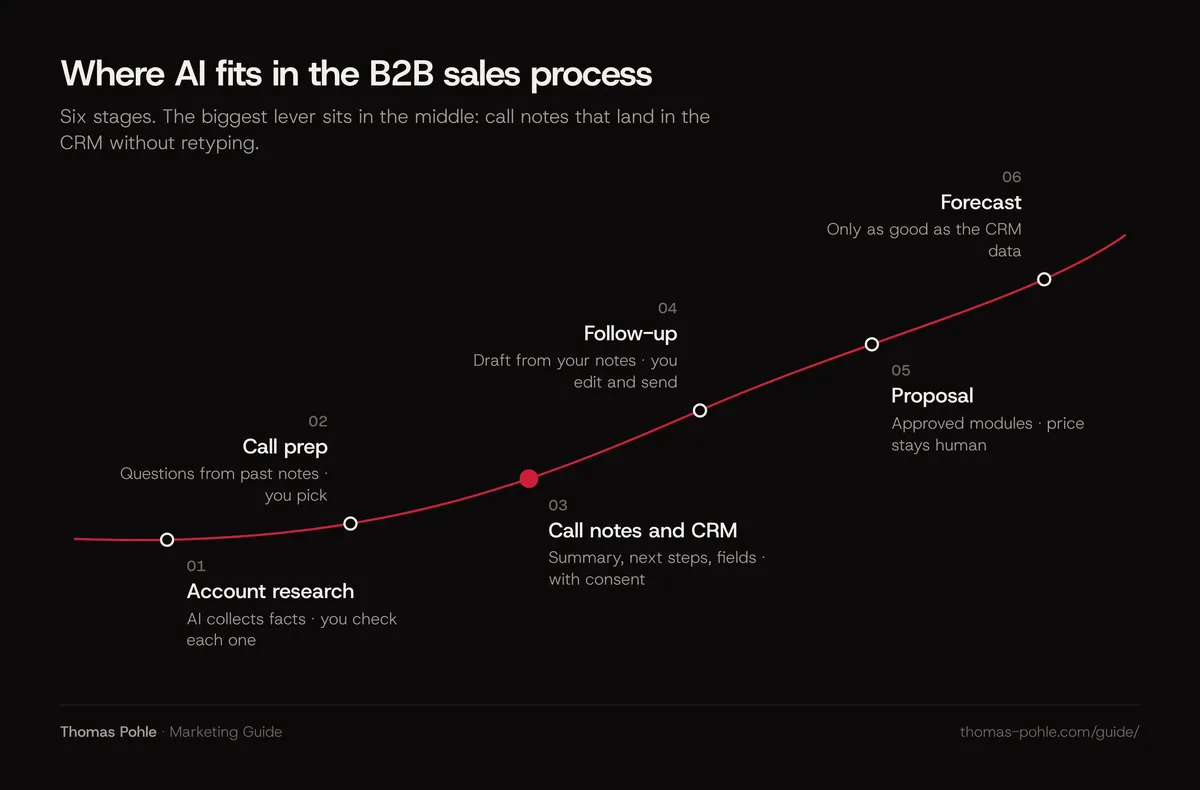
Start with the tasks that eat seller time and have an easy check: call notes and CRM updates, account research, call prep. Then follow-ups and proposals, where the seller's own input matters more. Forecasting comes last because it depends on clean CRM data. Outbound personalization at scale is where AI most often does harm.
The ranking below is my assessment. It weighs two things: how much seller time a task eats, and how directly it touches the quality of a buyer conversation, which is where deals are won.
| Use case | Effect on seller time | Effect on win rate | Start when |
|---|---|---|---|
| Call notes and CRM hygiene | High | Indirect, via better follow-ups and forecasts | Now, with consent in place |
| Account research | High | Medium, through better questions | Now, with a fact check |
| Call prep | Medium | Medium to high | Once notes are in the CRM |
| Follow-up emails | Medium | Medium, if drafted from your notes | Once notes are in the CRM |
| Proposals | Medium | Medium | Once you have approved modules |
| Forecasting | Low for sellers, high for managers | None directly | After two quarters of clean data |
| Outbound personalization at scale | High on paper | Often negative | Only with your own input per account |
How does AI help with account research and call prep?
AI turns an hour of reading about an account into a short brief: what the company does, recent news, open roles, who decides. The seller's job shifts from collecting facts to checking them and choosing the two or three questions that matter. That's where win rate moves, in the quality of the first conversation.
- Research brief. Feed the model the company website, the latest annual report or press releases and the job ads. Ask for a one-page brief with a source next to every fact. Check each one. Models invent plausible details, and a wrong fact in the first call costs you more than no fact.
- Call prep. Give the model the notes from the last call and the open points in the CRM. Ask for five questions. Pick two. The seller decides what to ask, never the model.
A typical scenario: a seller has three first calls tomorrow. Without AI, the prep happens in the ten minutes between meetings. With a research brief per account the evening before, every call starts with a specific question about the buyer's situation.
How does AI keep call notes and the CRM clean?
AI note-takers turn a recorded call into a summary, next steps and filled CRM fields, so sellers stop retyping and managers stop chasing updates. This is the use case with the clearest time effect, and it makes forecasting possible. It also needs the most care, because recording a call is a legal question.
Salesforce's February 2026 report shows how much depends on the data underneath. Over half of sales leaders with AI (51 %) say disconnected systems slow down their AI initiatives. 79 % of high performers prioritize data hygiene, against 54 % of underperformers. Again, vendor survey data and self-reported.
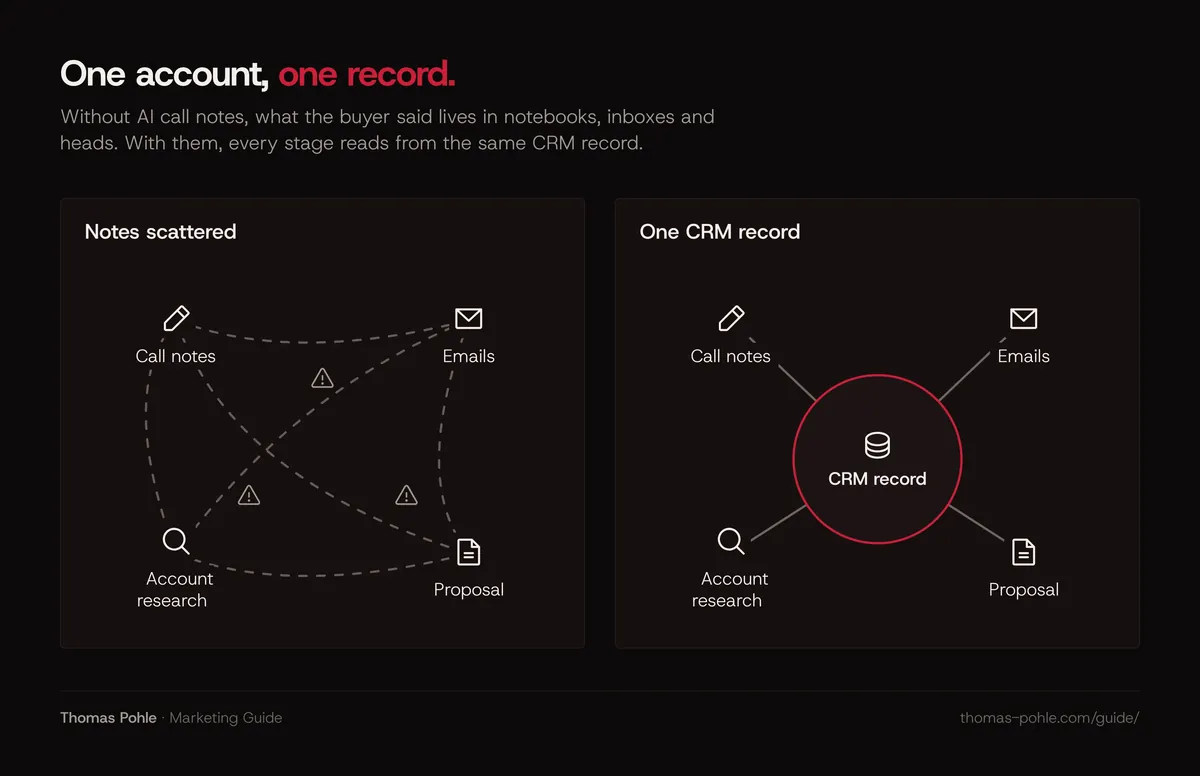
I've worked with Salesforce, HubSpot, Lemlist, Apollo and Clay. My rule is the same in all of them: decide which five CRM fields the AI fills after every call, and let a person approve them. Next step, date, decision makers, budget signal, competitor named. Everything else stays in the summary.
Can AI write your follow-ups and proposals?
AI can draft them. It shouldn't write them alone. The best follow-up still comes from the seller writing it, or at least giving the model their own input: what the buyer said, the exact concern, the agreed next step. That's what a buyer recognizes as a reply to their conversation, and no model can invent it.
- Follow-ups. Draft from the call notes, never from a template. The seller adds one sentence only they could write, then sends. If a draft could go to any buyer, it goes back.
- Proposals. Build a library of approved modules: scope descriptions, references, terms. AI assembles the draft for the account. Price, discounts and commitments stay with a person, because the proposal is a binding offer.
- Your voice. Keep three emails the seller wrote by hand and liked as examples for the model.
Where does AI hurt in B2B sales?
AI hurts sales where it pretends to be personal. A first line about the prospect's latest LinkedIn post, generated for thousands of contacts, reads as automated within seconds. Automated LinkedIn messages break the platform's rules, and in Germany unsolicited advertising emails need prior express consent. Buyers punish both.
- Fake personalization. Gartner reported in June 2025 that 73 % of B2B buyers actively avoid suppliers who send irrelevant outreach (survey of 632 buyers, fielded in 2024). A message that only pretends to know the buyer is irrelevant outreach with better grammar.
- Automated LinkedIn messages. LinkedIn's User Agreement prohibits using bots or other unauthorized automated methods to send messages, add contacts or drive engagement. Tools that do this put the seller's account at risk.
- Unsolicited emails in Germany. Section 7 of the German Act against Unfair Competition (UWG) treats advertising by electronic mail without the recipient's prior express consent as an unreasonable nuisance. In judgment 23 C 120/25 (20 November 2025) the Düsseldorf district court granted an injunction against two advertising emails to a company address, applying the standard of Section 7 UWG. Only express consent counted, presumed consent wasn't enough, so an indirect LinkedIn connection between the two sides didn't help. The ruling is about emails. Don't read it as permission for cold LinkedIn messages.
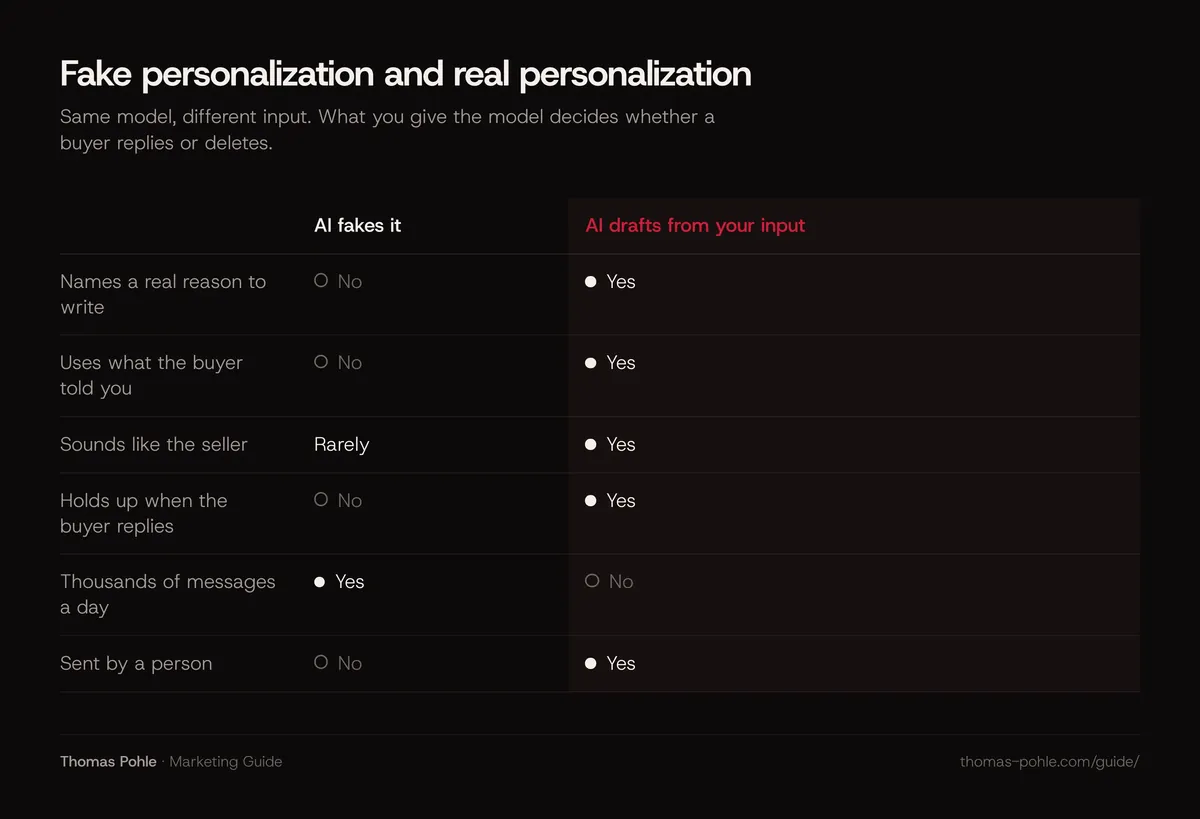
When outbound was my main offer, the campaigns started with a value proposition workshop, before any setup in Apollo. The message came from the company. The tool only sent it. I'd still build outbound that way: 20 to 30 accounts in the first round, each with a real reason to write.
Is it legal to record and transcribe sales calls?
Only with care. In Germany and Switzerland, recording a non-public conversation without consent can be a criminal offense, and transcribing it is processing personal data. The safe practice is to tell every participant at the start that the call will be recorded and transcribed, and to record only after a clear yes. This is a summary of the legal texts, not legal advice.
| Rule | What the text says | What it means for AI note-takers |
|---|---|---|
| German StGB § 201 | Recording another person's non-public spoken word without authorization is punishable | Ask before you record |
| Swiss StGB Art. 179ter | A participant who records a non-public conversation without the others' consent is punishable on complaint | Same: consent of all participants first |
| GDPR Art. 6 and 13 | Processing needs a legal basis; people must be informed of purpose and legal basis | Name the tool and purpose in your privacy notice |
| Swiss FADP Art. 6 and 19 | Data only for a purpose the person can recognize; duty to inform | Tell participants what happens with the transcript |
| EU AI Act Art. 50 para. 1 | Providers must build AI systems that interact directly with people so people learn it is AI, unless obvious; from 2 August 2026 | Voice or chat agents facing buyers must disclose it |
| EU AI Act Art. 5 para. 1 (f) | Placing on the market, putting into service or using AI to infer emotions of people at work is prohibited since 2 February 2025, except for medical or safety reasons | Avoid call analytics that score your sellers' emotions |
Swiss law has one narrow exception: Art. 179quinquies StGB allows a participant to record business telephone calls about orders, contracts and similar transactions, for evidence only. That doesn't cover AI analysis of discovery calls. For anything beyond the basics, ask your data protection officer or a lawyer.
How do you measure whether AI improves sales?
Measure the time first, then what sellers do with it, then results. Run a pilot with part of the team for one quarter and compare against sellers who work without the new tool. Track time spent selling, meetings per seller, conversion between pipeline stages and win rate on comparable deals.
A worked example, with Gartner's survey average as the input. A team of five sellers who each get 4.8 hours back per week gains 24 hours a week, three working days. If those hours go into more internal reporting, nothing changes for the buyer. Decide in advance where they go, for example two more first meetings per seller per week, and check in the CRM whether that happened.
- Time. Share of the week spent with buyers, before and after.
- Activity. First meetings and follow-ups sent within 24 hours of a call.
- Pipeline. Conversion from first meeting to qualified opportunity, and from proposal to won.
- Data quality. Share of opportunities with next step and date filled.
One quarter is short for win rate in B2B, where cycles often run longer. Read the first quarter for time and activity, and the second for pipeline.
What to do this week
- Ask your sellers. Which task eats the most time outside buyer conversations? Write down the top three.
- Check consent. If anyone uses an AI note-taker already, check that every call starts with a recording notice and a clear yes.
- Pick five CRM fields. Decide which fields AI should fill after every call and who approves them.
- Test one research brief. Have AI write a brief for one account you meet next week. Check every fact against its source.
- Stop fake personalization. Pause any sequence that generates "personal" first lines at scale or sends LinkedIn messages automatically.
- Collect three good emails. Each seller picks three emails they wrote themselves and liked. They become the examples for the model.
- Set the reinvestment rule. Decide where saved hours go before you buy any tool.
AI won't replace the conversation that wins a B2B deal. It removes the work around it. The teams that gain are the ones that put the freed hours in front of buyers. If you want an outside view on where AI belongs in your sales and marketing process, that's what a one-day Momentum Workshop is for. The tool side for marketing is covered in which AI tools a B2B marketing team needs, and the first steps for a whole company in where a mid-sized company should start with AI.
Frequently asked questions
Will AI replace B2B salespeople?
Not the ones who run real buyer conversations. Gartner (May 2026) found AI saves sellers about 4.8 hours a week, which changes the job more than it removes it. Research, notes and first drafts move to AI. Asking the right question, handling a concern and negotiating stay with people. The role that shrinks is the one that only sends volume.
Can I let an AI tool send LinkedIn messages for me?
LinkedIn's User Agreement prohibits bots and other unauthorized automated methods that send messages or add contacts, so you risk your account. In Germany, unsolicited advertising by electronic mail also needs prior express consent under Section 7 UWG. Use AI to draft a message from your own notes, then send it yourself, to people with a real reason to hear from you.
Do I have to tell a prospect that the call is recorded and transcribed?
Yes, tell them at the start and record only after a clear yes. Recording a non-public conversation without consent can be punishable under German StGB Section 201 and Swiss StGB Art. 179ter, and GDPR and the Swiss FADP require information about purpose and processing. This is a summary of the legal texts, not legal advice.
Which AI sales tool should a small B2B team start with?
Start with the AI features of the CRM you already use and a note-taker that writes into it. That covers call notes, summaries and follow-up drafts, the use cases with the clearest time effect. Add a research or outbound tool only once the CRM data is clean. A new tool on top of messy data adds another dashboard and little else.
Sources
- Salesforce (February 3, 2026): State of Sales report 2026, announcement with findings and methodology
- Gartner (May 19, 2026): AI saves sellers nearly five hours per week, yet 72% of sales organizations fail to reinvest time in high-value activities
- Gartner (June 25, 2025): Sales survey finds 61% of B2B buyers prefer a rep-free buying experience
- Brynjolfsson, Li, Raymond: Generative AI at Work, NBER Working Paper 31161
- LinkedIn User Agreement, Section 8.2 (effective November 3, 2025)
- Gesetz gegen den unlauteren Wettbewerb (UWG), § 7 Unzumutbare Belästigungen
- AG Düsseldorf, Urteil vom 20.11.2025, 23 C 120/25 (NRWE)
- Strafgesetzbuch (StGB), § 201 Verletzung der Vertraulichkeit des Wortes
- Schweizerisches Strafgesetzbuch (SR 311.0), Art. 179bis to 179quinquies, Fedlex
- Bundesgesetz über den Datenschutz (DSG, SR 235.1), Art. 6 and 19, Fedlex
- Regulation (EU) 2016/679 (GDPR), Articles 6 and 13, EUR-Lex
- Regulation (EU) 2024/1689 (Artificial Intelligence Act), Articles 5, 50 and 113, EUR-Lex
Thomas PohleB2B marketing advisor in Zurich. More than ten years in B2B marketing at Link11, Beekeeper and smino, most recently as Head of Marketing. CEO and co-founder of TEISENDA. Researched and drafted with AI tools, checked against the sources listed above. More about Thomas