B2B marketing in Berlin: what a campaign for your company would look like

I help B2B companies in Berlin plan and run campaigns that reach one defined buying group, through a workshop, a project or monthly advisory. This page shows a fictional Berlin health IT company and the ten-week campaign I'd build for it, around the Hauptstadtkongress at Messe Berlin, with real venues, media and costs.
I'm based near Zurich. For Berlin clients, workshops can run on site; projects and advisory mostly run remote. The scenario is invented, the local facts are sourced.
A fictional example from Berlin's health IT cluster
A fictional example to make it concrete. Bettwerk is an invented company: 35 people in Berlin, software that helps hospitals manage beds and admissions. It wants twelve qualified first meetings with hospitals in Berlin and Brandenburg within one quarter. That target is invented too.
I picked health IT because it's one of Berlin's real clusters. HealthCapital, the health cluster run by Berlin Partner and Brandenburg's economic development agency, counts more than 150 hospitals with over 35,000 beds in the region. Plus more than 380 medtech and digital health companies with 17,000 employees. Buyers and competitors sit close by.
The buying group for software like this has four roles: managing director, head of IT, director of nursing and controlling. My take: the director of nursing is the role most vendors underrate. Bed shortages land on that desk every single shift.
Why does the Berlin fair calendar matter so much right now?
Berlin's health IT calendar is changing. DMEA, the big digital health fair, was held in Berlin for the last time in April 2026 and moves to Munich from 2027. Messe Berlin, whose DMEA partnership ends, is launching a new event with Bitkom: Smart Health Europe, planned on the Berlin exhibition grounds from 2027. A Berlin vendor has to pick its stage.
| Event | Usual month and place | Who you meet | My verdict for Bettwerk |
|---|---|---|---|
| Hauptstadtkongress | June, hub27 at Messe Berlin | Hospital and nursing management, insurers | Main stage of the campaign |
| DMEA | April, Messe München from 2027 | Health IT buyers from all of Germany | Visit for IT heads, outside the Berlin plan |
| Smart Health Europe | New, first edition planned for 2027, Messe Berlin grounds | Health industry, care providers, insurers, policy | Visit the first edition before you book a booth |
| Digital Health Conference | November, Berlin | Digital health start-ups, investors, industry | Good for partners and investors |
| World Health Summit | October, Berlin | Global health policy and research | Skip for this sale |
The Hauptstadtkongress wins for one reason: the buying group is in the room. Its organizer says about a third of Germany's roughly 1,800 hospitals send their board, management, medical or nursing leadership, and the congress draws around 5,000 participants. Discount that organizer claim as much as you like: it's still your buying group in one building.
Smart Health Europe is new, and its first date has not settled yet; check the organizer before you plan around it. My rule for a new event: visit once, count your buying group in the halls, then decide.
Where do Berlin's buyers travel, and is out-of-home worth it?
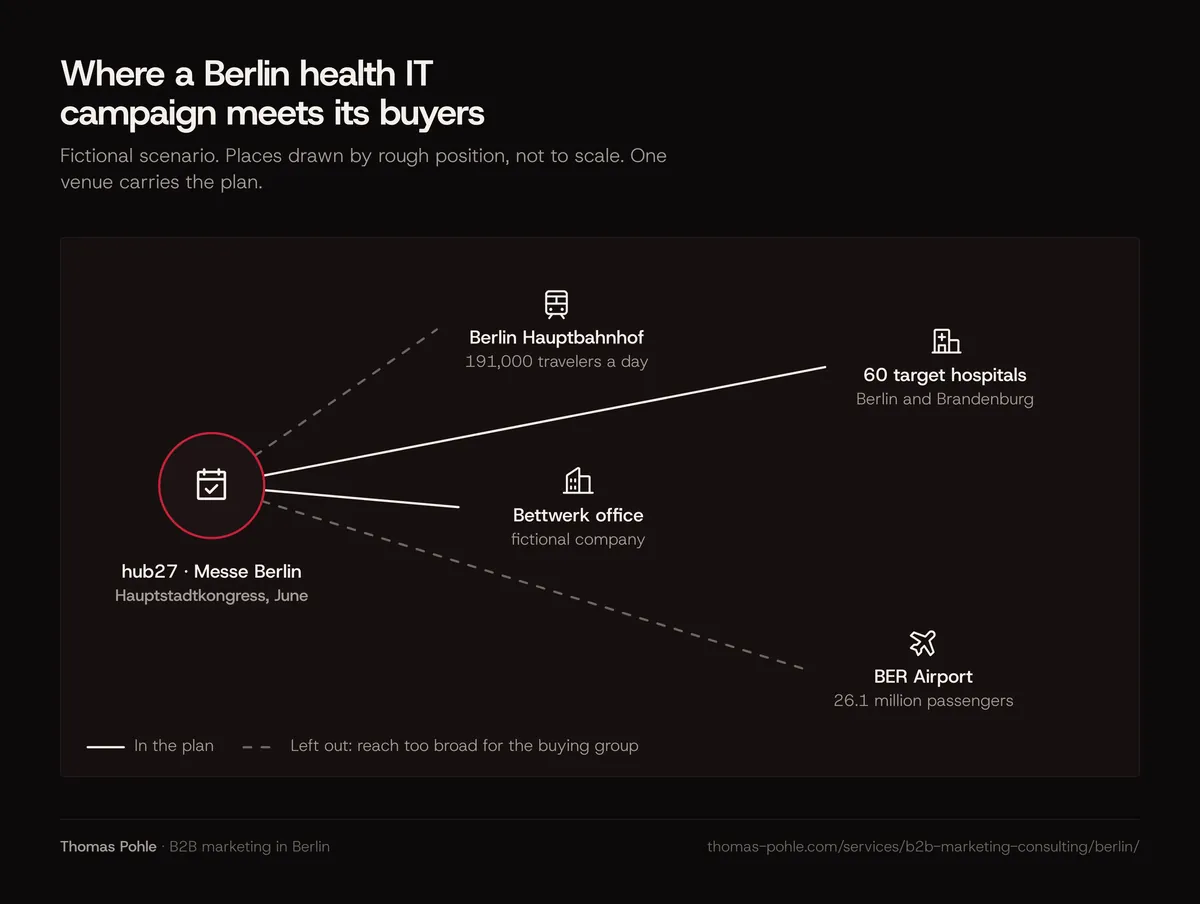
Berlin's traffic hubs are big, but they're the wrong lever for a buying group of a few hundred people. Berlin Hauptbahnhof had about 191,000 travelers a day in 2024, and BER handled 26.1 million passengers in 2025. In the same federal figures, Ostkreuz (about 254,000) and Friedrichstraße (about 229,000) were even busier. You'd pay for every person who will never buy hospital software.
- Street: Wall GmbH holds the exclusive right to illuminated and digital advertising on Berlin's public street land until 30 June 2035, per the Senate. Ilg-Außenwerbung has the advertising pillars, Ströer the advertising on 437 street clocks until the end of 2028.
- Airport: Flughafen Berlin Brandenburg GmbH sells the advertising at BER itself, including digital screens in Terminal 1.
- Venue: hub27 opened in 2019 in the south of the exhibition grounds, next to CityCube Berlin and within walking distance of the S-Bahn station Messe Süd.
My plan for Bettwerk skips the station and the airport. The out-of-home money goes into the congress building: the digital ad in the main entrance foyer costs EUR 1,500 for all congress days, rotating with other ads, per the organizer's 2026 brochure. Everyone who walks past it came for the congress.
How would the congress week run?
A congress week pays off when the meetings are booked before it starts. For Bettwerk the week runs on three things: a small presence in the exhibition forum, a meeting room and invitations sent four weeks ahead.
The organizer's 2026 prices give the frame. A start-up package costs EUR 1,300: a 15-minute talk plus a table for two congress days. Booths up to 10 square meters cost EUR 460 per square meter for early bookers and EUR 520 at the normal rate, with 6 square meters as the minimum; bigger booths cost less per square meter. Exhibitors can add a meeting room from EUR 900. All prices are before VAT.
My rule of thumb: plan the follow-up before the event starts. For Bettwerk that means a breakfast for 15 to 20 directors of nursing on the second congress morning, invitation only, and a follow-up call booked within five working days.
What does the local digital layer look like?
The digital layer has one job: make the 60 target hospitals know Bettwerk before the congress and fill the meeting calendar. In Berlin that takes three pieces: LinkedIn ads aimed at named hospitals, one paid health policy briefing, and the regional health networks.
- LinkedIn: target Berlin and Brandenburg by location, then company industry, job function and seniority, or upload the 60 hospitals as a company list. LinkedIn needs at least 300 members to run an ad set. Four roles in 60 hospitals can fall below that, so add deputies and the IT team.
- Tagesspiegel Background Gesundheit & E-Health: a weekday briefing with more than 16,900 recipients and a 30% open rate, according to the publisher (November 2025). A text ad lists at EUR 1,349, three placements at EUR 3,642.30.
- Networks: HealthCapital runs an event calendar and a newsletter for the cluster. IHK Berlin has a committee and an industry network for the health economy.
- Language: German for every page and invitation that goes to hospitals. My view: a hospital manager in Brandenburg shouldn't have to read your pitch in English.
How to pick the accounts is in the guide on account-based marketing.
What do the timeline and the budget look like?
The campaign takes ten weeks with the congress in week eight. Two weeks for the list and the messages, five weeks to warm up the list and book meetings, the congress, then two weeks to turn meetings into opportunities. Media and events cost roughly EUR 16,000 to 25,000.
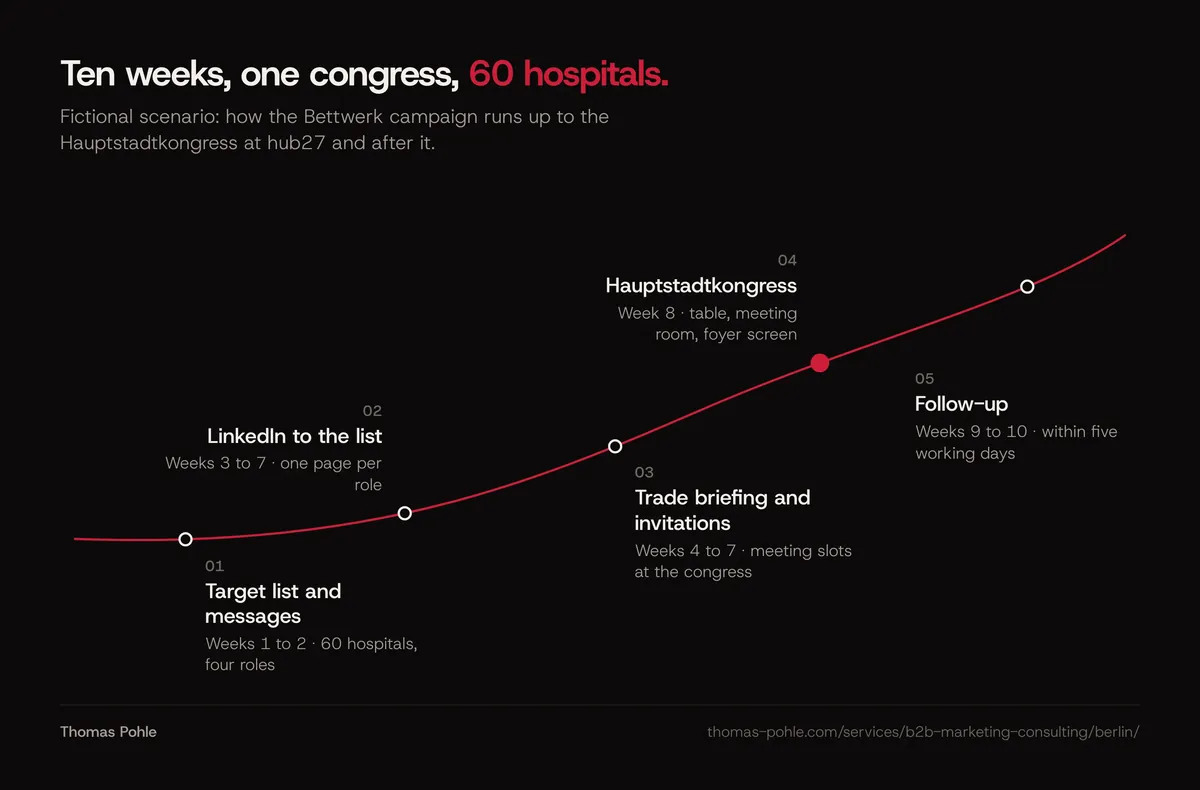
| Phase | What happens | Guide value (EUR) | Basis |
|---|---|---|---|
| Weeks 1 to 2: list and messages | 60 hospitals, four roles | Part of the project | My fee, see below |
| Weeks 3 to 7: LinkedIn | Ads to the company list | 5,000 to 9,000 | My estimate, small audience |
| Weeks 4 to 7: trade briefing | Three text ads in Tagesspiegel Background | 3,642 | Publisher list price |
| Week 8: congress | Booth of 6 to 9 square meters, meeting room, foyer screen | 5,200 to 7,100 | Organizer prices 2026 |
| Weeks 8 to 10: breakfast and follow-up | 15 to 20 guests, follow-up calls | 2,000 to 5,000 | My estimate |
The congress line: 6 square meters at the early rate of EUR 460, plus EUR 900 for the room and EUR 1,500 for the screen at the low end; 9 square meters at EUR 520 at the high end. LinkedIn publishes no fixed prices, so that line is my estimate for reaching a few hundred people repeatedly over five weeks. The breakfast line covers a private room with catering near the venue for up to 20 guests. The start-up package would be cheaper than a booth, but the brochure sells the room and the screen only to exhibitors, partners and sponsors. My part would be a Momentum Project, from EUR 7,800. If positioning isn't settled yet, a one-day Momentum Workshop from EUR 4,200 comes first. Guide price: depending on scope and effort the price may be higher; it is fixed before the project starts.
How would you measure the Berlin campaign?
Measure the campaign against the list of named hospitals, not against reach: how many of the 60 engaged, took a meeting or became an opportunity. Impressions only count when they lead back to a listed hospital.
- Coverage: hospitals on the list with at least one engaged person.
- Meetings booked before the congress and meetings held during it. The scenario target is twelve qualified first meetings.
- Opportunities in the CRM 90 days after the congress.
- Searches for the Bettwerk name, compared with the weeks before the campaign.
- Direct traffic from QR codes on the table and the breakfast cards.
Which numbers belong in a monthly marketing report is in the guide on measuring marketing success.
What does this mean for your company in Berlin?
Berlin offers more events, media and reach than a small B2B team could ever use. That's the trap. A Berlin plan gets better the more it leaves out. Find the one place where your buying group gathers each year, book meetings for it weeks ahead, and spend the rest on named accounts.
The same logic works outside health IT: event first, then accounts, then channels. How that fits into a full market plan is in the guide on go-to-market strategy. How the meetings turn into a steady pipeline after the congress is in the guide on B2B lead generation. What I do and what it costs is on the page for B2B marketing consulting.
Want this worked out for your company and your Berlin event? Book a 30-minute call. You tell me where it's stuck. I tell you straight what I'd do first.
Frequently asked questions
Do you work on site in Berlin?
I'm based near Zurich and work with companies in Germany and Switzerland. For Berlin clients, workshops can run on site; projects and monthly advisory mostly run remote; the format and dates go into the offer before we start.
Is a presence at the Hauptstadtkongress worth it for a small health IT company?
It can be, if your buyers are hospital managers or nursing directors. The organizer offered a start-up package for EUR 1,300 in 2026, with a 15-minute talk and a table for two days. Book the meetings first. A small table with ten confirmed meetings beats a big booth without any.
What changes for Berlin health IT companies now that DMEA moves to Munich?
DMEA was held in Berlin for the last time in April 2026 and takes place at Messe München from 2027. Messe Berlin and Bitkom are starting Smart Health Europe on the Berlin exhibition grounds, with the first edition planned for 2027. For a Berlin vendor selling to hospitals, the Hauptstadtkongress in June becomes the key local stage.
What does a B2B campaign like this cost in Berlin?
For the fictional scenario on this page, media and events add up to about EUR 16,000 to 25,000 over ten weeks, before VAT. My fee comes on top: a Momentum Project from EUR 7,800, fixed before the project starts.
Sources
- HealthCapital (Berlin Partner, WFBB): Fact Sheet Cluster Gesundheitswirtschaft Berlin-Brandenburg (2026 II)
- DMEA: Facts, last DMEA in Berlin and move to Munich (2026)
- Bitkom: Smart Health Europe, Messe Berlin und Bitkom starten Kongressmesse (January 2026)
- Hauptstadtkongress: Informationsbroschüre zum Ausstellungsforum HSK 2026 (October 2025)
- Bitkom: Digital Health Startup Pitch at the Digital Health Conference 2026
- Deutscher Bundestag, hib: Straftaten an Bahnhöfen, Reisende pro Tag 2024 (February 2025)
- Flughafen Berlin Brandenburg GmbH: Werbung am BER (2026)
- Senatsverwaltung Berlin: Werberechtsverträge in Berlin (2026)
- Senatsverwaltung Berlin: Messe Berlin eröffnet neue Messe- und Kongresshalle hub27 (August 2019)
- Tagesspiegel Background: Mediadaten 2026 (January 2026)
- LinkedIn: Targeting options for LinkedIn Ads (2026)
- IHK Berlin: Gesundheitswirtschaft in der IHK Berlin (2026)
Thomas PohleB2B marketing advisor in Zurich. More than ten years in B2B marketing at Link11, Beekeeper and smino, most recently as Head of Marketing. CEO and co-founder of TEISENDA. Researched and drafted with AI tools, checked against the sources listed above. More about Thomas