What does a marketing consultant do, and when do you need one?

A marketing consultant diagnoses why your marketing isn't producing pipeline, decides with you what to fix first and designs the plan your team runs. The work comes in three mandates: a one-day workshop, a project of four to twelve weeks, or monthly advisory. You hire one for judgement and direction. For more hands, you hire an agency or people.
This guide is for founders, CEOs and marketing leads who are weighing outside help and want to know what they'd actually get. The full leadership role is covered in the guide on what a head of marketing does. Here you get the consultant's side: the work itself, the three mandates with deliverables and durations, what it costs, the signals for and against, and a checklist with tests to pick the right person.
What does a marketing consultant actually do?
A marketing consultant does four things: finds out where marketing breaks, makes the decisions that are stuck, designs a plan your team can run, and checks that the change holds. The output is a decision and a working setup. A consultant who leaves you with a slide deck and no owner for the next step has done half the job.
The US Bureau of Labor Statistics describes the wider job family of management analysts in similar steps: gather information about the problem, interview staff and observe the work, analyze financial and other data, develop solutions, recommend changes in presentations or written reports, and confer with managers to check that the changes work (Occupational Outlook Handbook, page last modified August 2026). Marketing consulting is that job applied to positioning, channels, budget and the handover to sales.
| Task | What the consultant does | What you get |
|---|---|---|
| Diagnose | Reads your website, numbers and pipeline, talks to sales and customers | A written view of where it breaks |
| Decide | Forces the open questions: who you serve, which channel first, what stops | Three to five decisions on paper |
| Design | Turns the decisions into a plan with owners, budget and numbers | A plan for the next 90 days |
| Build | Sets up one campaign, channel or launch with your team (project mandate) | Something that runs |
| Transfer | Documents, trains, steps back | A team that runs it alone |
My take: the decision step is where a consultant earns the fee. Most B2B teams know their options. What they lack is someone senior enough to pick one and say no to the rest.
How is a marketing consultant different from an agency or a fractional CMO?
A consultant brings judgement and a plan, an agency brings execution capacity, and a fractional CMO takes over the leadership role part-time and answers for the results. The difference is who does the work and who carries the responsibility.
| Consultant | Agency | Fractional CMO | |
|---|---|---|---|
| Delivers | Diagnosis, decisions, plan, setup | Campaigns, content, ads, design | Leadership of marketing |
| Who executes | Your team, with the consultant | The agency's staff | Your team, led by the CMO |
| Owns results | No, advises | Its own deliverables | Yes, marketing's numbers |
| Typical engagement | A day to a few months | Retainer or project | Some days a month, for months |
The lines blur in practice, so ask each one: who writes, sets up and reports, and who decides? How a team splits in-house and external work is covered in the guide on B2B marketing team structure.
What are the three typical consulting mandates?
Marketing consulting usually comes in three mandates. A workshop of one day settles direction. A project of four to twelve weeks builds one thing, such as a campaign, a channel or a launch. Monthly advisory puts a senior head at the table without a hire. Pick the mandate by your situation, not by what the consultant likes to sell.
Workshop: when the direction is missing
One day with the people who decide: founder or CEO, sales lead, whoever runs marketing. The usual agenda is positioning (who you serve and why you win), the ideal customer and the one channel that moves first. The deliverable is a short written summary of the decisions plus a 90-day plan with owners. It fits when everyone is busy but pulls in different directions.
Project: when one thing has to be built
Four to twelve weeks on one defined outcome: an outbound campaign to 20 to 30 named accounts, a new website structure, a product launch, a reporting setup. The consultant builds it with your team and hands it over once it runs without them. It fits when you know what to do and nobody has the time or experience to set it up.
Advisory: when a senior head is missing
A fixed monthly slot: sparring for the CEO, a review of plans and numbers, hands on the team when it counts. Your team does the work. It fits when you have people who execute but nobody senior who sets priorities and challenges them. If you need someone who owns the numbers, that's a fractional CMO.
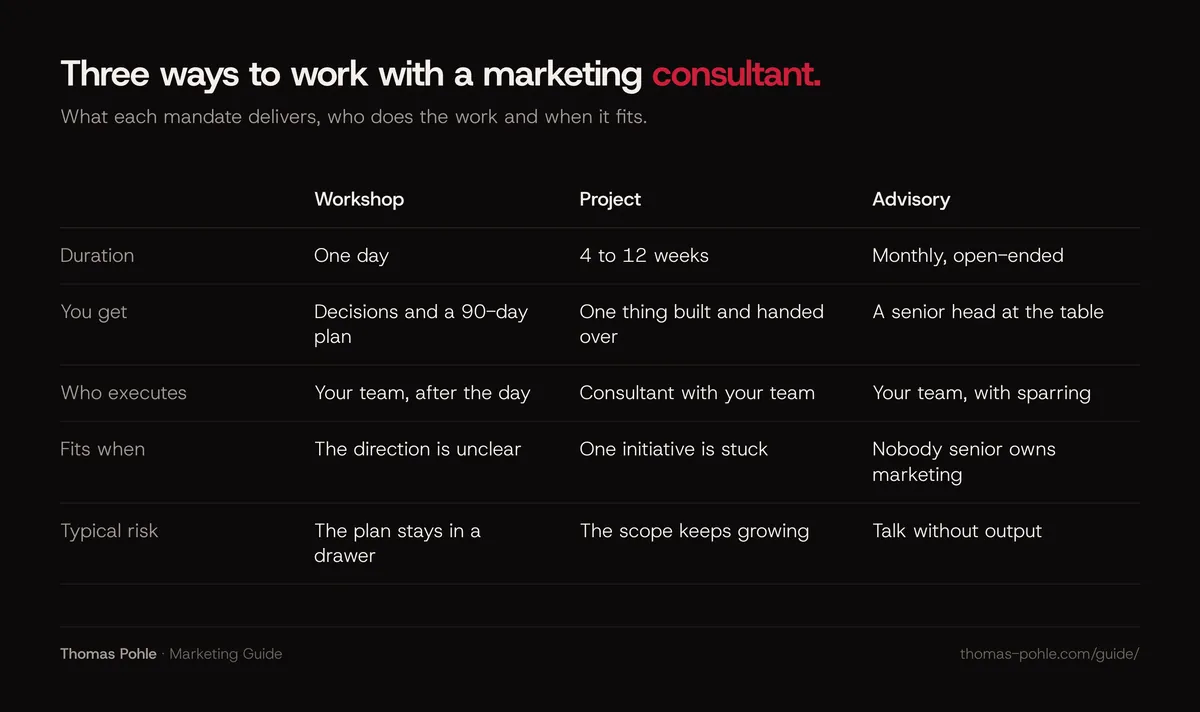
When I set up my own offer, it started as four packages shown as a timeline. I noticed the timeline told a sequence that never happens in real engagements. Clients don't walk through packages in order. So I cut it to three formats chosen by the client's situation: workshop, project, advisory. That's the logic I'd use to judge any consultant's offer.
How does a consulting engagement run from first call to handover?
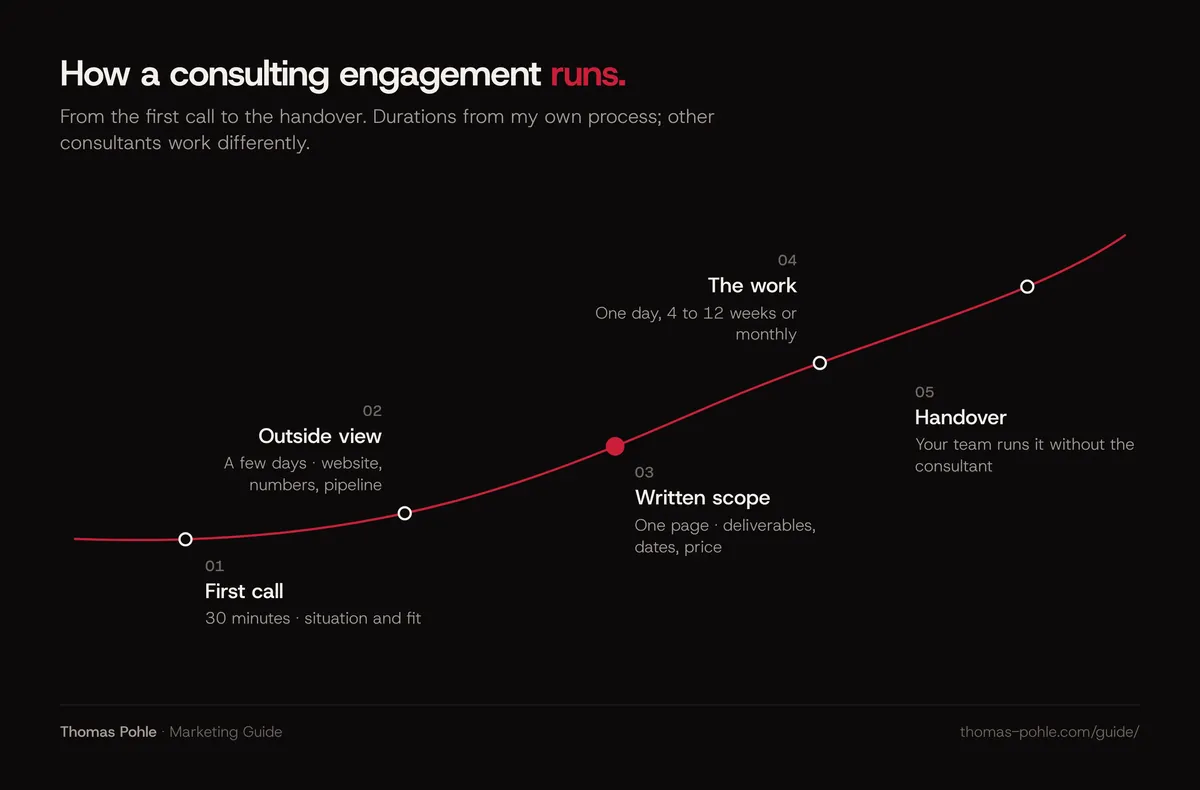
A good engagement has three phases: agree in writing what will be delivered, do the work, and close it with a handover. The international guideline for management consultancy services, ISO 20700:2017, is organized around those same phases: contracting, execution and closure. The written scope in the middle is what protects you.
Here is how I start, as one example. A 30-minute call where you describe the situation and I say what I'd do first. Then a few days of analysis of your website, numbers and pipeline, with my honest take in writing. Then one decision on the format, a one-page offer with scope, dates and price, and we go. Check that yours has each of these steps somewhere.
- Before the work: the consultant has read your material, talked to sales and written down what they think is wrong.
- During the work: one internal owner on your side, a fixed weekly slot, decisions within a week.
- At the end: documentation your team can use, a last review of the numbers, and a clear date when the consultant steps back.
What does a marketing consultant cost?
Independent consultants in German-speaking Europe charge around 120 euros an hour net, according to freelancermap's Freelancer-Kompass 2026. Half of the consultants surveyed sit between 100 and 135 euros. The figures cover self-employed consultants of all kinds, not consulting firms and not marketing consultants alone. Published rates for marketing consultants specifically are thin.
The survey behind the numbers: freelancermap ran four focus surveys on its platform between 17 November 2025 and 8 February 2026, with about 5,400 freelancers and self-employed people in the DACH region taking part. The average hourly rate across all fields was 103 euros. For consultants specifically, freelancermap's July 2026 analysis reports the 120 euro median, 122 euros for those who bill day rates and 110 euros for those who bill by the hour. It's self-reported data from one platform.
A worked example with those numbers, labelled as arithmetic: a project of ten consulting days at eight hours and the 120 euro median comes to 9,600 euros net.
For comparison, my own guide prices on the B2B marketing consulting page: a positioning workshop from CHF 4,200, projects from CHF 7,800 and monthly advisory from CHF 3,500. My rule of thumb for any quote: when the scope is clear, fix the price per deliverable. Hours suit open questions, with a cap so you can plan.
When do you need a marketing consultant, and when don't you?
You need a marketing consultant when the problem is direction or experience: nobody can say who you serve, which channel comes first or why the budget isn't producing pipeline. You don't need one when the plan is clear and only capacity is missing. Then hire an agency, a freelancer or your own people.
Signals that you need one:
- Three people, three pitches. Sales, the founder and the website describe the company differently. That's a positioning question, and a workshop settles it faster than a hire.
- Spending without an answer. Trade fairs, ads and tools cost money and nobody can say which of it brings deals. The guide on how much marketing budget a B2B company needs shows the numbers you should be able to name.
- A launch or market entry ahead and nobody on the team has done one.
- The CEO runs marketing on the side and wants a sparring partner before hiring a full-time lead.
Signals that you don't:
- The plan exists and is good. You need execution. A consultant would rewrite a plan that doesn't need rewriting.
- Nobody internal will own the result. Without an owner the consultant's work evaporates. Fix ownership first, or hire a fractional CMO who takes it.
- You expect leads in four weeks. A consultant changes the system. If you need meetings next month, outbound with your own salesperson is faster.
How do you choose the right marketing consultant?
Choose a marketing consultant by testing three things before you sign: references you can call yourself, a written scope with named deliverables, and the name of the person who does the work. The checklist below turns each test into a pass or fail you can apply in one week.
| Test | How to run it | Pass if |
|---|---|---|
| References you can call | Ask for two clients from the last 24 months and phone them yourself | Both say what changed and would hire again |
| Written scope | Ask for one page with deliverables, dates and price | Every deliverable is a noun you can check |
| Who does the work | Ask who sits in your meetings and writes the documents | The person you met, named in writing |
| First-week plan | Ask what happens in week one | Concrete: interviews, data, a date for findings |
| Handover | Ask when and how they step back | A date, and documentation your team keeps |
| Conflicts | Ask about tool or agency commissions | Disclosed in writing, or none |
My threshold: five of six passes, and the first three are mandatory. A consultant who can't name two clients you may call, or won't put the deliverables on one page, will be just as vague once you've paid. A similar test logic for agencies is in the guide on choosing an AI SEO agency.
How do you get the most out of a marketing consultant?
You get the most out of a marketing consultant when you name one internal owner, give access to real numbers in week one, decide within days, and plan the handover from the start. Consultants are expensive when they wait. They're cheap when your team learns the work and keeps it after they leave.
- Give them the uncomfortable data. Lost deals, churn reasons, the budget line nobody defends. A consultant who only sees the good numbers will optimize the wrong thing.
- Put sales in the room. Positioning or campaigns decided without sales get ignored by sales.
- Ask for the reasoning. Every recommendation should come with why and what it replaces. That's how the knowledge stays in your company.
If positioning turns out to be the core problem, the step-by-step method is in the guide on how to develop your positioning.
What to do this week
- Write down in two sentences what you want an outside person to change. If you can't, start with a workshop.
- Decide whether you lack direction, a built system or a senior head. That picks the mandate.
- Name the internal owner who will carry the result after the consultant leaves.
- Pull three numbers for the first call: marketing spend last year, deals won, and where those deals came from.
- Ask two candidates for a one-page scope with deliverables, dates and price.
- Call two references per candidate yourself. Ask what changed and whether they'd hire them again.
- Score each candidate on the six tests. Five passes, including the first three, or you keep looking.
Good consulting makes itself unnecessary. If after six months you still can't run the thing without your consultant, the transfer failed, whatever the results look like. If you want to see how I'd approach your situation, a one-day Momentum Workshop is the usual start.
Frequently asked questions
What is the difference between a marketing consultant and a marketing advisor?
In practice the terms overlap. Consultant often means a defined mandate with deliverables, such as a workshop or a project. Advisor often means an ongoing role, such as monthly sparring with the CEO. Read the scope rather than the title: what gets delivered, by when, and who executes.
Is a marketing consultant worth it for a small B2B company?
It is when a small company lacks direction and can't yet afford a senior full-time hire. A one-day workshop or a short project costs a fraction of a yearly salary and can settle positioning and the first channel. It isn't worth it when the plan is clear and only execution capacity is missing.
How long does a marketing consulting project take?
A workshop takes one day plus preparation and a written summary. Projects usually run four to twelve weeks for one campaign, channel or launch. Advisory runs monthly for as long as it helps. Be wary of open-ended projects without a date for the handover.
Can a marketing consultant also execute campaigns?
Many do, especially in project mandates where they set up a campaign or a channel with your team. The goal should still be that your team runs it afterwards. If you want someone to run campaigns permanently, an agency or your own hire is usually the cheaper and more sensible choice.
What should a marketing consulting agreement contain?
At minimum the deliverables as checkable nouns, dates, the price and how it's billed, who does the work, what you provide, and how either side can end it. Rules for contracts differ by country, so have the agreement checked by your own lawyer. This is general information, not legal advice.
Sources
- U.S. Bureau of Labor Statistics: Management Analysts, Occupational Outlook Handbook (last modified August 2026)
- freelancermap: Freelancer-Kompass 2026 (about 5,400 respondents, 17 November 2025 to 8 February 2026)
- freelancermap: Stundensatz selbstständige Unternehmensberater und Consultants (July 2026, Freelancer-Kompass 2026 data)
- ISO 20700:2017, Guidelines for management consultancy services (clauses 5 Contracting, 6 Execution, 7 Closure)
- Thomas Pohle: B2B marketing consulting, formats and guide prices

Thomas PohleB2B marketing advisor in Zurich. More than ten years in B2B marketing at Link11, Beekeeper and smino, most recently as Head of Marketing. CEO and co-founder of TEISENDA. Researched and drafted with AI tools, checked against the sources listed above. More about Thomas