How should a B2B marketing team be structured?

Structure a B2B marketing team around what has to stay close to customers and data. Keep positioning, content built on your own expertise, marketing operations and the handover to sales in-house. Buy design, paid media, video and web development from freelancers or agencies. One person owns the plan, three people split by function, eight add specialists.
This guide is for founders and CEOs deciding whom to hire next and what to buy instead. The leader's role is covered in the pillar on the head of marketing in a B2B company. This one covers the team itself: setups for one, three and eight people, a decision table and a budget example.
What does a B2B marketing team structure have to decide?
A B2B marketing team structure answers three questions. Who owns the plan and the result. Which tasks your own people do every week. And which tasks you buy from freelancers, agencies or a fractional leader. Org charts come after those answers. In my view, a team of three with clear answers beats a team of eight without them.
There are three common ways to cut the work:
- By channel. One person for SEO, one for social, one for events. Easy to explain, hard to run: every channel tells its own story and nobody owns the buyer.
- By function. Product marketing and positioning, content, demand generation, marketing operations. Each function serves every channel. This is my default for B2B teams up to about ten people.
- By market or segment. A small pod per country or industry. It only pays off once you sell into several markets that need different messages, usually well beyond eight people.
Whatever the cut, marketing and sales share pipeline definitions and meet every week. At smino, where I was Head of Marketing, I led a team of four plus agencies, and we ran marketing and sales as one team. In my view, that shared weekly rhythm matters more than any box on the org chart.
Which roles should stay in-house and which should go external?
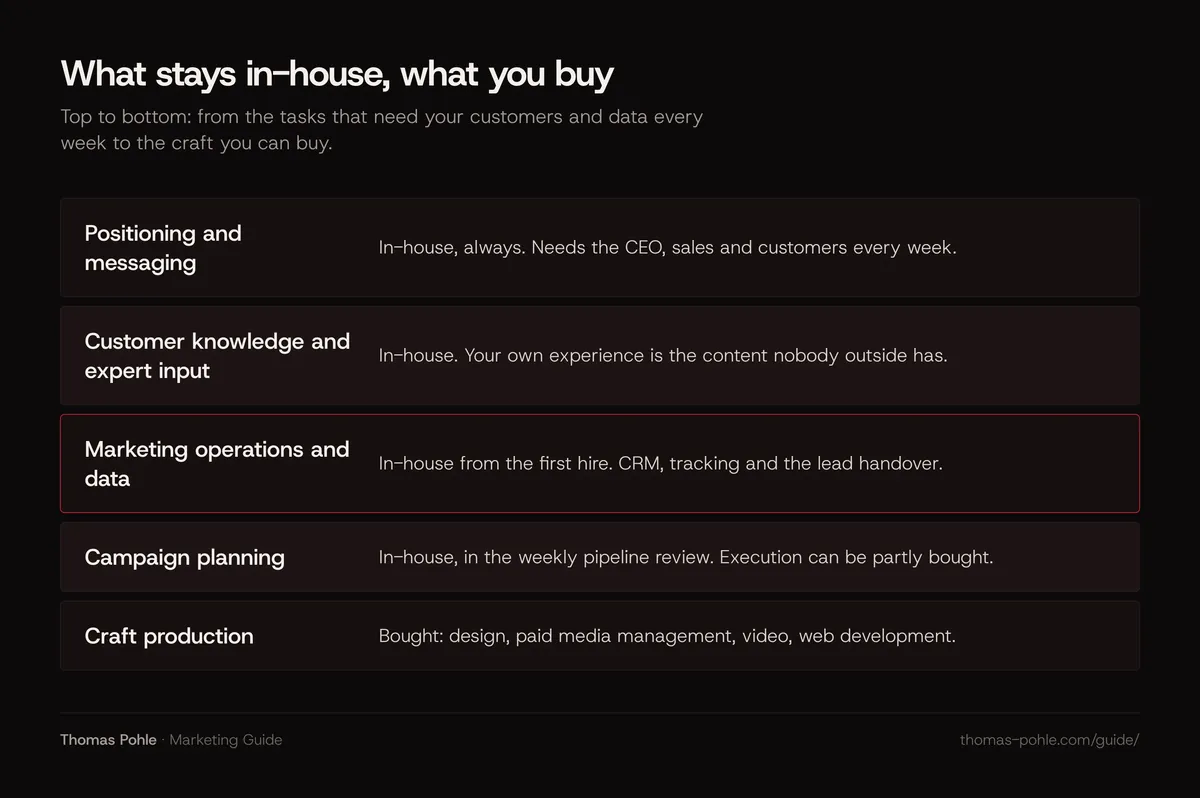
Keep in-house everything that needs your customers, your data or your CEO every week: positioning, the expert input behind your content, marketing operations and the sales handover. Buy what needs deep craft and little company knowledge: design production, paid media management, video, web development. PR sits in between, because media relationships take years to build.
Large advertisers have moved in the same direction. The ANA's 2023 survey of 162 member companies found that 82% have an in-house agency, up from 78% in 2018, while 92% of respondents also work with external agencies. Among those, on average 61% of the work is done in-house. The top benefit named was cost efficiency, followed by better knowledge of the brand and institutional knowledge. ANA members are large advertisers, so read this as a direction, never as a benchmark for a 60-person firm.
| Task | Where it belongs | Why | Partner if external |
|---|---|---|---|
| Positioning and messaging | In-house | Needs the CEO, sales and customers every week | Workshop facilitator, once |
| Customer stories and expert content | In-house | Your experience is the content. Nobody outside has it | Editor for polishing |
| Marketing operations, CRM, tracking | In-house | Owns the data and the lead handover | Freelancer for the first setup |
| Campaign planning with sales | In-house | Lives in the weekly pipeline review | None |
| PR and media relations | Partly | The story stays in-house, contacts can be bought | PR freelancer per market |
| Design production | External until daily volume | Craft with uneven volume | Freelance designer or studio |
| Paid media management | External until spend is steady | Needs platform depth and constant practice | Specialist freelancer or agency |
| Video, photography, web development | External | Equipment, craft, project-based work | Production company, developer |
My rule of thumb for moving a task in-house: when it fills more than half a role for six months in a row, and the freelancer bills you for learning your business again every month. Before that, buying gets you more craft per franc.
How do you set up a one-person B2B marketing team?
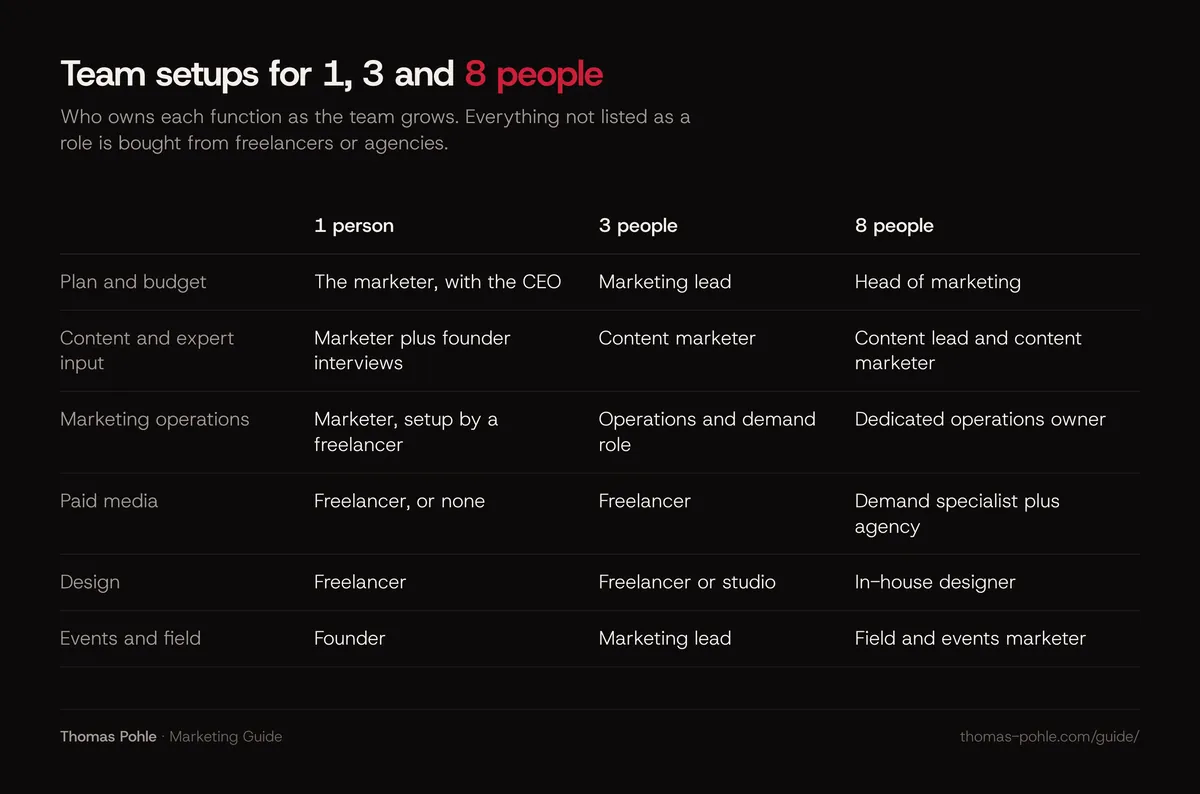
A one-person B2B marketing team works when that person owns the plan and runs exactly one channel properly, with the founder supplying customer knowledge and freelancers covering the craft. The first marketer should be a generalist who writes well and understands the CRM. A specialist hired first builds a channel nobody else can support.
What the one person does:
- Positioning on one page, written with the CEO and checked against three customer calls. The guide on building a B2B marketing strategy shows the five decisions behind it.
- One channel, run every week. For most B2B firms that's LinkedIn plus the website, or outbound to a named list of 20 to 30 target accounts.
- The website and the CRM basics. Forms that land in the CRM, a lead definition agreed with sales, one monthly report.
- Content from the founder's head. A 30-minute interview a week turns into a post, a page update or a sales one-pager.
What gets bought: a freelance designer on call, a developer for website changes, and, only if there's budget for ads, a paid media freelancer. What gets dropped: every other channel. A solo marketer with five channels runs none of them.
The CEO's part is fixed: one hour a week for interviews and one slot with sales.
How do you structure a three-person B2B marketing team?
A three-person B2B marketing team splits by function: a marketing lead who owns positioning, plan and sales alignment, a content marketer who turns customer knowledge into pages and posts, and a marketing operations and demand person who runs the CRM, automation, tracking and campaigns. Design, video and paid media management stay external.
- Marketing lead. Positioning and product marketing, the quarterly plan, the budget, the weekly pipeline review with sales. Also writes the most important pages personally.
- Content marketer. Customer interviews, case studies, website content, LinkedIn, sales material.
- Marketing operations and demand. CRM hygiene, forms, lead scoring, nurture emails, tracking, campaign setup. The guide to marketing automation in B2B covers what this role builds first.
My rule of thumb: three people can run two channels well: one for demand that exists today, one that builds future demand. A third channel starves one of them.
What does an eight-person B2B marketing team look like?
An eight-person B2B marketing team still cuts by function, now with depth: a head of marketing, a product marketer, two content people, a demand generation specialist, a marketing operations owner, a field and events marketer and an in-house designer. Agencies stay for media buying, video, PR in other markets and development.
- Head of marketing. Plan, budget, team, scorecard. Writes less, decides more.
- Product marketing manager. Positioning per product, launches, competitive material, sales enablement.
- Content lead and content marketer. One owns the topic plan and the editorial standard, the other produces with subject matter experts.
- Demand generation specialist. Paid campaigns, account-based programs, webinars.
- Marketing operations. CRM, automation, data quality, attribution, the tool stack.
- Field and events marketing. Trade fairs, customer events, partner programs.
- Designer. At this size the volume justifies one person who keeps the brand consistent every day.
At eight, two leads under the head of marketing (content and demand) keep the span manageable, and one weekly planning meeting stops the functions from drifting into channel silos.
How much of the budget should go to people versus agencies?
There's no fixed split, but in a small B2B company a few salaries quickly take most of the budget, which is why every in-house hire is also a decision against media and outside craft.
For reference: in Gartner's 2026 CMO Spend Survey (fielded January to March 2026, published June 2026) of 401 marketing leaders, most of them at companies with more than $1 billion in revenue, labor's share of the marketing budget rose from 21.9% in 2025 to 24.5% in 2026. A small company can't copy that split, because one salary is a much larger share of a small budget.
A typical scenario, with assumed numbers you should replace with your own. A B2B company with CHF 10 million revenue plans CHF 500,000 for marketing, people included. Assume CHF 140,000 per in-house marketer per year, fully loaded.
| Line | Three in-house | Two in-house plus external craft |
|---|---|---|
| In-house people | CHF 420,000 | CHF 280,000 |
| Freelancers and agency (design, paid media management, video) | CHF 0 | CHF 60,000 |
| Left for media, events and tools | CHF 80,000 | CHF 160,000 |
| In-house people as share of the budget | 84% | 56% |
Neither column is right by default. The first buys capacity and knowledge that stays. The second doubles what's left for media, events and tools. A plan built on trade fairs and paid campaigns favors the second. A plan built on content and outbound may favor the third in-house person. The guide on allocating a marketing budget shows how to split the remainder across channels.
How does AI change the structure of a B2B marketing team?
AI shrinks production hours. It doesn't replace the people who bring customer knowledge, judgment and the relationship with sales. Plan a smaller production load per person, and put the saved time into customer interviews and sales calls. Writing it yourself, or at least giving your own input, still produces the content buyers react to.
The data points the same way. In the Content Marketing Institute's 2027 B2B research, published in November 2026 and based on 861 B2B marketers, 88% say their organization uses AI-powered content creation tools, and the share of all respondents using AI agents more than doubled, from 28% to 59%. Asked to pick up to three contributions of AI, marketers named speed (78%) and efficiency (59%) most often. Quality ranked near the bottom at 17%.
What that means for each setup, in my view:
- One person. AI handles research, interview transcripts, repurposed drafts and the monthly report. The founder interview stays human, because that's where the substance comes from.
- Three people. The content marketer drafts less and spends more time with customers. Operations automates reporting and data cleanup.
- Eight people. Maybe one content producer fewer. Never one product marketer fewer.
The craft of briefing a model with your own material is in the guide on writing marketing copy with AI that doesn't sound like AI.
Which team structure mistakes cost B2B companies the most?
The costly mistakes are structural. Letting an agency own the strategy, leaving marketing operations without an owner, and running a freelancer as a hidden employee. Each looks cheaper at first and costs you later.
- The agency owns the strategy. When the contract ends, the knowledge leaves with it. My rule for every external partner, me included: we build it together, and the knowledge stays with you when the partner is gone.
- Nobody owns operations. Leads sit in spreadsheets and sales stops trusting marketing's numbers.
- The freelancer is really an employee. Fixed hours, one client, your laptop. In Germany both parties can ask the Deutsche Rentenversicherung Bund for a status determination under section 7a of the Fourth Book of the Social Code (SGB IV). In Switzerland the compensation office decides case by case. According to the AHV/IV leaflet 2.02 (as of 1 January 2026), working for only one client is usually classed as employment. This is no legal advice. Check your setup with the authority or a lawyer.
What to do this week
You don't need a reorganization to start. These seven steps take a few hours and use only what you already know about your team and budget.
- List every marketing task done in the last three months and who did it, by name, including freelancers and agencies.
- Mark each task with the decision table: in-house, partly or external.
- Check whether marketing operations has one named owner. If not, that's your next decision.
- Count your active channels. More than one per marketer means you're spreading too thin.
- Run the budget arithmetic: in-house people as a share of the total marketing budget, and what's left for media.
- Check every long-running freelancer against the status criteria in your country.
- Book one hour a week of founder or CEO time for content interviews.
Team structure is a sequence of decisions, and most of them are reversible. The one that isn't is letting customer knowledge sit outside your company. If you want an outside view on your setup before the next hire, a one-day Momentum Workshop is where I'd start.
Frequently asked questions
What is the first marketing hire a B2B company should make?
A generalist who writes well, understands the CRM and can run one channel properly. That person owns the plan with the CEO and buys design and development as needed. A specialist hired first, say a paid media expert, runs ads for a positioning nobody has written down.
Should a B2B company hire an agency or build an in-house team?
Usually both. Keep positioning, expert content, marketing operations and the sales handover in-house, because they need customer and company knowledge every week. Buy design, paid media management, video and development. Move a task in-house when it fills more than half a role for six months in a row.
When does a fractional head of marketing make sense?
When the team has zero to two people and nobody owns the plan yet. A fractional leader sets positioning, plan and scorecard one or two days a week, and the team executes. I describe my own advisory as marketing leadership without the hire. The pillar on the head of marketing has the signals for the switch to full-time.
How big should a B2B marketing team be?
In my view there's no reliable benchmark by revenue or headcount. Size the team by the plan: one person runs one channel, three people two channels plus operations, eight people several channels, events and their own design. Then check what's left for media after salaries.
Do I still need a content marketer if we use AI?
Yes, but the job changes. AI takes research, transcripts and first drafts. The content marketer spends the saved time with customers and subject matter experts, because own experience and own input produce the content buyers react to. In CMI's 2027 research, only 17% of marketers named quality as one of AI's main contributions.
Sources
- Gartner (June 2026): Marketing survey finds awareness and conversion account for 62.6% of total media spend (labor share 21.9% to 24.5%)
- Content Marketing Institute (November 2026): Faster and cheaper, but not better. What the 2027 B2B Content and Marketing Trends report reveals
- ANA (2023): In-house agencies no longer a trend, they're here to stay
- Sozialgesetzbuch IV, § 7a Feststellung des Erwerbsstatus (gesetze-im-internet.de)
- AHV/IV Merkblatt 2.02: Beiträge der Selbstständigerwerbenden an die AHV, die IV und die EO (Stand 1. Januar 2026)

Thomas PohleB2B marketing advisor in Zurich. More than ten years in B2B marketing at Link11, Beekeeper and smino, most recently as Head of Marketing. CEO and co-founder of TEISENDA. Researched and drafted with AI tools, checked against the sources listed above. More about Thomas