How do you develop your positioning step by step?

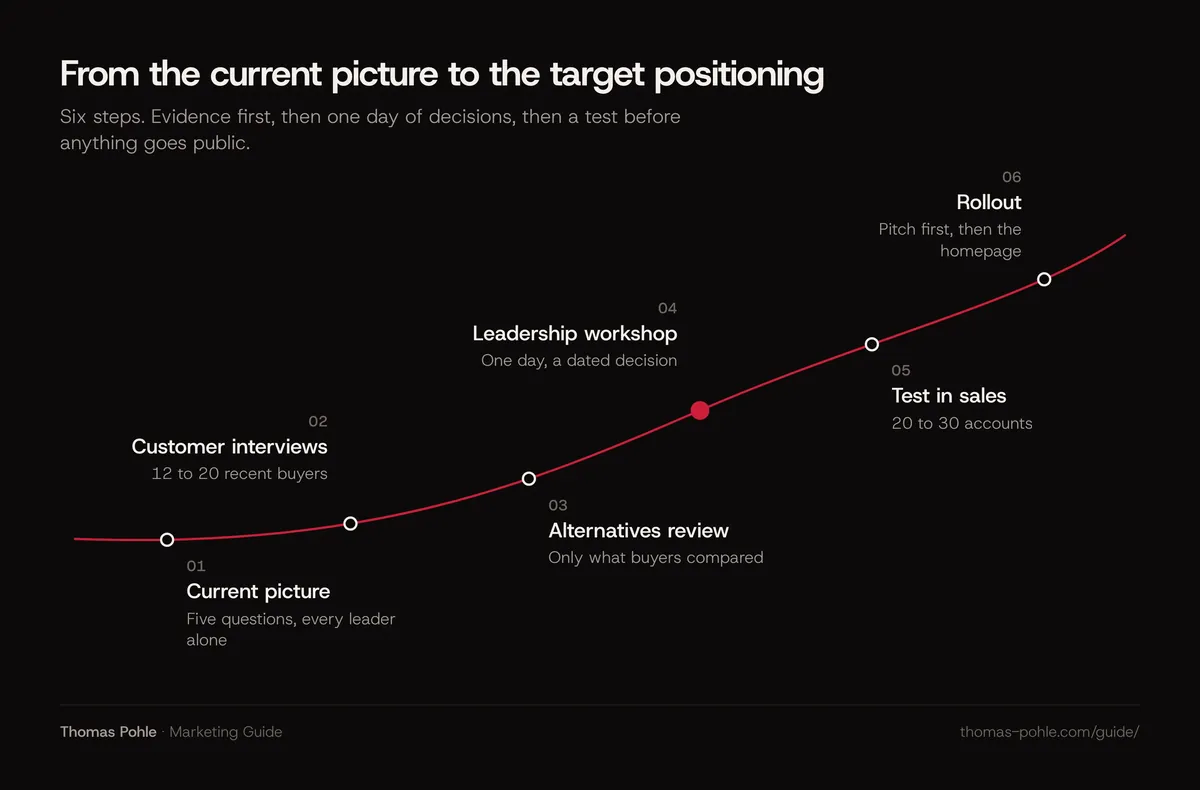
Develop your positioning as a short project with six steps: write down today's positioning as each leader sees it, interview 12 to 20 recent buyers, review the alternatives they compared, decide the target positioning in a one-day leadership workshop, test it with 20 to 30 accounts in sales calls, then roll it out.
This guide is for founders, CEOs and marketing leads who know their positioning is blurry and now have to run the process. What positioning is and which parts it has is covered in the guide on positioning for B2B companies. Here you get the project itself: who is in the room, which inputs you need, the interview guide, the workshop agenda, the outputs, and how to test and roll out the result.
What does the positioning process look like from start to finish?
The positioning process runs from the current picture to the target positioning in six steps: capture how the leadership describes the company today, interview recent buyers, review the alternatives they compared, decide in a one-day leadership workshop, test the result in sales calls, then roll it out. My rule of thumb: four to six weeks to the workshop, six more weeks of testing.
The order matters. Al Ries and Jack Trout argued in their 1981 book Positioning: The Battle for Your Mind that a position lives in the prospect's mind. That's why the buyers speak before the leadership decides. April Dunford, author of Obviously Awesome, describes the steps you run inside the workshop: let go of where you came from, isolate what's unique, map it to value, find who cares most, choose the market frame. Everything before the workshop feeds those steps with evidence instead of opinion.
| Step | Who does it | Output |
|---|---|---|
| 1. Current picture | Every leader alone, then the moderator | Five answers per person, side by side |
| 2. Customer interviews | One interviewer who didn't sell the deal | 12 to 20 notes or transcripts, quotes sorted |
| 3. Alternatives review | Marketing with sales | One page per alternative buyers named |
| 4. Leadership workshop | CEO, sales, marketing, product, customer success | Dated positioning document and sacrifice list |
| 5. Test | Sales, with marketing listening in | Notes from 20 to 30 accounts, a go or a fix |
| 6. Rollout | Marketing owns it, sales goes first | New pitch, homepage, proposal template |
How do you capture your current positioning before talking to customers?
Capture the current positioning by asking every member of the leadership team the same five questions, in writing and alone, before any meeting. Who is our best customer? What would they use without us? What do we do that the alternatives don't? What is that worth to the customer? Which category do we belong in? The differences between the answers are your starting point.
Collect the answers before anyone has heard the others. In a group, the first loud answer wins, and you lose the picture you need. Add the homepage, the sales deck, the last ten proposals and the deals won and lost in the past twelve months.
This is where Dunford's first step starts. She describes weak positioning as hanging on to a default position, usually the one the product had when it was founded. The written answers make that default visible. If the CEO describes the company of five years ago and sales describes something else, you've found the gap.
How many customer interviews do you need, and whom do you ask?
For a first positioning project, plan 12 to 20 interviews per customer segment. Saturation research supports that range: Guest, Bunce and Johnson found in 2006 that saturation occurred within the first twelve of 60 interviews and concluded that twelve should be enough for a fairly homogeneous group. Griffin and Hauser's 1993 study compared interview methods, and Hauser's MIT course note reports that in one study about ten one-hour interviews identified roughly 90 percent of customer needs, and that twenty per distinct customer segment are usually enough.
Both come from studies outside B2B, so treat them as a guide. My rule of thumb: stop when three interviews in a row add nothing new, and add interviews when your customers fall into clearly different segments.
- Recent buyers. Customers who signed in the last twelve months still remember why they started looking and what else they compared.
- Your best fit. Customers who got value fast and would buy again.
- Some lost deals. Three to five buyers who chose an alternative tell you more about the alternatives than any website.
- A neutral interviewer. Not the salesperson who closed the deal. Buyers are polite to the person who sold to them.
Record only with consent and summarize each call on one page. Then look for the common denominator. When I positioned my own advisory, I listed every trigger that makes buyers call, from no time to no pipeline, and found one thing they shared: standstill.
Which questions belong in the interview guide?
A good positioning interview asks about what the buyer did. What they think of you matters less. Ask what triggered the search, what they used before, which alternatives they compared, why they picked you and what changed afterward. Opinions are cheap. Past decisions are hard to invent.
Rob Fitzpatrick built a whole book, The Mom Test, on this problem: how to ask questions that give real data when people tend to tell you what you want to hear. The guide below follows that idea.
| Question | What it shows you |
|---|---|
| What happened that made you start looking? | The trigger, and with it the buying situation you win |
| What did you use or do before? | The real alternative, often a spreadsheet or doing nothing |
| What else did you look at, and why not that? | The alternatives you compete with in practice |
| What almost stopped you from buying? | Risks and objections the positioning must answer |
| Why us in the end? | The attributes that decided, in the buyer's words |
| What is different now, and how do you notice it? | The value, ideally with a number the customer tracks |
| How would you describe us to a colleague? | The category and wording buyers already use |
How do you review competitors without copying their messaging?
Review only the alternatives your buyers named in the interviews, including doing nothing, a spreadsheet or hiring someone. For each one, write down what buyers said it's good at, why they didn't pick it, and what that alternative claims about itself. Your own list of competitors comes last, because it usually reflects how you see the market.
Put one alternative on one page: who buys it, what buyers like about it, where it failed them, and its main homepage claim. That last line protects you. If your future positioning could stand on a competitor's homepage, it isn't one. The guide on how to differentiate when everyone sounds the same has a simple logo swap test for this.
Bring the pages into the workshop and draw the map there, with buyer evidence on the wall. The guide on creating a positioning map shows how.
Who belongs in the leadership workshop, and how does the day run?
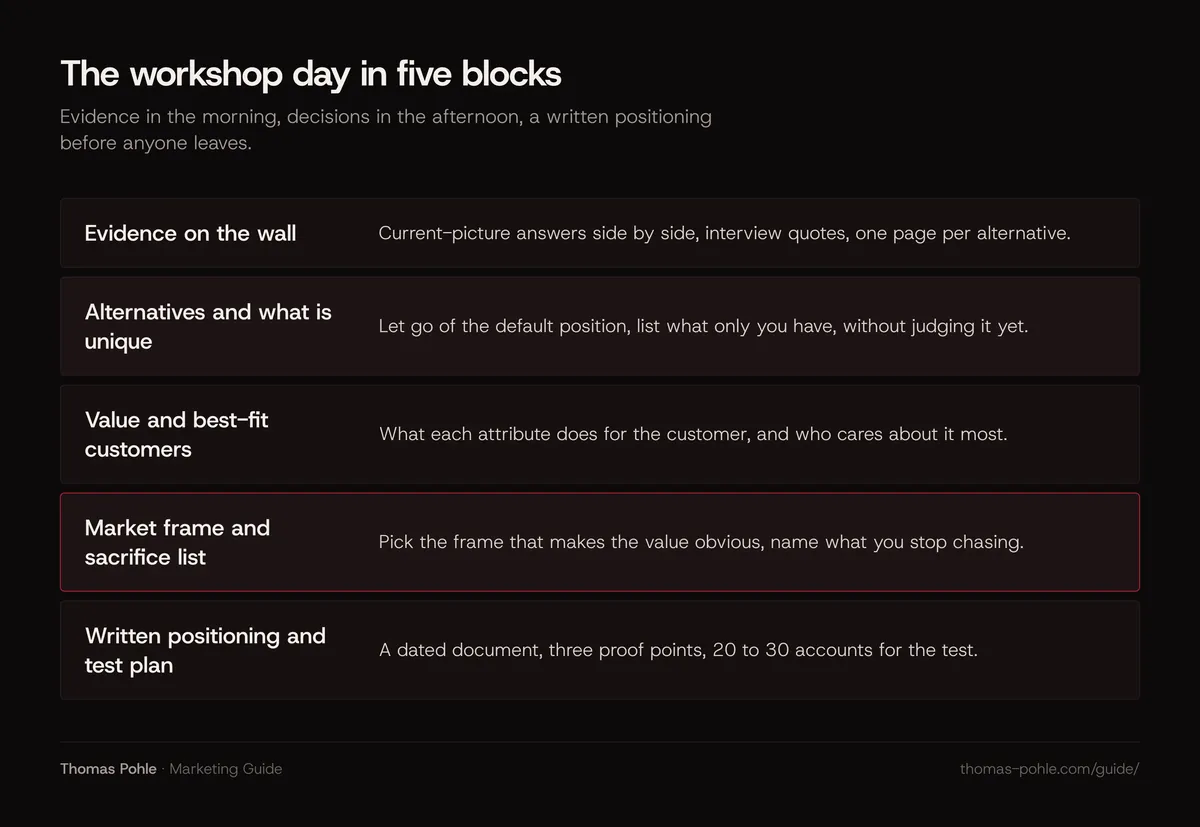
The workshop needs the people who will live with the decision: the CEO or founder, the heads of sales, marketing and product, and customer success. I'd keep it to six to eight people and one moderator. The day turns the evidence into decisions: alternatives, unique attributes, value, best-fit customers and the market frame, then a written, dated positioning.
April Dunford names the same team in her podcast episode on preparing a positioning exercise (February 2026): marketing, sales and product, usually customer success, and the CEO or founder. She also wants several sales voices in the room, because only sales knows who really shows up in a deal. My own rule: the CEO speaks last in each round, otherwise the room agrees too early.
This is the core of the one-day workshop I run with leadership teams: positioning, ideal customer and the one channel that moves first, so the team leaves with a plan it can run on Monday. Without the interviews, the day turns into a debate about taste.
What has to come out of the room:
- A dated positioning document. Alternatives, unique attributes, value, best-fit customers, market frame. Dunford advises a dated template, so you can review it later, and warns against the fill-in-the-blank positioning statement.
- A sacrifice list. Segments, features and deals you stop chasing. If nothing is on it, nothing was decided.
- Three proof points. Claims a buyer can check, taken from the interviews.
- Open questions for the test. The two or three assumptions nobody could prove in the room.
Messaging comes later. Dunford is clear that positioning is not messaging; it is the input for the words, which you write once the test has passed.
What does the process look like for a real company?
Here is a worked example with a fictional company. Brennwald AG, invented for this guide, makes maintenance planning software and has about 80 employees. Its homepage says "flexible maintenance software for every industry". Sales wins deals, but each one looks different. All numbers below are assumptions for the example.
In the current picture, the five leaders gave four different best customers. The team ran 14 interviews: ten recent customers and four lost deals. The buyers who got value fastest were food and pharma packaging plants that face regular inspections. Leadership saw other maintenance software as the rival. The buyers' real alternative was a spreadsheet plus the maintenance module of their ERP system. What decided the deal was one attribute: inspection records ready for the auditor without a week of searching.
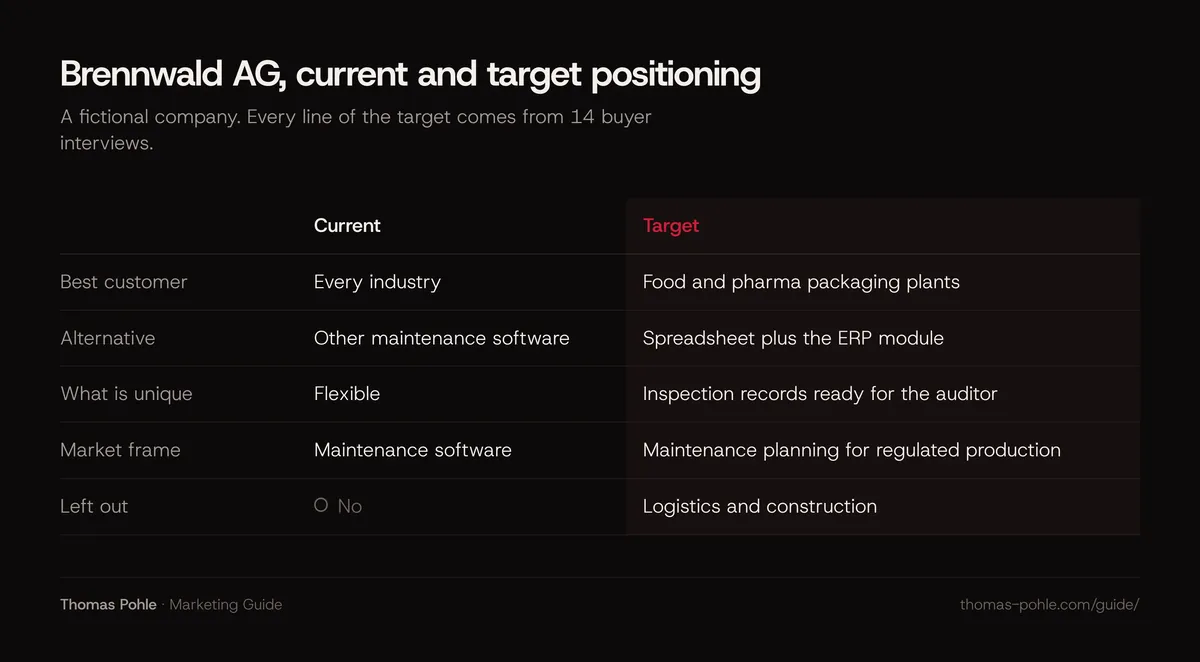
The workshop chose the frame "maintenance planning for regulated production" and put logistics and construction on the sacrifice list. The test plan: 25 named accounts from food and pharma packaging over six weeks, with one question tracked after each first call. Did the buyer bring up inspections without being prompted? I would set the pass mark at more than half of the first calls. Below that, the team goes back to the interview notes before touching the website.
How do you test and roll out the new positioning?
Test the new positioning in real sales conversations before you change the website. Pick 20 to 30 accounts that match the best-fit profile, use the new story in first calls for four to six weeks, and track whether buyers repeat the core point back to you. Roll out only after that, starting with the sales pitch, then the homepage.
Roll out where buyers meet you first. In B2B that's often a person, so I'd go in this order:
- Sales pitch and first-call script. One page, practiced with the whole sales team.
- Homepage and the most visited pages. The headline names the buyer situation.
- Proposal template and case studies. The same frame and proof points.
- LinkedIn profiles and company page. The leadership says it the same way as the website.
- Review after 90 days. Win rate in the best-fit segment, deal size, and how often buyers use your words.
A brand-level version of the result belongs in your brand positioning once the company positioning holds. If you want help running the process with your leadership, a one-day Momentum Workshop is where I'd start.
What to do this week
You can start the positioning project this week with a few hours of work and without a budget. The goal: the current picture and the interview list are ready before anyone books a workshop date. These steps get you there, in this order:
- Send the five current-picture questions to every leader and ask for written answers within three days.
- Pull the deals won and lost in the past twelve months, with the reason sales gave for each.
- Pick 15 recent customers and four lost deals and ask them for a 30-minute call.
- Name one interviewer who didn't sell those deals.
- Print the seven interview questions and test them in the first two calls.
- Block one full day with the CEO, sales, marketing, product and customer success five weeks from now.
- Agree on the test before the workshop: 20 to 30 named accounts and one question to track.
Positioning isn't done after one round. Alternatives change and new buyers arrive with new triggers. Repeat the interviews once a year and keep the dated document, so the next team sees what was decided and why.
Frequently asked questions
How long does it take to develop a positioning?
My rule of thumb: the project runs about four to six weeks until the workshop, mainly because booking 12 to 20 customer interviews takes time. The workshop itself is one day. Then plan four to six weeks of testing in sales conversations before you change the website.
Should an external moderator run the positioning workshop?
It helps. Someone from inside the company is either a participant with an opinion or junior to the CEO, and both make it hard to stop a debate. An external moderator can enforce the order of evidence before opinion and can say when the room is avoiding a decision.
Can you develop a positioning without customer interviews?
You can write one, but you can't check it. Without interviews, the team decides based on its own view of alternatives and value, which is exactly the view the project is meant to test. If calls are impossible, use won and lost deal notes, sales call recordings with consent and support tickets. Treat the result as a thesis and test it harder.
What is the difference between current and target positioning?
The current positioning is how the company is described and perceived today: on the homepage, in sales calls and in the answers of the leadership team. The target positioning is the deliberate choice of customers, alternatives, value and market frame the leadership commits to. The project closes the gap between both, step by step, and the rollout makes the target visible.
How often should you revisit your positioning?
Review the dated positioning document once a year, and earlier when something big changes: a new competitor wins deals against you, your best-fit segment shifts, or you launch a product that changes what you do. April Dunford also stresses that positioning is not a one-time exercise.
Sources
- April Dunford: A Product Positioning Exercise (17 October 2019)
- Positioning with April Dunford (podcast, Apple Podcasts): Preparing for a Positioning Exercise (5 February 2026)
- April Dunford: Obviously Awesome, publisher page (Page Two)
- Al Ries and Jack Trout: Positioning, The Battle for Your Mind (McGraw-Hill, first published 1981), Open Library record
- Guest, Bunce and Johnson: How Many Interviews Are Enough?, Field Methods 18(1), 2006
- Nielsen Norman Group: How Many Participants for a UX Interview? (Maria Rosala, 31 October 2021), summary of Guest, Bunce and Johnson 2006
- Griffin and Hauser: The Voice of the Customer, Marketing Science 12(1), 1993 (abstract)
- John R. Hauser: Note on the Voice of the Customer, MIT OpenCourseWare 15.810 (Fall 2015)
- Rob Fitzpatrick: The Mom Test (book page)

Thomas PohleB2B marketing advisor in Zurich. More than ten years in B2B marketing at Link11, Beekeeper and smino, most recently as Head of Marketing. CEO and co-founder of TEISENDA. Researched and drafted with AI tools, checked against the sources listed above. More about Thomas