How do you write a positioning statement?

Write a positioning statement as two sentences with six parts: the target customer, their need, your category, the main benefit, the difference from the alternative buyers would otherwise choose, and the proof. Write it after the positioning is decided, from buyer evidence. It's an internal document for briefings and sales. Your website headline is a separate job.
This guide is for founders, CEOs and marketing leads who now need to write their positioning down. What positioning is belongs to the guide on positioning for B2B companies, and the project behind it to how to develop your positioning step by step. Here you get only the statement.
What is a positioning statement, and what is it for?
A positioning statement is an internal summary of your positioning in one or two sentences. It names the target customer, their need, your category, the main benefit, the difference from the alternative and the proof. Its job is to make everyone who writes, sells or briefs an agency start from the same sentence.
Alice Tybout and Brian Sternthal write in Kellogg on Branding (2005) that managers develop formal positioning statements to ensure a shared vision across the organization and to guide tactical thinking. Partners such as the advertising agency may get it. Consumers aren't expected to read it. They see its results: design, pricing, communication and channels.
My take: a statement is good when a new colleague can make the right call without asking you. Precision beats sound.
Which parts belong in a positioning statement?
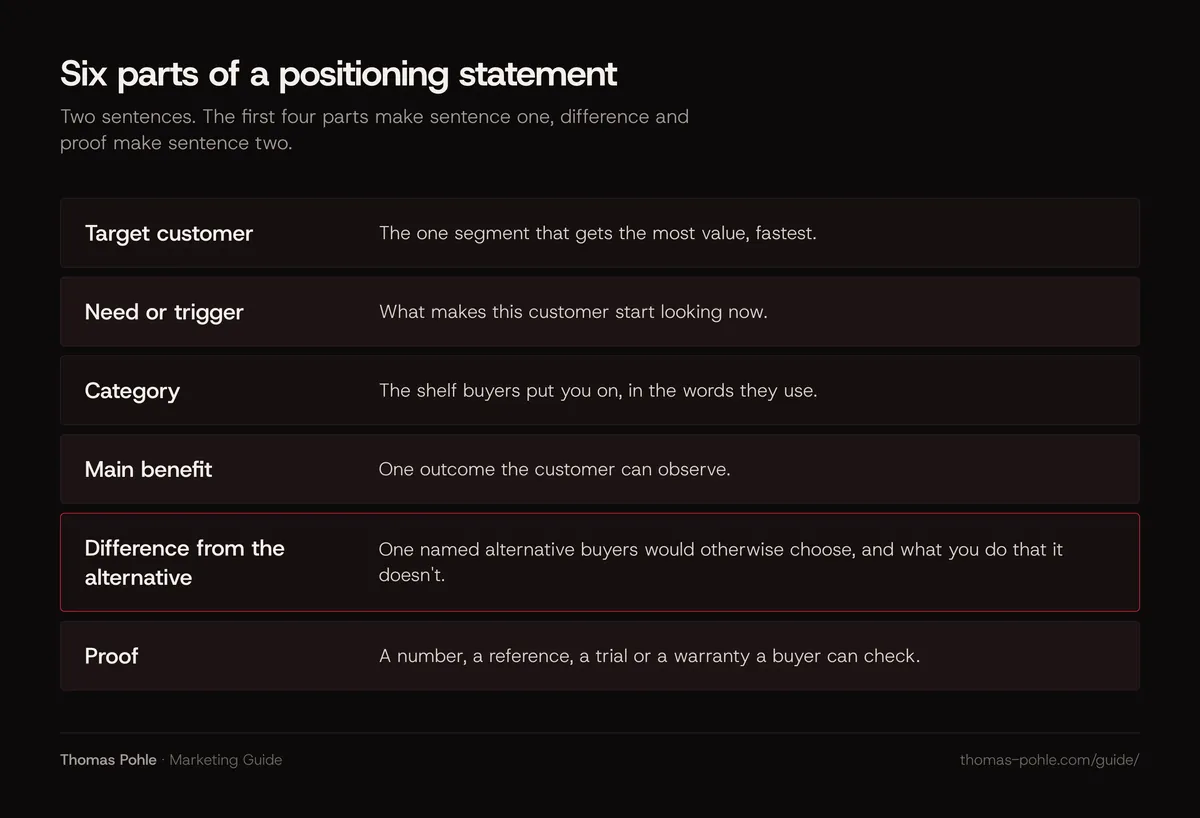
A complete positioning statement has six parts: the target customer, the need or trigger, the category, the main benefit, the difference from the alternative the buyer would otherwise choose, and the proof. The first four fit into sentence one. Difference and proof make sentence two. Leave one out and your team guesses.
For [target customer] who [need or trigger], [company or product] is a [category] that [main benefit]. Unlike [the alternative buyers would otherwise choose], we [difference], shown by [proof].
- Target customer. The one segment that gets the most value, fastest. "SMEs" is too wide.
- Need or trigger. What makes this customer start looking now. "Wants more efficiency" is a wish, no trigger.
- Category. The shelf buyers put you on, in their words. "Platform" and "solution" are no category.
- Main benefit. One outcome the customer can observe. One, no feature list.
- Difference from the alternative. One named alternative and what you do that it doesn't. Often that alternative is a spreadsheet, a new hire or doing nothing.
- Proof. A number, a reference, a trial or a warranty a buyer can check. "Leading" proves nothing.
Where does the template come from, and why does April Dunford reject it?
The classic template comes from Geoffrey Moore's book Crossing the Chasm, first published in 1991. Kellogg on Branding offers a four-part format. April Dunford, author of Obviously Awesome, calls the fill-in-the-blanks statement harmful. Together they tell you when to write it.
Geoffrey Moore and the elevator test
The elevator test asks whether you can explain your product in the time of an elevator ride. Marketer Avi Hein's 2011 post on the book's positioning advice spells out what failing costs: your claim can't travel by word of mouth, and your marketing communications end up all over the map.
Hein gives the formula with six blanks, paraphrased here: the target customers in one beachhead segment, the current market alternative they're dissatisfied with, your new product category, the key problem it solves, the competing product or substitute, and the key whole product features you've assembled. Jim Highsmith's 2001 version words it differently.
The Kellogg format with reasons to believe
Tybout and Sternthal name four components: the targeted customers, the frame of reference, the point of difference and the reasons to believe. Their example is the power tool brand DeWalt: tradesmen who can't afford downtime as the target, professional power tools as the frame, dependability as the difference, and quality standards, a service network and a guarantee to repair or replace any tool within 48 hours as reasons to believe.
In B2B, buyers check claims, so I'd never drop the proof. My six parts take Moore's need and named alternative and Kellogg's reasons to believe.
April Dunford's objection
One section of Dunford's 2019 post on a positioning exercise carries the heading "The Positioning Statement is Harmful and You Should Never Do One". Her three reasons: the exercise assumes great positioning is already in your head, the result is hard for teams to share and remember, and it gives a false sense of being done. In Lenny's Newsletter (January 2021) she compares it to Mad Libs and says most products could sit in several market categories, so no blank has one obvious answer.
I agree with her about the method. Blanks filled in a meeting room give you the team's assumptions. Where I differ: once the positioning is decided from evidence, a short sentence is useful. My rule: the statement is the last line of the positioning work, never the first. Dunford herself advises writing the result down in a dated document. I'd put the statement at the top of it.
How do you write the statement step by step?
Write the statement from your positioning document, never from a blank page. Start with the alternative, then the difference and the benefit, then customer, need and category, then the proof. Write long first, then cut. If you can't fill a part from buyer evidence, stop and get the evidence.
- Collect inputs. Positioning document, interview notes, deals won and lost.
- Name one alternative. The one most buyers named in interviews.
- Write the difference and the benefit. One thing you do that the alternative doesn't, and what the customer notices.
- Narrow customer, need and category. The segment that cares most, the event that makes it look, the term buyers use.
- Attach proof. A number with a year, a reference, a trial, a warranty.
- Cut. Remove adjectives, second benefits and second segments. Then read it aloud.
Write the first version yourself. An AI assistant can help in the last step with shorter variants of a clause. It can't know which alternative your buyers compared or which proof they asked for. Your interviews and decisions are the input.
What do filled-in positioning statements look like?
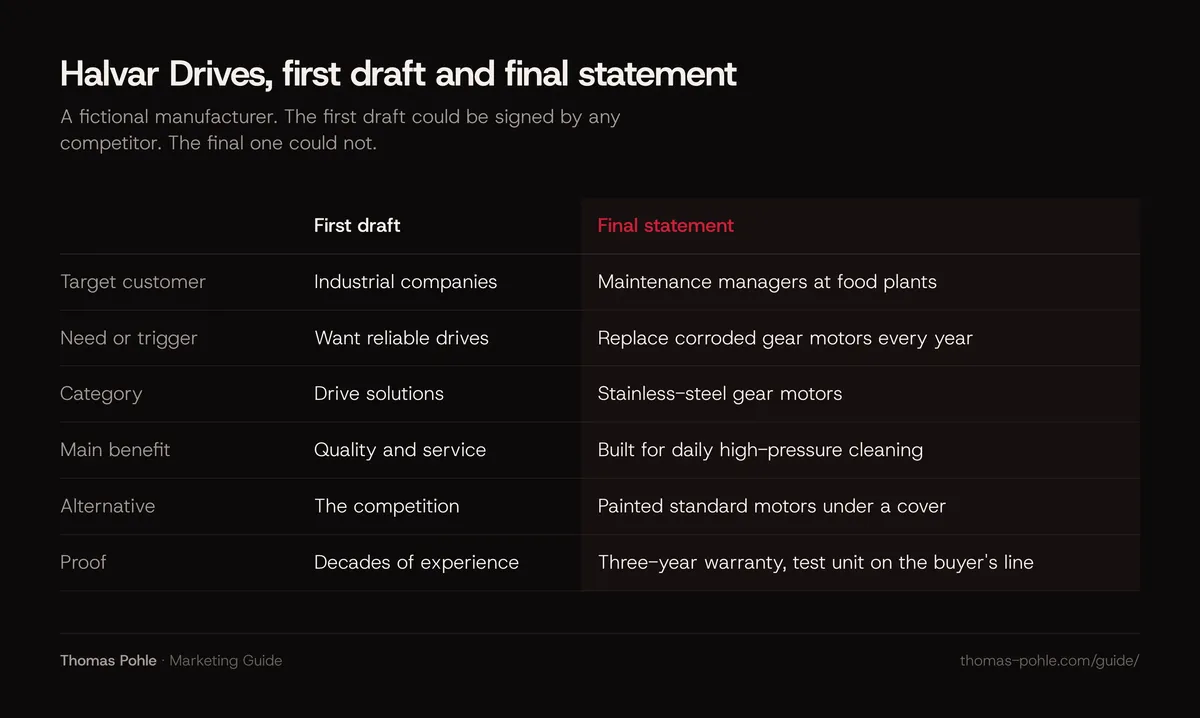
Here are statements for a B2B service, a software company and an industrial manufacturer. All three companies are invented for this guide, and so is every number in them. Each has at most 60 words, one named alternative and proof a buyer could check.
B2B service
For Swiss engineering firms with 20 to 100 employees that lose public tenders over last-minute paperwork, Fristwerk is a bid management service that submits complete tenders on time. Unlike leaving bids to project managers after hours, we run each submission with a dedicated two-person team, and all 41 tenders in 2025 went in before the deadline.
Software as a service
For HR leads at logistics firms with 200 to 2,000 shift workers who rebuild the roster after every sick call, Rostermill is shift planning software that fills an open shift in minutes. Unlike a spreadsheet plus a group chat, it offers the shift only to qualified workers who are free, which buyers verify in a 30-day pilot at one site.
Industrial manufacturer
For maintenance managers at food plants who replace corroded gear motors on washdown lines every year, Halvar Drives makes stainless-steel gear motors built for daily high-pressure cleaning. Unlike painted standard motors under a cover, ours have no paint to flake, backed by a three-year warranty and a test unit on the buyer's line.
How do you test a positioning statement?
A good statement passes seven checks before anyone uses it: no competitor could sign it, sales can say it in one breath, it names what you leave out, every part traces back to evidence, a buyer can verify the proof, the wording matches the buyers' own, and colleagues remember it a week later.
| Test | How you run it | Pass mark |
|---|---|---|
| Signature | Put the names of your three main alternatives into the statement, one after the other | None of the three could sign it truthfully |
| One breath | A salesperson says it aloud from memory | Two sentences, at most 60 words, about 25 seconds |
| Sacrifice | List the customers and deals the statement rules out | At least two segments or deal types you now turn down |
| Evidence | Write the source next to each of the six parts | Six of six come from interviews or deal data |
| Proof | Ask whether a buyer can check the proof before signing | A number, a reference, a trial or a document; no adjective |
| Buyer's words | Compare category and need with the interview notes | Both appear in words buyers used |
| Recall | A week later, five colleagues write down customer and alternative | At least four of five match |
The pass marks are my rules of thumb, and no study stands behind them. The signature test is the hardest, the same idea as the logo swap test in the guide on how to differentiate when everyone sounds the same. If it fails here or in the evidence test, the positioning is the problem. Go back to the interviews.
How is it different from a tagline, a value proposition and a mission?
A positioning statement is the internal reference. A value proposition tells buyers what they get. A tagline is the short line people remember. A mission describes what business the company is in. Confusion starts when one sentence has to do all four jobs.
| Term | Who reads it | Length | Question it answers |
|---|---|---|---|
| Positioning statement | Your team, agencies, partners | Two sentences | For whom, against what, why us, and how do we prove it? |
| Value proposition | Buyers, in sales and on the website | A few sentences or a short list | What does the customer get, and what is it worth? |
| Tagline or claim | Everyone | A few words | How do people remember us? |
| Mission statement | Employees, investors, the public | One or two sentences | What business are we in, and whom do we serve? |
The terms aren't standardized. James Anderson, James Narus and Wouter van Rossum noted in Harvard Business Review in 2006 that there is no agreement on what a customer value proposition is. Bain & Company defines a mission statement as a definition of the company's business, who it serves, what it does and its objectives. Agree internally which document is which.
My own claim is "Momentum for B2B marketing." That's a tagline. It names no segment, no alternative and no proof, and nobody could brief an agency with it. For the brand-level statement, see brand positioning.
Where do you use the statement, and why isn't it your website headline?
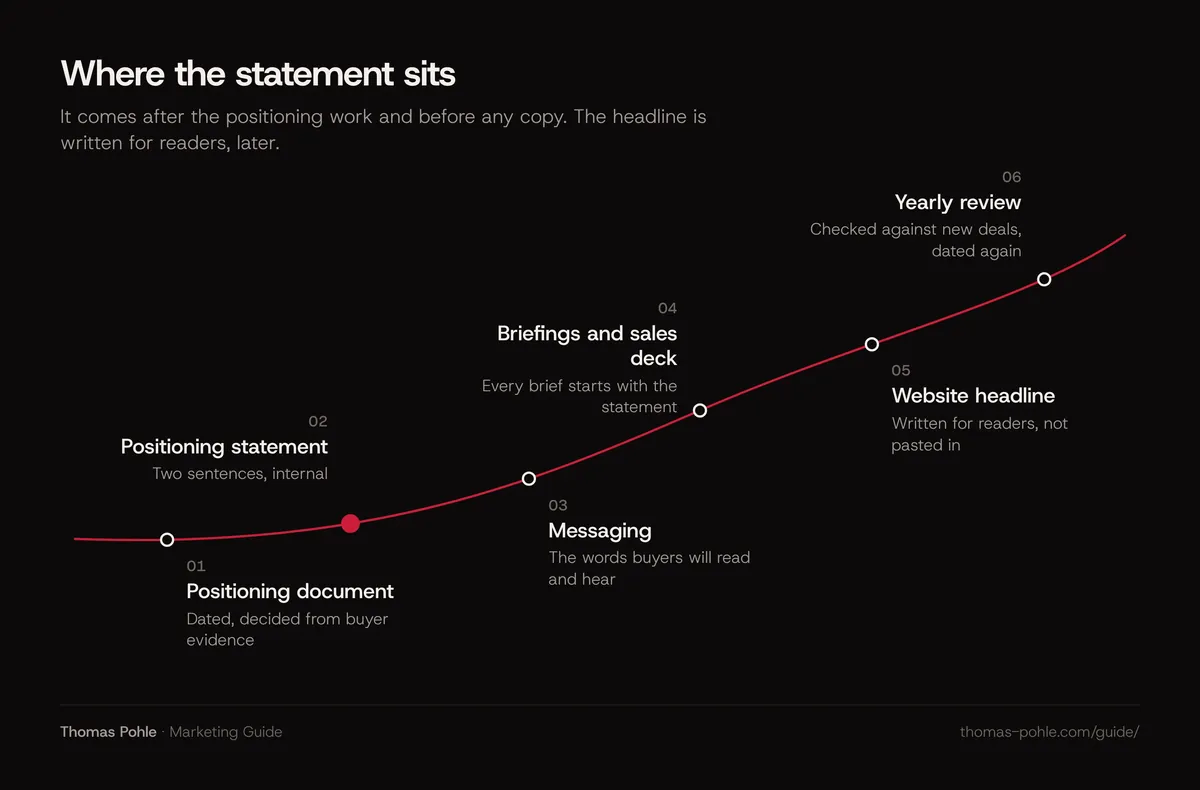
Use the statement wherever someone has to decide what to say or build: at the top of every agency and freelancer briefing, as the logic of the sales deck, in onboarding and in product decisions. It doesn't go on the website. A homepage headline is written for readers, and that is a different job.
- Briefings. It's the first paragraph of every brief for an agency, a freelancer or an AI tool.
- Sales deck. The slides follow its order: need, alternative, difference, proof. The sentence appears on no slide.
- Product and offers. Check requests from outside the segment against it.
- Messaging. The words buyers read are derived from it. Dunford draws the same line: positioning is the input for messaging.
My own homepage shows the gap. It opened with "Your marketing has stalled." A storytelling review found that the line forces readers to accept a diagnosis first and loses people who think things are going okay. In October 2026 I replaced it with "Your marketing doesn't need another strategy deck. It needs momentum." Neither line names a segment, a category or proof. A headline has to keep one reader reading.
Date the statement and review it yearly, or sooner when a new alternative starts winning deals.
What to do this week
You can write and test a first statement this week if the positioning is decided. If it isn't, find out which of the six parts you can't fill from evidence. That list is your plan for the positioning work.
- Pull out your positioning document, interview notes and the deals won and lost in the past twelve months.
- Fill the six parts as a list, with the source next to each one.
- Mark every part without a source as an open question.
- Write the two sentences yourself and cut them to at most 60 words.
- Run the signature test with your three main alternatives.
- Ask two salespeople to say it aloud from memory the next day.
- Put the dated statement at the top of your briefing template.
A statement won't fix a positioning that was never decided. If the six parts won't come together, the decisions are missing, and a one-day Momentum Workshop is where I'd start.
Frequently asked questions
How long should a positioning statement be?
Two sentences. Jim Highsmith's 2001 sample of Geoffrey Moore's template has two. My rule of thumb is at most 60 words, about 25 seconds aloud. A longer one usually holds a second benefit or a second target group.
Should the positioning statement appear on the website?
No. Tybout and Sternthal note in Kellogg on Branding that consumers aren't expected to read a positioning statement. They see its results. Your homepage headline, service pages and case studies are derived from it and written for readers.
Does every product need its own positioning statement?
If the products are bought by different people, against different alternatives, yes. Write one company statement and one per product. If two products share the customer, the alternative and the proof, one statement is enough. Avi Hein's version of Moore's formula targets one beachhead segment.
How often should you update a positioning statement?
Review it once a year and whenever something big changes: a new alternative wins deals against you, your best-fit segment shifts, or you launch a product that changes what you do. April Dunford warns that positioning can't be a one-and-done exercise.
Sources
- Wikipedia: Crossing the Chasm (publication history, 1991, revised 1999 and 2014)
- Avi Hein: Positioning, Defining the Battle (Crossing the Chasm Strategy Part 6), 21 November 2011
- Jim Highsmith: product vision article (2001) with Moore's template, reprinted by Joel Spolsky, Joel on Software (9 May 2002)
- Alice M. Tybout and Brian Sternthal: Brand Positioning, chapter 1 of Kellogg on Branding (Wiley, 2005), sample chapter (PDF)
- April Dunford: A Product Positioning Exercise (17 October 2019)
- April Dunford: A quickstart guide to positioning, Lenny's Newsletter (26 January 2021)
- James C. Anderson, James A. Narus and Wouter van Rossum: Customer Value Propositions in Business Markets, Harvard Business Review (March 2006)
- Bain & Company: Mission and Vision Statements, Management Tools (31 January 2023)

Thomas PohleB2B marketing advisor in Zurich. More than ten years in B2B marketing at Link11, Beekeeper and smino, most recently as Head of Marketing. CEO and co-founder of TEISENDA. Researched and drafted with AI tools, checked against the sources listed above. More about Thomas