How do you track marketing spend during the year?

Track marketing spend in a monthly tracker that puts four numbers side by side for every line: plan, committed, actual and effect. Committed shows what contracts already lock in. The gap between plan and committed or actual shows what you can still move. Close the month in one hour, review effect every quarter and only shift money that isn't contractually bound.
This guide is for founders, CEOs and marketing leads who signed off a budget in January and now have to steer it. The pillar on what a B2B head of marketing does puts budget ownership into the role. The guides on planning a marketing budget step by step and on the marketing budget template cover how the plan gets built. This one covers the months after that.
You get the tracker's columns, a one-hour monthly close, contract rules and a mid-year example.
What does a marketing budget tracker have to show?
A marketing budget tracker has to show four numbers per line: what you planned, what you've committed by contract, what has actually been booked and what effect the money had. From those four you calculate a fifth, the money that is still free to move. Without that fifth number, every mid-year discussion about shifting budget is a guess.
Many trackers stop at plan against actual. That shows whether you overspent. It doesn't show what you can still change, or whether the spend worked.
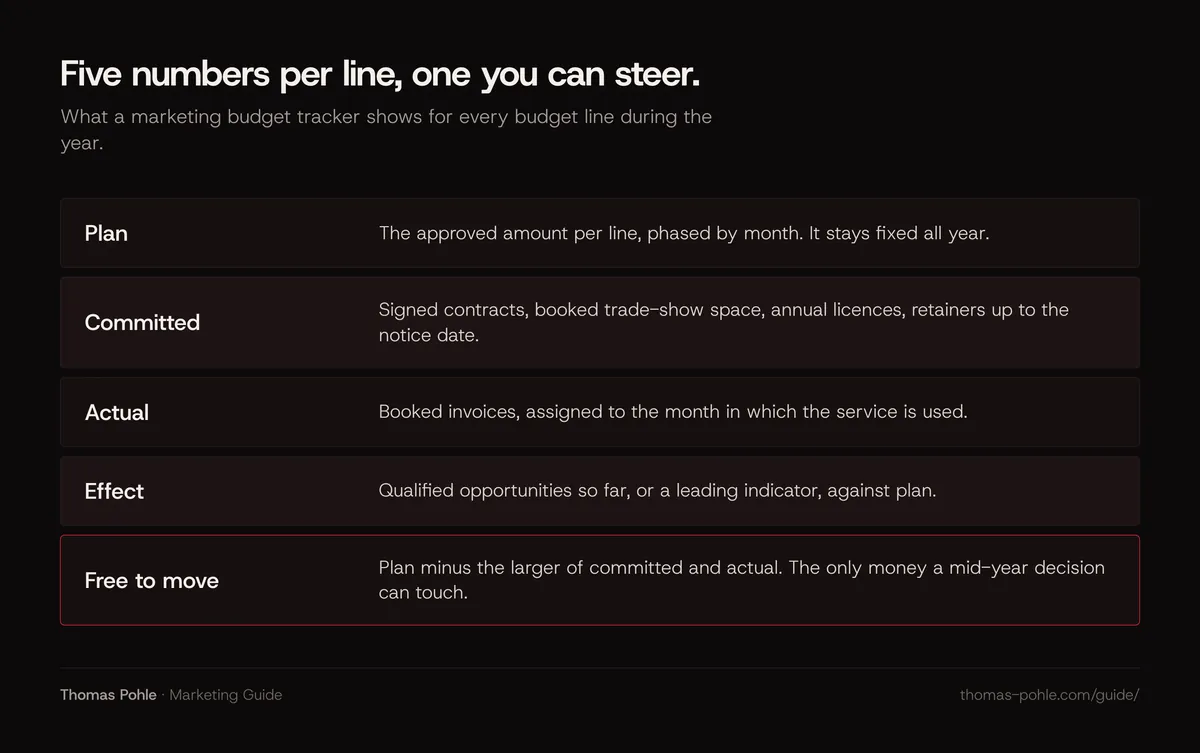
- Plan. The approved amount per line, phased by month. It stays fixed all year.
- Committed. Money you can no longer get back: signed contracts, booked trade-show space, annual licences, a retainer up to its notice date.
- Actual. Invoices booked, assigned to the month in which the service is used.
- Effect. What the line delivered so far: qualified opportunities, or a leading indicator where opportunities take longer.
- Free to move. Plan minus the larger of committed and actual. This is the only money a mid-year decision can touch.
Which columns does the tracker need?
The tracker needs one row per budget line and about eight columns: line and owner, plan, committed, actual, free to move, effect, cost per opportunity and the last decision with its date. Keep it in the same file as the budget plan, on its own tab, so plan numbers are never typed twice.
| Column | What goes in | Why it's there |
|---|---|---|
| Line and owner | One budget line, one named person | Someone answers for every variance |
| Plan | Approved amount, by month and year to date | The fixed reference point |
| Committed | Signed but not yet booked, plus notice periods | Shows what can no longer move |
| Actual | Booked invoices by month of use | Spend against plan |
| Free to move | Plan minus the larger of committed and actual | The room for decisions |
| Effect | Opportunities or a leading indicator, against plan | Whether the money works |
| Cost per opportunity | Actual divided by opportunities, year to date | Comparing lines |
| Decision and date | Keep, cap, shift, stop or give notice | A record of what you changed |
Fixed lines like salaries and tools get no opportunity target and an empty effect cell. The formulas from the budget template carry over; the tracker adds the committed and free-to-move columns.
Why is committed spend the number many trackers miss?
Committed spend is missing from many trackers because accounting only sees invoices, and many marketing costs are fixed months before the invoice arrives. A trade-show stand, an annual software licence or an agency contract binds the money at signing. If the tracker ignores that, the budget looks free on paper while most of it is already spoken for.
Trade shows show the problem most clearly. In the 2026 terms of participation for DMEXCO in Cologne, withdrawal after the exhibitor's admission is generally no longer possible, and the invoice for the stand is due immediately on receipt after admission. Only as an exception, if it can re-let the space, does the organizer release you, for a flat 25% of the participation price; otherwise the full price stays due. Other organizers set their own terms. Read yours before you book.
Agency retainers work the same way. The money up to the next possible notice date is committed, whatever the agency delivers. In my view, treat annual CRM, automation and data licences as committed for the full term from signing, unless the contract says otherwise.
My view, from running marketing in-house as Head of Marketing with a team of four plus agencies: the committed column changes the mid-year meeting. The useful question is rarely "how much is left?" It's "how much is left that we can still decide about?"
How do you track annual contracts, retainers and trade-show deposits?
Track each cost in two places: as committed from the day it's signed, and as actual in the months in which you use it. An annual licence paid in January then shows up as one twelfth per month. A trade-show stand paid in spring shows up in the month of the show. The actual column then follows the work, so effect can be compared with it.
Accounting follows a similar logic for the annual accounts. Germany's Commercial Code, § 252 (1) no. 5 HGB, requires expenses of a financial year to be recognized regardless of when they are paid. The Swiss Code of Obligations, Art. 958b OR, requires expenses and income to be separated by period and by nature. That's background, not legal or accounting advice: ask your finance team how they book marketing costs and match the tracker to that.
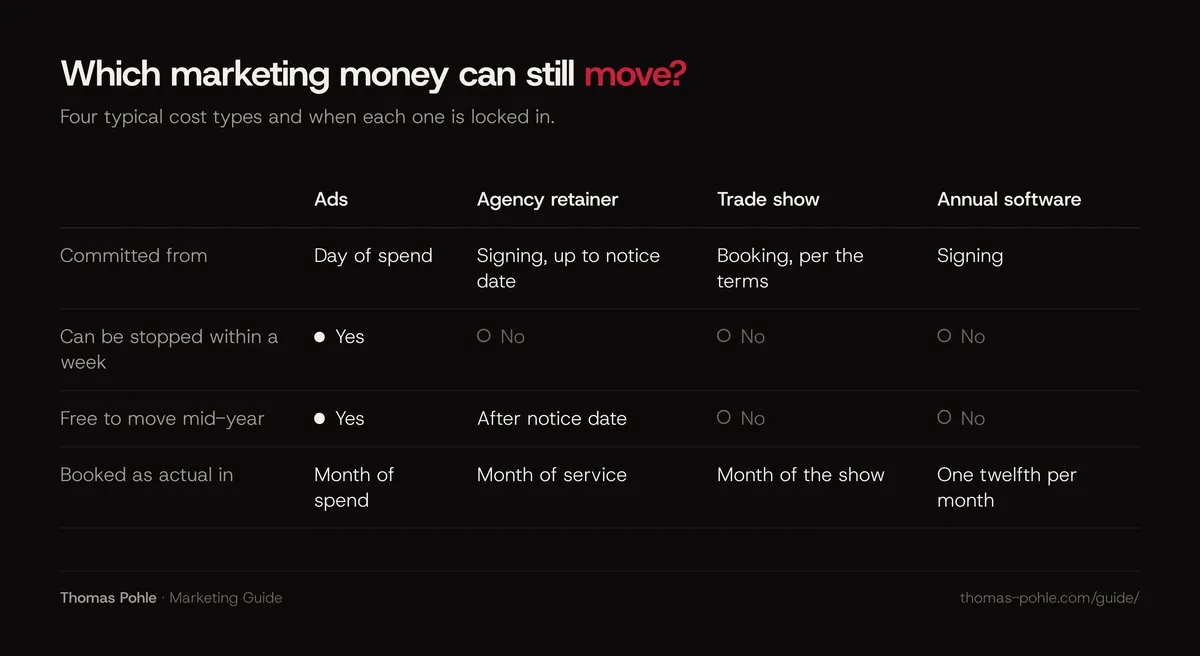
Ad platforms are the opposite case: committed only when spent, so the most flexible line, and the fastest-moving one. Google Ads may spend up to twice the average daily budget on a single day, and no more than 30.4 times the average daily budget in a month. LinkedIn's help pages say actual daily spend can be up to 100% higher than the daily budget on a given day. Check ad spend weekly and book it at the monthly close.
How do you run the monthly close in one hour?
The monthly close is a fixed one-hour slot in the first week of the month. Pull the booked invoices from finance, add new contracts to committed, spread annual costs to the months of use, update the effect per line from the CRM, recalculate free to move and write one sentence for every line that's more than 10% off plan.
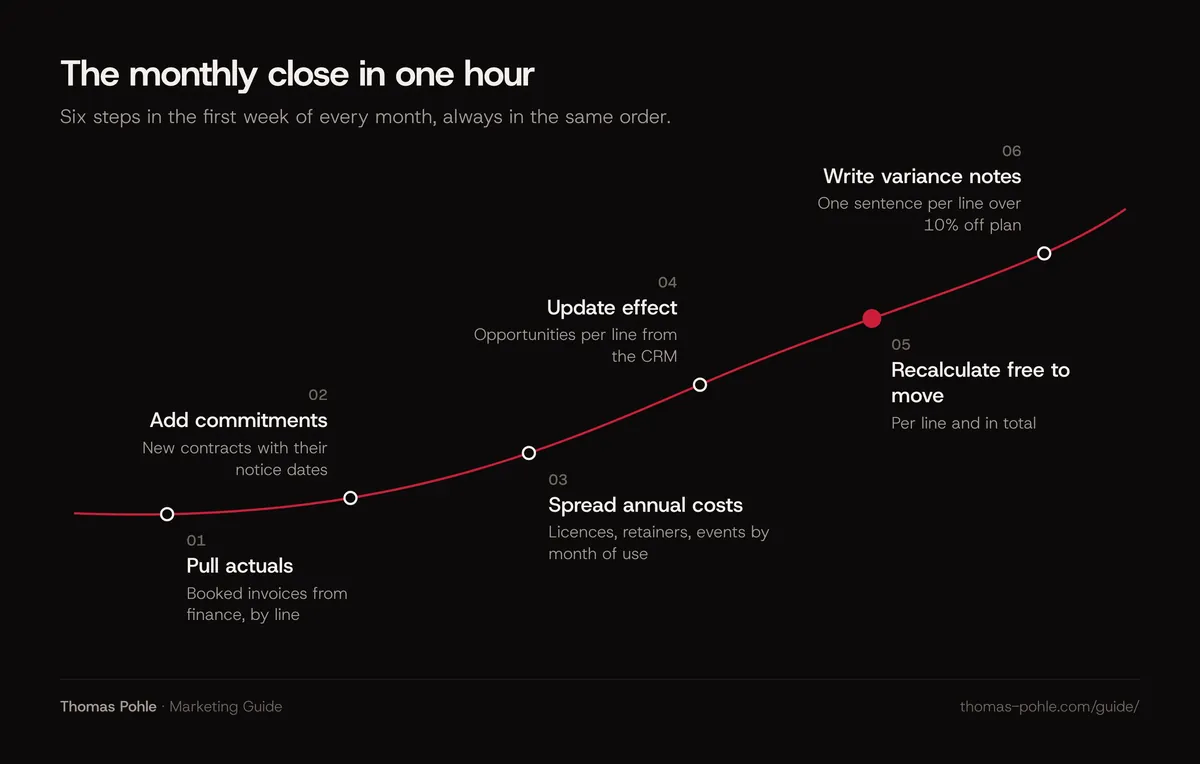
- Pull actuals. Booked invoices from finance, by line.
- Add commitments. Every contract, booking or order signed last month, with its notice date.
- Spread annual costs. Licences, retainers and events into the months they cover.
- Update effect. Opportunities per line from the CRM, with the same definition as in the plan.
- Recalculate free to move. Per line and in total.
- Write variance notes. One sentence for every line more than 10% off plan, as in the planning guide's monthly rule.
The hour only works with a settled opportunity definition. How to count opportunities per channel without heavy tracking is in the guide on measuring marketing success in B2B.
What does a filled-in tracker look like at mid-year?
Here is an example, with assumed numbers for a fictional Swiss B2B software company. It has a program budget of CHF 400,000 for the year, and the tracker shows the status after the June close. Salaries are left out. Of the CHF 400,000, only CHF 146,000 is still free to move, although CHF 263,000 hasn't been booked yet.
| Line | Plan · committed · actual (CHF) | Free to move | Effect so far |
|---|---|---|---|
| LinkedIn ads | 90,000 · 0 · 52,000 | 38,000 | 14 opp. vs 15 planned · 3,714 per opp. |
| Google Ads | 60,000 · 0 · 24,000 | 36,000 | 9 opp. vs 10 planned · 2,667 per opp. |
| Trade show (October) | 80,000 · 62,000 · 0 | 18,000 | Show not yet held |
| Content agency retainer | 72,000 · 72,000 · 36,000 | 0 | 4 opp. vs 6 planned · 9,000 per opp. |
| Webinars | 20,000 · 0 · 6,000 | 14,000 | 5 opp. vs 4 planned · 1,200 per opp. |
| Tools (annual licences) | 38,000 · 38,000 · 19,000 | 0 | No opportunity target |
| Reserve | 40,000 · 0 · 0 | 40,000 | Not released |
How the example reads. LinkedIn's planned cost per opportunity was CHF 3,000 (90,000 for 30). At 3,714 it runs 24% above plan, under the 30% threshold the planning guide uses, so it stays and gets watched. The agency retainer runs 50% above its planned 6,000 per opportunity, but none of its money is free. Its decision comes at the notice date. Webinars deliver below plan cost and are the natural place for released reserve money.
The trade-show line shows why committed matters. Plan against actual says CHF 80,000 unspent. In reality only 18,000 for stand construction and travel is still open.
When should you move money during the year?
Move money during the year only from lines with money free to move, and only when the effect data supports it. A line that runs well above its planned cost per opportunity for two months gets capped. Its free money goes to the line with the lowest cost per opportunity that can still absorb more. Committed money waits for its exit date.
My working rules, which are rules of thumb and not benchmarks:
- Cap. 30% above planned cost per opportunity for two months in a row, the threshold from the planning guide. Cap the line at its current monthly spend.
- Shift. Only free-to-move money. Never count on money from a line that is committed until its notice date.
- Retainers. Put every notice date in the tracker and in the calendar three months ahead. That's when the effect discussion with the agency happens.
- Trade shows. The decision point is the booking. Judge the show at its next booking date by the opportunities it created.
- Reserve. Released only by a named decision, with amount and reason in the decision column.
- Brand. Stays at plan unless the whole budget is cut. A quarter's data can't judge it.
Which channel should get the freed money is a question of the buying process. The guide on splitting the marketing budget across channels covers that.
How is the quarterly review different from the monthly close?
The monthly close updates numbers. The quarterly review makes decisions. Once a quarter, marketing lead, CEO and someone from finance look at effect and cost per opportunity per line, decide keep, cap, shift or stop, release or keep the reserve and check every notice date in the next six months.
Budget pressure makes this meeting more important. In Gartner's 2026 CMO Spend Survey of 401 marketing leaders in North America, the UK and Europe (published May 2026), 56% said their marketing organization lacks the budget to deliver its 2026 strategy. A team that shows in one table what is free, what is locked and what works is far better placed when the CFO asks for cuts.
I'm allergic to slide decks that nobody runs, and the same goes for trackers that nobody updates. A tracker that is filled once a quarter in a rush is a report. Updated every month, it's a steering tool.
What to do this week
You can set up the tracker in an afternoon. Start from this year's budget file and the last invoice export, messy or not. The first close will show gaps, mostly in committed spend and in effect per line. Better to find them now than in the next budget round.
- Add a tracker tab next to your budget plan with the eight columns from the table above.
- Collect every signed contract, licence and booking and enter it as committed.
- Write every notice date and trade-show booking deadline into the tracker and the calendar.
- Calculate free to move per line and in total. Compare it with what you thought was left.
- Agree with finance in which month each annual cost is booked.
- Book the monthly close as a one-hour slot in the first week of every month.
- Book the next quarterly review with the CEO and finance.
After two or three closes it's routine. The mid-year discussion then moves from who overspent to where the free money works best.
If you want to set up the tracker and the first quarterly review with someone who has run a budget in-house, a one-day Momentum Workshop is a good start.
Frequently asked questions
What is the difference between a marketing budget and a marketing budget tracker?
The budget is the plan you approve once a year: lines, amounts, phasing and the opportunities each line should deliver. The tracker is the working file for the year. It compares that plan every month with what is committed by contract, what has been booked and what effect each line had, so you can see where money can still move.
How often should you update a marketing budget tracker?
Update it once a month in a fixed one-hour close, and review it with leadership once a quarter. Check ad spend weekly in between, because ad platforms can spend more than the daily budget on single days.
Should a marketing budget tracker follow invoices or payments?
For steering, book costs in the months in which you use them and track signed contracts separately as committed. An annual licence then shows up as one twelfth per month. Your finance team may book differently for the annual accounts, so agree the logic with them once and note it in the file.
What is a good template for a marketing budget tracker?
A spreadsheet tab next to the budget plan with one row per line and eight columns: line and owner, plan, committed, actual, free to move, effect, cost per opportunity and the last decision with its date. A spreadsheet is enough for most B2B teams.
What should you do when an agency retainer underperforms mid-year?
Check the notice date first. Money up to that date is committed, so shifting it isn't possible. Use the time until the notice date to agree on what the agency has to deliver, measure it in the tracker and decide at the notice date with the numbers on the table. Don't add new budget to the line in the meantime.
Sources
- Gartner: 2026 CMO Spend Survey finds CMOs allocate 15.3% of marketing budgets to AI (press release, May 2026)
- Marketing Dive: AI remains a top priority for CMOs, but spending lags (May 11, 2026, on the Gartner 2026 CMO Spend Survey)
- Koelnmesse: DMEXCO 2026 Teilnahmebedingungen, Allgemeiner und Besonderer Teil
- Google Ads Help: About average daily budgets
- LinkedIn Marketing Solutions Help: Campaign and ad set budgets
- Handelsgesetzbuch (HGB) § 252 Allgemeine Bewertungsgrundsätze
- Swiss Code of Obligations (OR) Art. 958b, Fedlex

Thomas PohleB2B marketing advisor in Zurich. More than ten years in B2B marketing at Link11, Beekeeper and smino, most recently as Head of Marketing. CEO and co-founder of TEISENDA. Researched and drafted with AI tools, checked against the sources listed above. More about Thomas