Is half of the marketing budget really wasted?

No. The famous line about half the advertising money being wasted has no verified source, and in B2B the real problem is different. Some of your budget can be measured with attribution, some can be tested with holdout groups, some only shows in what buyers tell you, and a deliberate share stays unmeasured. Waste is the money nobody planned to judge.
This is for founders, CEOs and heads of marketing who hear the quote in budget meetings, usually right before someone cuts brand spend. You get the history of the line, what B2B tracking can and can't see today, and a way to give every budget line its own measurement method. How the role that owns this budget works is in the guide to the B2B head of marketing.
Who said half the marketing budget is wasted?
Nobody can prove who said it. The line is usually credited to the American retailer John Wanamaker, sometimes to the soap maker Lord Leverhulme. Quote Investigator, which traces quotes to their earliest printed source, found no direct record from either man. Wanamaker is the leading candidate, but only because others credited him, first in 1919.
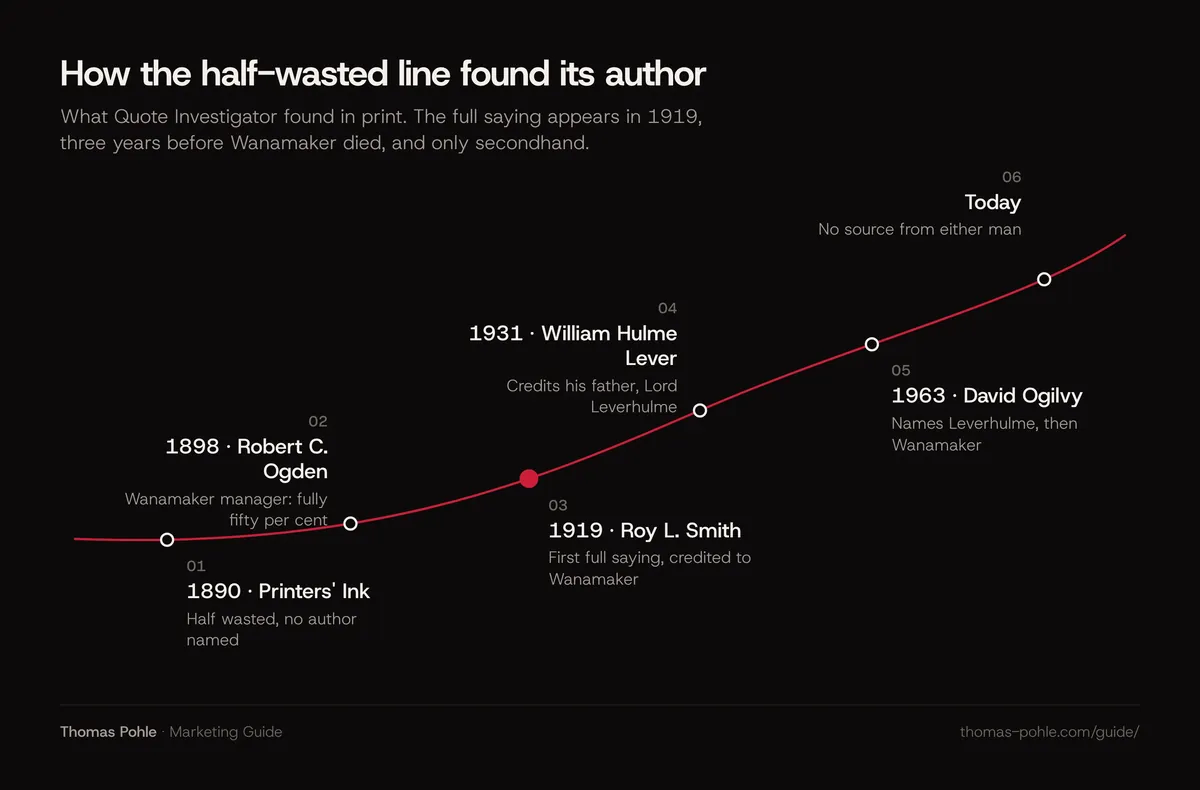
What Quote Investigator found in print:
- 1890: the trade journal Printers' Ink warns that roughly half of advertising money is wasted. No author, no "which half".
- 1898: The Bankers Magazine reports that Robert C. Ogden, head of Wanamaker's New York house, said fully fifty per cent of advertising money was wasted through poor placement.
- 1919: Reverend Roy L. Smith, at a Bible conference in Indiana, credits the full saying to Wanamaker, who died in 1922. It's the earliest full version with a name attached.
- 1931: William Hulme Lever credits his late father, Lord Leverhulme.
- 1963: David Ogilvy, in Confessions of an Advertising Man, names Leverhulme and, after him, Wanamaker.
My rule for hooks: provocative is fine if the body can defend it, false never is. "Wanamaker said" fails that test. "A saying credited to Wanamaker" is a fair way to open a budget discussion.
Is half of the marketing budget really wasted?
There's no evidence that exactly half of any marketing budget is wasted. The number is a figure of speech. Real waste can be measured in places, and it's sometimes large. But the quote mixes up two things: money that produces nothing, and money whose effect you simply can't trace to a single click.
A well-measured example of real waste is programmatic advertising. In December 2023 the US Association of National Advertisers (ANA) published a study based on log-level data from 21 major advertisers. It found that only 36 cents of every dollar that enters a demand-side platform effectively reaches the consumer, and put the efficiency gains available to advertisers at 22 billion dollars. These are large advertisers buying programmatic media through demand-side platforms, so the numbers don't transfer to B2B one to one. They show that waste can be found when someone looks.
In B2B, I see two kinds of waste more often. Spend that reaches people who will never buy, such as ads to the wrong job titles. And spend nobody planned to evaluate, renewed because it was in last year's budget. The second is a measurement problem, and that's what the rest of this guide is about.
What can you measure in B2B marketing today?
You can measure what happens in your own systems: clicks, form fills, booked meetings, opportunities and won deals with their recorded sources. You can't measure most of what happens before a buyer shows up: conversations inside the buying group, peer recommendations, private shares and memory built over years. B2B measurement is strong at the end of the journey and weak at the start.
| What you want to know | Measurable? | Why |
|---|---|---|
| Clicks and form fills from ads and search | Partly | Only for visitors who consent and keep their cookies |
| Meetings booked from outbound or events | Yes | Sales records them in the CRM if you insist on it |
| Source of a new opportunity | Partly | The CRM shows the last recorded touch, rarely the first real one |
| Role of each person in the buying group | No | Most of them never fill in a form or talk to sales |
| Peer tips, chat groups, forwarded emails | No | Private shares arrive without a referrer (dark social) |
| AI assistants that put you on a shortlist | Partly | You only see the visit when someone clicks through |
| Memory of your brand among future buyers | Not by tracking | Needs a survey, branded search trends and patience |
Which of these numbers belong in the leadership meeting is in the pillar on measuring B2B marketing success.
Why does tracking see less every year?
Tracking sees less because consent rules, browsers and ad platforms have all narrowed what can be recorded about a visitor. In Germany, analytics and ad cookies generally need consent, because they aren't strictly necessary for the service the visitor asked for. Safari blocks third-party cookies outright and deletes script-set cookies after seven days without interaction.
The main limits, with their primary sources (none of this is legal advice):
- Consent: in Germany, § 25 TDDDG allows storing or reading information on a user's device only with consent, unless it's strictly necessary for the service the user asked for. Visitors who decline don't show up in tracking-based reports.
- Safari: WebKit says Intelligent Tracking Prevention blocks all third-party cookies by default and deletes cookies created in JavaScript after seven days without user interaction, or caps them at 24 hours after a link with tracking parameters.
- Chrome: in October 2025 Google kept third-party cookies as a user choice and retired Privacy Sandbox technologies such as the Attribution Reporting API, Topics and Protected Audience.
- Modeling thresholds: Google Analytics 4 estimates visitors who declined consent only when a property has at least 1,000 events per day from them for seven days and at least 1,000 daily consenting users on 7 of the previous 28 days. Many B2B sites never get there.
My own site is the extreme case. It sets no cookies and counts visitors only if they agree. Tracking-based attribution doesn't exist for it, by choice. I don't miss it much, because the important questions in B2B were never answered by cookies.
Which part of the budget works without being measurable?
Brand building works without being measurable in the short term. It reaches the buyers who aren't in the market today and makes your name come to mind when a need appears. Its effect shows up months later, credited to other channels. That money isn't wasted. It's invisible to tools that count clicks.
Two primary sources make the case. The LinkedIn B2B Institute's 95-5 rule says about 95 % of potential buyers are out of the market today and will be in it sometime in the future. It recommends linking your brand to buying situations, called category entry points, before buyers start looking. And in their 2019 report for the B2B Institute, based on B2B cases in the IPA Databank, Les Binet and Peter Field found that efficiency appears highest with around 46 % of the budget on brand building and 54 % on activation, a rough estimate from a small sample. They also found that 10 points of extra share of voice went with about 0.7 percentage points of market share growth per year, a result they call tentative.
Treat these numbers as direction, not as a formula. But if you cut everything you can't attribute, you cut what fills next year's pipeline. How to score brand measures against pipeline measures is in the guide to which B2B marketing measures are worth it.
How do you split the budget by how you measure it?
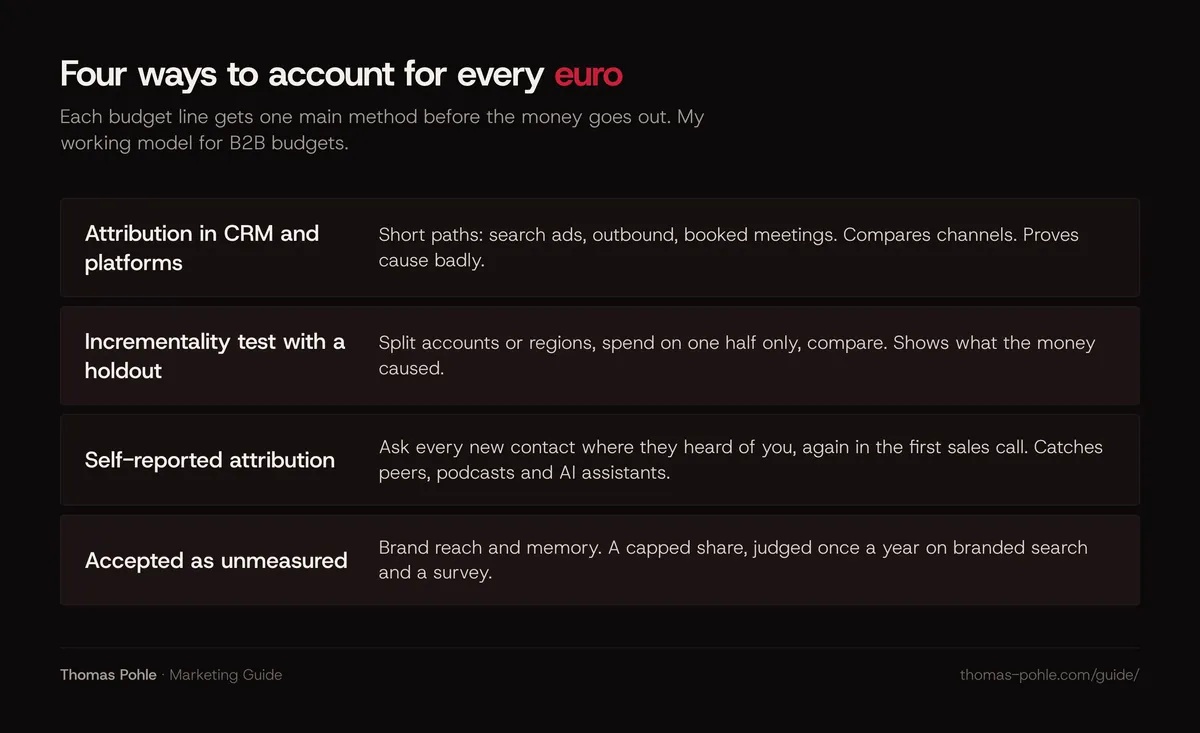
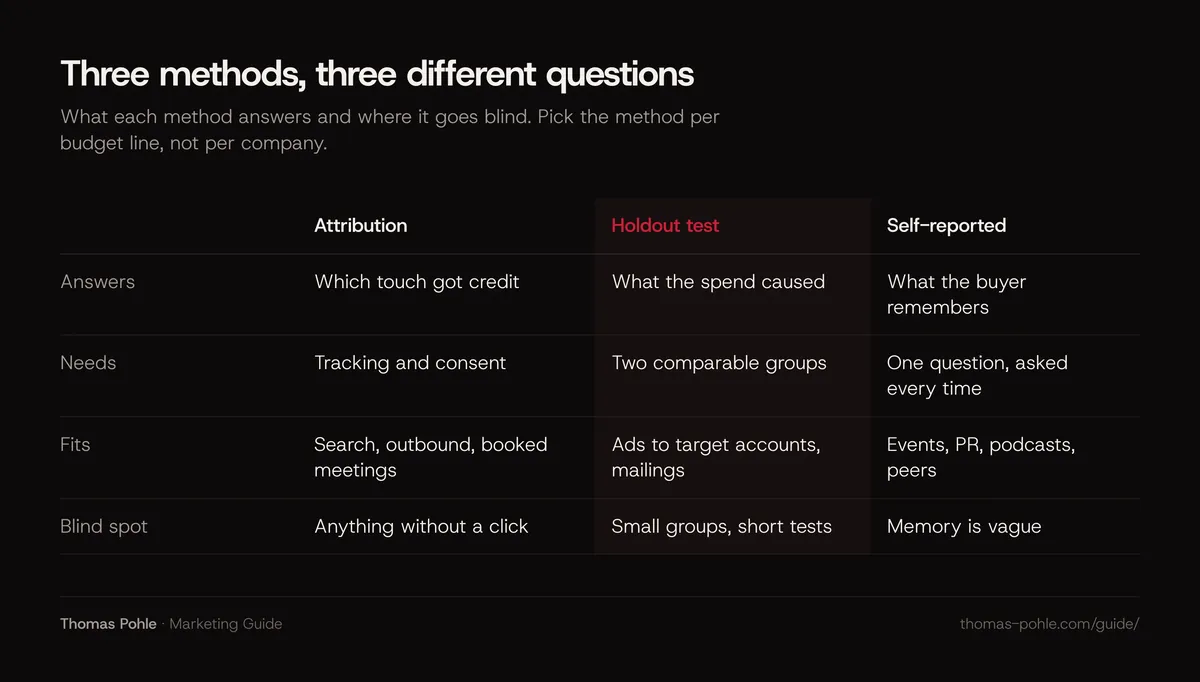
Give every budget line one main measurement method before the money goes out: attribution for short, trackable paths, an incrementality test with a holdout for spend that targets a defined group, self-reported attribution for channels that work through memory and conversation, and a capped share you accept as unmeasured. Then waste becomes visible line by line.
Attribution
Use it where the path from spend to contact is short: search ads, outbound, booked meetings at a fair. It compares channels well and proves cause badly, because it credits whatever touch it recorded.
Incrementality tests with a holdout
An incrementality test compares a group that gets the spend with a group that doesn't. Google's Conversion Lift does this with users or regions as groups, but it isn't available for every account and runs through an account representative. Google's open-source marketing mix model Meridian asks for at least two years of weekly regional data, or three years of national data. Both are out of reach for many mid-sized B2B companies.
The B2B version is simpler. Split your target accounts at random into two groups with a similar mix. Run the LinkedIn ads or the mailing to one group for two quarters, then compare meetings and opportunities per 100 accounts. With 20 to 30 accounts per side, a normal pilot size, read the result as a direction. My rule of thumb: for anything you'd call proof, you need a few hundred accounts per group.
Self-reported attribution
Ask every new contact "How did you hear about us?" as an open text field, and ask again in the first sales call. Sort the answers into a few buckets monthly. Where they disagree with the CRM source, you see what tracking misses: a colleague's tip, a podcast, an AI assistant. Memory is imperfect, so use it for trends, not exact credit.
Accepted as unmeasured
Some spend, mostly brand reach, gets no per-campaign measurement on purpose. Decide the share in advance and judge it yearly on branded search, inbound from untouched accounts and a short survey of your target group. Unmeasured by accident is waste.
What does the split look like in a worked example?
Here is an example for a fictional B2B software company with a marketing budget of EUR 400,000 a year and a sales cycle of about nine months. All numbers are invented for illustration.
| Budget line | Amount (EUR) | Main method | What counts as success |
|---|---|---|---|
| Search ads | 60,000 | Attribution | Qualified opportunities per euro, by quarter |
| Outbound and direct mail | 40,000 | Attribution | Meetings with target accounts |
| LinkedIn ads to target accounts | 70,000 | Holdout test | More opportunities per 100 accounts than the holdout half |
| Trade show with pre-booked meetings | 90,000 | Attribution plus self-reported | Booked meetings, then deals that name the fair |
| Content and SEO | 50,000 | Self-reported plus Search Console | Answers that name an article, rising impressions |
| PR and founder posts | 30,000 | Self-reported | Contacts who name an article, post or interview |
| Brand reach, sponsoring, podcast | 30,000 | Accepted as unmeasured | Branded search and survey, once a year |
| Tools and measurement | 30,000 | Not a channel | The other lines can be judged |
In this example EUR 100,000, a quarter of the budget, runs on attribution. EUR 70,000 is tested against a holdout. EUR 170,000 is judged by records plus buyer answers. EUR 30,000, 7.5 %, is unmeasured by decision. That's far from half. The company still can't say which euro worked, but it knows which line is under review and when it gets cut.
Plan the split with the channel mix in how to split the marketing budget across channels and keep the method on each line in the marketing budget tracker.
What to do this week
- Stop quoting Wanamaker as fact: say "a saying credited to him".
- List your budget lines: next to each, write the one method that will judge it: attribution, holdout, self-reported or unmeasured.
- Find the orphans: a line without a method is your real waste risk.
- Add the open question: "How did you hear about us?" as a free text field on every form and in the first sales call.
- Plan one holdout: pick the paid channel aimed at target accounts and split the list at random for the next two quarters.
- Cap the unmeasured share: agree a number with leadership and the yearly signals that review it.
The best answer to the quote is a list of budget lines, each with its method. If you want a second pair of eyes on that list, a one-day Momentum Workshop is a good place to sort it out with your team.
Frequently asked questions
Did John Wanamaker really say half his advertising was wasted?
There's no direct record. Quote Investigator found the full saying first in a 1919 speech by Reverend Roy L. Smith, who credited it to Wanamaker. Texts from 1890 and 1898 mention half the money being wasted, without the famous second half. Wanamaker is the leading candidate, but the credit is secondhand.
Was it Wanamaker or Lord Leverhulme?
The Leverhulme version is later. According to Quote Investigator, William Hulme Lever credited his father in 1931, six years after Lord Leverhulme died, and in 1963 David Ogilvy named Leverhulme before Wanamaker. The Wanamaker credit appears earlier, in 1919. Quote Investigator found no direct record of the line from either man.
How much of a B2B marketing budget can be measured?
There's no reliable benchmark, and anyone quoting one should name the study. In my view the useful question is which method judges each budget line. In the fictional example in this article, a quarter of the budget runs on attribution and under a tenth stays unmeasured by decision. Your split depends on your channels and sales cycle.
What is an incrementality test in B2B marketing?
It compares a group that receives a marketing measure with a comparable group that doesn't, so the difference shows what the spend caused. In B2B the simplest form is an account holdout: split your target accounts at random, run the campaign to one half for two quarters, and compare meetings and opportunities per 100 accounts.
Should I cut brand spend because it can't be attributed?
No. Brand spend works on buyers who aren't in the market yet, so attribution rarely credits it. The LinkedIn B2B Institute's 95-5 rule and Binet and Field's B2B work both argue for steady brand investment. Cap the unmeasured share, review it yearly on branded search and a survey, and cut it only if those signals stay flat.
Sources
- Quote Investigator: One-Half the Money I Spend for Advertising Is Wasted, But I Have Never Been Able To Decide Which Half (April 2022)
- ANA: Programmatic Media Supply Chain Transparency Study (December 2023)
- Gesetze im Internet: § 25 TDDDG, Schutz der Privatsphäre bei Endeinrichtungen
- WebKit: Tracking Prevention in WebKit
- Google Privacy Sandbox: Update on plans for Privacy Sandbox technologies (October 2025)
- Google Analytics Help: [GA4] Behavioral modeling for consent mode
- Google Ads Help: About Conversion Lift
- Google for Developers: Meridian, collect and organize your data
- Les Binet and Peter Field for LinkedIn B2B Institute: The 5 Principles of Growth in B2B Marketing (2019, PDF)
- LinkedIn B2B Institute: The 95-5 rule

Thomas PohleB2B marketing advisor in Zurich. More than ten years in B2B marketing at Link11, Beekeeper and smino, most recently as Head of Marketing. CEO and co-founder of TEISENDA. Researched and drafted with AI tools, checked against the sources listed above. More about Thomas