How do you improve texts with AI without losing your own voice?

Write the draft yourself, then use AI as your editor. Run five separate passes: structure, cut, sharpen, facts and voice. Give each pass one narrow prompt, ask for suggestions instead of a rewrite, and keep facts, numbers, opinions and quotes in your own hands. AI can flag claims to check. It can't verify them.
This guide is for founders and marketing leads who write their own articles, posts and proposals and want them tighter. The big picture sits in the pillar on using AI in marketing without losing quality. Writing copy with AI from a brief is covered in AI marketing copy that doesn't sound like AI. This one starts later: your text exists, and AI gets the red pencil.
Why should AI edit your text instead of writing it?
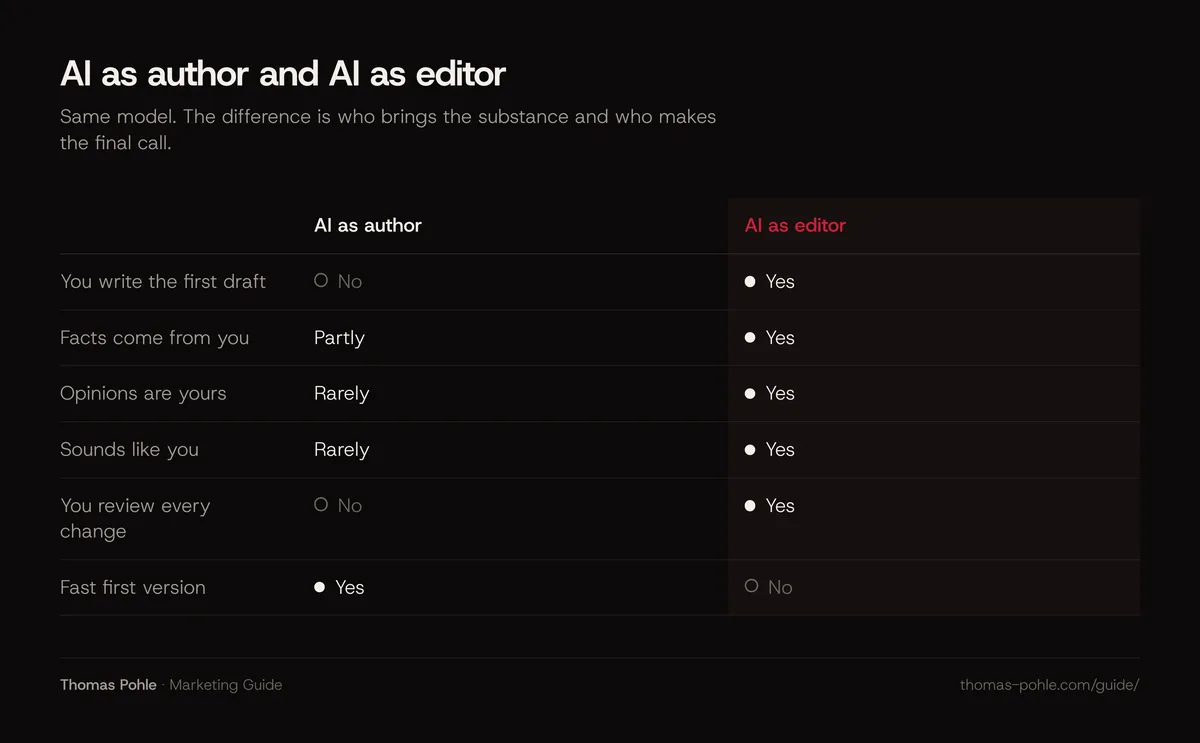
AI should edit because the substance of a good text comes from you: what you saw, what you decided, what you think. A model has none of that. As an editor it works on what you wrote and makes it clearer. As an author it fills the gaps with the most likely sentences, and those sound like everyone else.
My rule: write it yourself, or at least give your own input. Real reactions from readers come from real experience, and a model can't supply that. Google's helpful-content guidance asks the same: does the content provide original information and demonstrate first-hand expertise?
Second, AI help doesn't stay neutral.
- It shifts opinions. Maurice Jakesch and colleagues (CHI 2023) had 1,506 people write with an assistant configured to argue one side. The model affected the opinions in their texts, and their own attitudes in a later survey moved toward the model's stance.
- It flattens style. Dhruv Agarwal, Mor Naaman and Aditya Vashistha (CHI 2025) studied 118 participants from India and the US. With AI suggestions, the Indian participants moved toward Western writing styles, in content and in form.
Both studies tested suggestions while writing, which goes further than editing a finished draft. My view: the risk is smaller when you edit, but it's there. So every prompt below asks for suggestions, and you decide.
What can you hand to AI, and what stays yours?
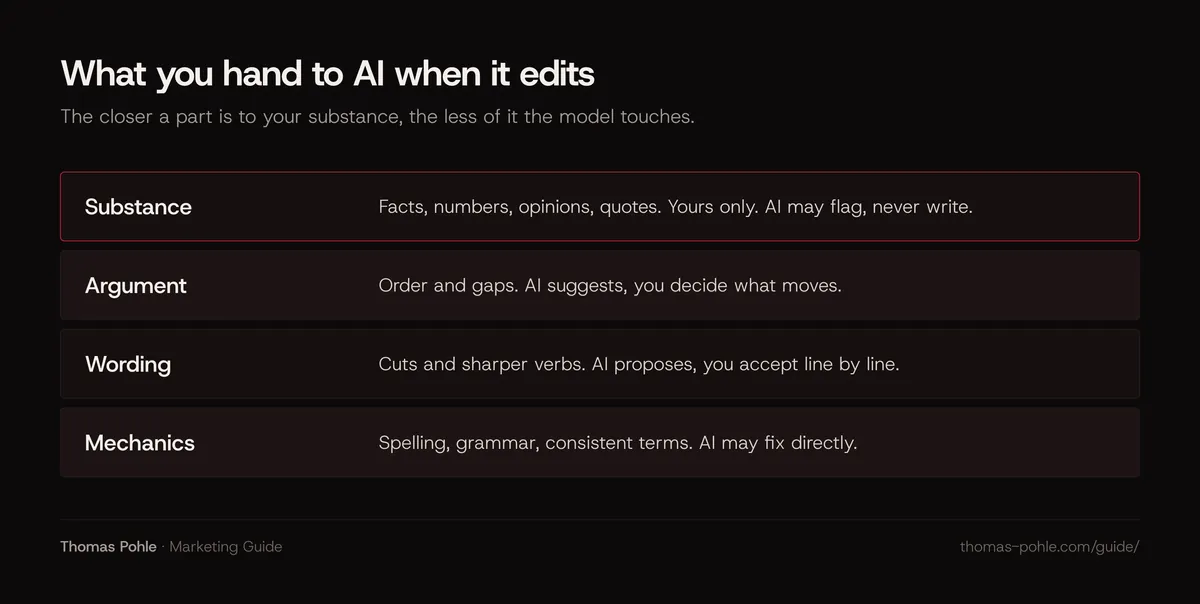
Hand AI the work on form: order, length, wording, spelling and consistency. Keep the substance: facts, numbers, examples, opinions, verdicts and quotes. The test: if a change could make a sentence untrue or change your view, the model may point at it, never write it.
| Task | Hand to AI? | Why |
|---|---|---|
| Find gaps in the structure | Yes, as suggestions | A fresh reader sees order problems you don't |
| Cut repetition and filler | Yes, as suggestions | You decide what a cut costs |
| Sharper verbs, shorter sentences | Yes, as suggestions | Wording is form, as long as meaning stays |
| Spelling, grammar, terms | Yes, directly | Low risk, easy to check |
| List claims to check | Yes | A list helps, the check is yours |
| Verify facts and numbers | No | Models guess when unsure |
| Add examples or numbers | No | They would be invented |
| Opinions and verdicts | No | AI help can shift opinions |
| Quotes | No | A quote is what someone said, word for word |
| Headline and first sentence | Partly | Ask for options, write the final yourself |
How do you write an editing prompt that keeps your text?
An editing prompt names the model's role, forbids a rewrite, protects your facts and opinions, and asks for a list of suggestions with reasons. One pass, one task. A model asked to "improve this text" changes everything at once, and you can no longer see which change helped and which one hurt.
Anthropic's guide on hallucinations recommends giving the model explicit permission to say it doesn't know; that's built in. Paste this base prompt once, then swap the task line per pass:
You are my editor. I wrote the text below.
Do not rewrite it. Suggest changes only.
Keep my words, my opinions and my facts.
Never add facts, numbers, examples or quotes.
List: original, suggestion, reason.
If unsure or nothing needs changing,
say so.

Task for this pass: [ONE TASK]

[PASTE YOUR TEXT]
The list format matters. A finished new version sounds fine, so you accept changes you never decided on. A list makes you decide line by line. Before you paste anything, check that your tool runs under a data processing agreement; the guide on AI tools for B2B marketing teams covers that check.
How does the five-pass editing workflow run?
Run the passes in a fixed order, from big to small: structure, cut, sharpen, facts, voice. Structure first, because moving a section wastes earlier word edits. Facts once the wording is settled. Voice last, because every earlier pass can pull the text away from you.
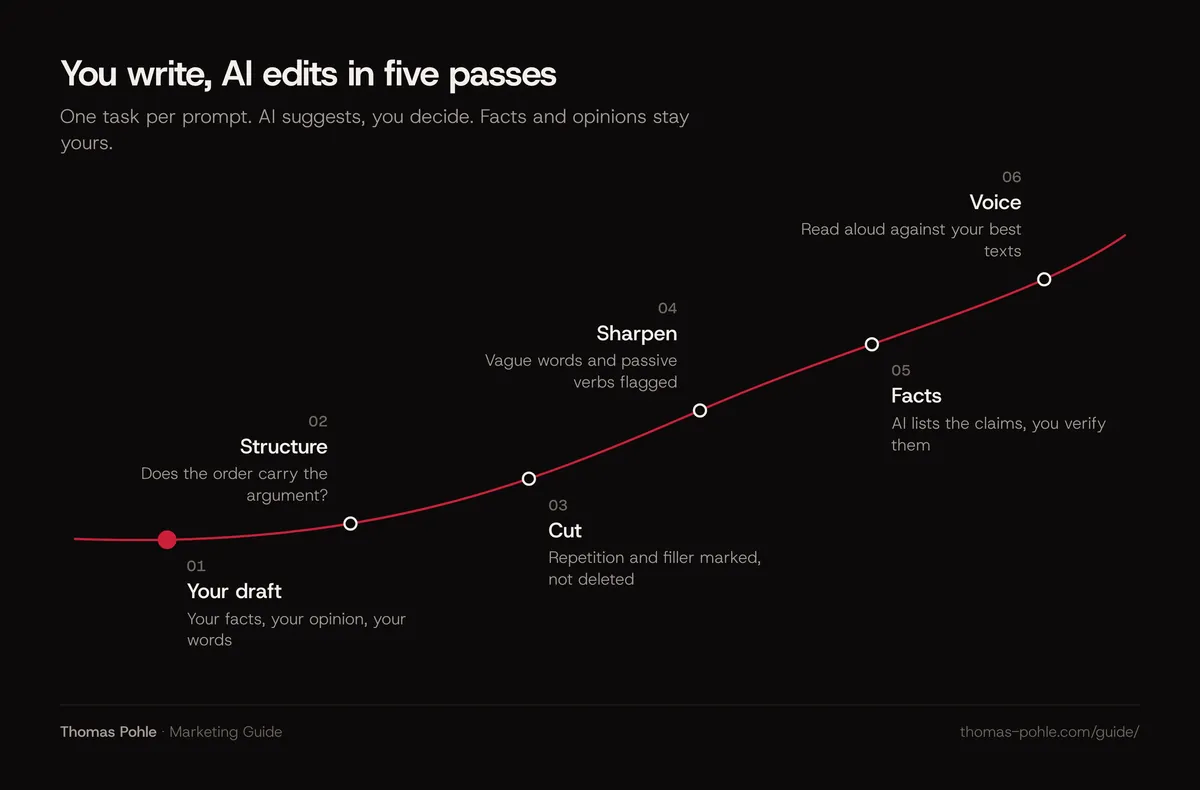
Pass 1: structure
The structure pass checks whether your sections carry one clear claim. I think not every idea deserves to be published, and a weak section should be called weak. Hence the last line:
Task: check the structure only.
1. Summarize my main claim in one sentence.
   If you can't, say so.
2. List each section with its job in the
   argument in five words or fewer.
3. Name sections that repeat each other,
   come in the wrong order, or don't
   support the claim.
4. Name the weakest section and why.
   Be blunt.
Pass 2: cut
The cut pass marks what can go. It deletes nothing, because only you know whether a sentence sets up a later point.
Task: find what can go.
Mark sentences that repeat an earlier
point, throat-clearing openers, filler
words and phrases that say nothing.
Quote each and say what is lost if it
goes. Target: 20 % shorter.
The 20 % target is my rule of thumb for first drafts. If the model finds less, your draft was already tight.
Pass 3: sharpen
The sharpen pass offers one sharper version per weak spot, using only words and facts already in your text.
Task: sharpen the wording.
Flag vague words, passive sentences,
long nouns where a verb would do, and
sentences over 25 words.
Offer one sharper version per flag,
using only words and facts already
in my text. Max 10 flags, worst first.
Pass 4: facts
The fact pass turns the model into your checklist. It doesn't judge whether a claim is true. That part is yours.
Task: list every factual claim.
Quote each number, date, name, study,
quote and statement about how something
works. Say what source would prove
each. Don't judge whether it's true.
Pass 5: voice
The voice pass compares the edit with three texts that sound like you and catches what earlier passes smoothed away.
Task: compare the voice.
Below: three texts of mine, then the
edit. List sentences in the edit that
don't sound like the examples, and why.
Flag any opinion that got softer.

[EXAMPLE 1] [EXAMPLE 2] [EXAMPLE 3]
[EDITED TEXT]
Can AI check the facts in your text?
No. AI can find the claims in your text and tell you which ones need a source. It can't confirm that a number, date or quote is correct, because a language model may produce a plausible answer instead of admitting it doesn't know. Use it to build the checklist, then check each item against the original source yourself.
The reason is documented. Adam Tauman Kalai and colleagues argue in "Why Language Models Hallucinate" (September 2025) that training and evaluation reward guessing over acknowledging uncertainty. Anthropic's guide on reducing hallucinations says its techniques reduce them without eliminating them.
Google is just as clear for anything you publish. Its guidance on generative AI content, checked in November 2026, says it's critical to manually fact-check and review all AI-generated content before publishing, metadata included: title, meta description, structured data and alt text. My routine after the fact pass:
- Open the source. Every number gets checked against the original study or page, never against a summary.
- Read quotes word for word. If you can't find the exact wording, it isn't a quote.
- Cut what you can't prove. Or turn it into an opinion and mark it as yours.
What does an AI edit look like before and after?
An edit done this way changes length and wording and leaves the substance alone. Constructed example: a made-up machine builder and a paragraph I wrote to show a typical first draft. None of it is a real client text.
The first draft, 58 words:
In the last few years we have seen more and more of our customers in mechanical engineering struggling with the topic of spare parts logistics, which is why we decided at the beginning of this year to take a closer look at how the process actually works in practice and what could potentially be done to improve it.
What the passes flagged:
- Cut. "In the last few years" and "at the beginning of this year" compete as time markers; "actually", "in practice" and "potentially" add nothing.
- Sharpen. "Take a closer look at" hides the verb.
- Facts. "More and more of our customers" is a claim. What number proves it?
- Rejected. One suggestion opened with "Spare parts logistics is a crucial challenge for modern manufacturers". Generic, and not what the author saw. It goes.
The edit, 30 words, written by the author from the suggestions:
Our machine-building customers lose days waiting for spare parts. So in January we watched the process at three of them, from the error message to the part in the van.
"Three of them" and "lose days" came from the author, never from the model, and both get checked against the author's records first.
How do you keep your own voice when AI edits?
Keep your voice by deciding every change yourself, by comparing the edit with texts that sound like you, and by protecting the sentences that make you sound human. An editor optimizing for polish tends to remove exactly those: the admission, the hard verdict, the odd turn of phrase. Put them back.
My view: saying "I got this wrong" builds trust when it comes from someone who otherwise sounds competent. Authority comes from experience, never from self-praise. My rules:
- Accept less than you reject. My rule of thumb: if you accept almost every suggestion, read the edit aloud before it goes out. Either the draft was weak or the model is writing for you.
- Edit by hand at the end. The last read is yours, out loud, without a model in the loop.
If a draft sounds generic after five passes, the substance is missing, and no prompt adds it. The guide on what AI should do in content marketing shows how to get your own material into a text.
Do you have to disclose that AI edited your text?
Two sources decide this. Google recommends explaining how AI was used where readers would reasonably expect it. The EU AI Act requires disclosure for AI-generated or manipulated text published to inform the public on matters of public interest, unless it went through human review or editorial control and someone holds editorial responsibility.
- Google. Its helpful-content guidance asks whether the use of automation, including AI generation, is self-evident to visitors, and suggests adding background where it would be reasonably expected. Its spam policies target content made primarily to manipulate rankings and pages mass-generated without value for users, not AI help as such, as the guide on AI-assisted SEO explains.
- EU AI Act, Article 50(4). Deployers who use AI to generate or manipulate text published to inform the public on matters of public interest must disclose that. The duty doesn't apply where the content has undergone human review or editorial control and a person or company holds editorial responsibility. It has applied since 2 August 2026 (Article 113); the 2026 amendment, Regulation (EU) 2026/1744, left this paragraph unchanged.
A workflow where you write, decide every change and check every fact is human review by design. Whether that covers your text is a question for a lawyer. This isn't legal advice.
What to do this week
- Pick one text you wrote yourself and haven't published yet.
- Save the base prompt above as a template in the AI tool your company has approved.
- Run the structure pass. If the model can't state your claim in one sentence, rewrite the claim before anything else.
- Run the cut and sharpen passes and accept changes line by line, never as a full new version.
- Run the fact pass and open the source for every number, date and quote on the list.
- Build a voice file with three of your own texts and run the voice pass.
Models will get better at editing. The split won't change: the model works on form, you own the substance. If you want to set up this workflow and a voice file with your team, that's a good topic for a one-day Momentum Workshop.
Frequently asked questions
Which AI tool is best for editing text?
The prompt matters more than the tool. Most general-purpose AI assistants will return a list of suggestions when you ask for one and forbid a rewrite. Pick the tool your company has approved under a data processing agreement and save the base prompt as a template.
Is a text still mine if AI edited it?
In my view, yes, as long as the claim, the facts, the examples and the opinions came from you and you decided every change. If the model wrote whole paragraphs that you kept, it co-wrote the text.
Can AI fact-check my article?
It can list every claim and say what kind of source would prove it. It can't confirm that a claim is true, because language models may guess when they're unsure. Open the original source for every number, date and quote yourself.
Should I let AI rewrite whole paragraphs?
Only as a sketch you then rewrite yourself. A full rewrite hides which change did what, and it is where your facts drift and your opinions soften. If a paragraph is so weak that you want it replaced, the structure pass has found a gap in your substance. Fill it with your own material, then edit again.
Sources
- Google Search Central: Guidance on using generative AI content on your website
- Google Search Central: Creating helpful, reliable, people-first content
- Regulation (EU) 2024/1689 (Artificial Intelligence Act), Articles 50 and 113, EUR-Lex
- Regulation (EU) 2026/1744 amending the Artificial Intelligence Act (Digital Omnibus on AI), EUR-Lex
- Jakesch, Bhat, Buschek, Zalmanson, Naaman (2023): Co-Writing with Opinionated Language Models Affects Users' Views, CHI 2023
- Agarwal, Naaman, Vashistha (2025): AI Suggestions Homogenize Writing Toward Western Styles and Diminish Cultural Nuances, CHI 2025
- Kalai, Nachum, Vempala, Zhang (September 2025): Why Language Models Hallucinate
- Anthropic: Reduce hallucinations (Claude documentation)
Thomas PohleB2B marketing advisor in Zurich. More than ten years in B2B marketing at Link11, Beekeeper and smino, most recently as Head of Marketing. CEO and co-founder of TEISENDA. Researched and drafted with AI tools, checked against the sources listed above. More about Thomas