Which SEO tasks can AI take over, and which can it not?

AI-assisted SEO works when AI runs the data work and drafts what you publish, while a person approves every change and owns the facts. Keyword clustering, audits, reports, metadata and schema drafts are safe to hand over. Topic choice, experience, numbers and sign-off stay human. Generating many pages mainly to rank violates Google's scaled content abuse policy.
This guide is for founders and marketing leads who get offered SEO agents that promise to run the whole channel. You get a decision table for twelve tasks, an agent workflow, a worked example and a checklist with thresholds. The strategy behind it, from crawler access to measurement, is in the pillar guide on how SEO changes when AI answers the search.
Which SEO tasks can AI safely take over?
AI can safely take over SEO work where a mistake is cheap and visible before anyone outside sees it: data pulls, crawl and log analysis, keyword clustering, report summaries and first drafts of metadata, schema and internal links. The line is publication. Whatever reaches your site or a buyer needs a person who checked it and signs for it.
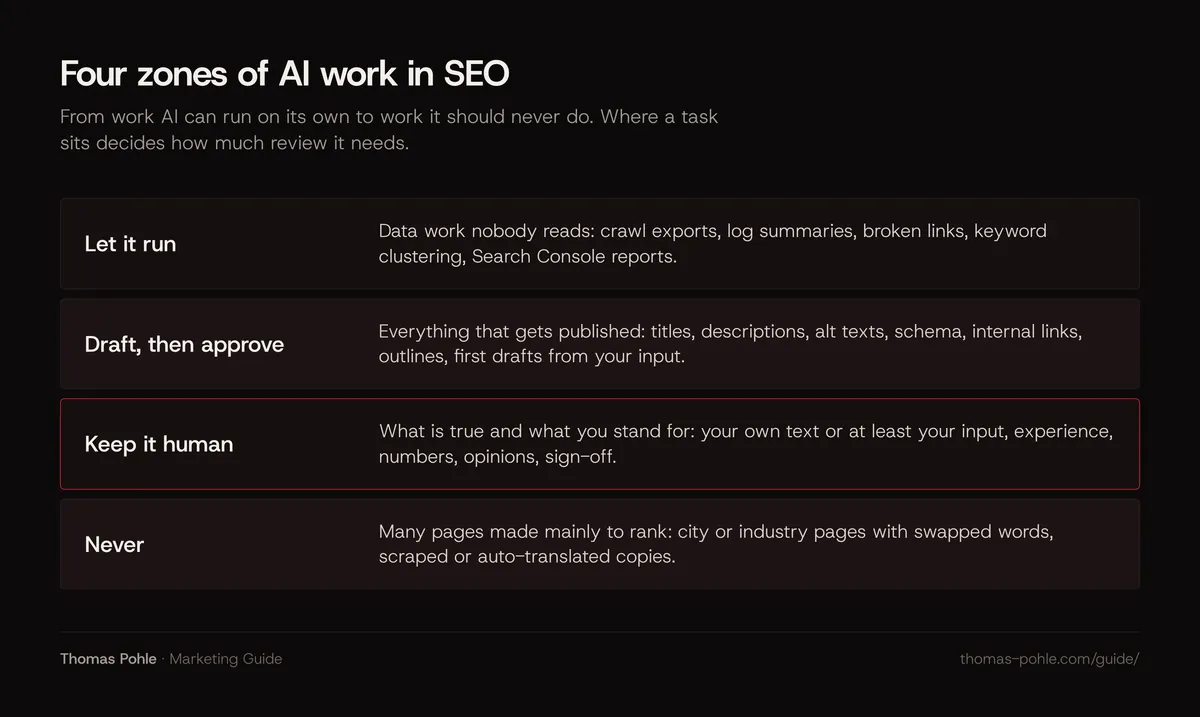
I sort every task into one of four zones. The zone decides how much review it needs.
- Let it run. Work nobody outside reads: crawls, logs, keyword clusters, reports.
- Draft, then approve. Everything that gets published, from titles and schema to first drafts built from your input.
- Keep it human. Your own text or at least your input, your experience, your numbers, topics that matter for sales, the final yes.
- Never. Many pages made mainly to rank.
Every process I touch starts with one question: can AI do this faster, or do it for us? In SEO the answer is yes for most of the hours. It's no for the few decisions that make a page worth ranking.
My view on the text itself: writing it yourself is still the best approach, and your own input is the minimum. In the end what counts is whether visitors engage: read on, reply, call. That comes far more reliably from real, personal experience than from a clean draft. Google's helpful content page asks the same: does the content show first-hand expertise, for example from using a product or visiting a place?
What does Google say about AI-generated content in 2026?
Google does not penalize content because AI wrote it. It penalizes content made mainly to manipulate rankings, however it was made. Its guidance on generative AI content says AI is useful for research and structure, and that you must fact-check all output before publishing, including metadata and structured data.
In February 2023 Google wrote that "appropriate use of AI or automation is not against our guidelines."
- March 2024. Google introduced the scaled content abuse policy. It applies, in Google's words, "no matter whether content is produced through automation, human efforts, or some combination of human and automated processes."
- May 15, 2026. Google clarified in its documentation changelog that its spam policies also apply to generative AI responses in Google Search. Its new guide on optimizing for generative AI features says that creating separate content for every query variation, primarily to manipulate rankings or AI responses, violates the scaled content abuse policy.
- October 1, 2026. Google updated its generative AI guidance with pointers to its quality rater guidelines on scaled content abuse and on content made with little effort, originality or added value.
The rater guidelines (version of September 11, 2025) are blunt. Pages made up of content created at scale with no original content or added value "should be rated Lowest, no matter how they are created." Google adds that rater scores don't directly change rankings. Raters help Google evaluate its ranking systems.
Where does scaled content abuse start?
Scaled content abuse starts when many pages exist mainly to catch searches and add little a reader can't find elsewhere. Google's spam policy names the patterns: generating many pages with AI without adding value, scraping or automatically translating content, stitching pages together and making many pages that contain keywords but make little sense.
Volume alone isn't the trigger. The test is whether each page carries something of its own. In B2B, four patterns come up again and again:
- City and region pages. "Our service in Basel", "in Bern", "in Lucerne" with the same text. Google's doorway abuse examples include pages "targeted at specific regions or cities that funnel users to one page."
- Industry pages from one template. The same product paragraph with the industry name swapped in.
- AI glossaries. Hundreds of definitions any assistant could give. In my reading, that's Google's commodity content: common knowledge.
- Machine translations. A German site pushed into French and Italian without an editor.
Google's spam policy says violating sites "may rank lower in results or not appear in results at all." A manual action for thin content means fixing all affected pages before you request a review.
Which SEO tasks can you hand to AI tools and agents?
Hand AI the tasks where the output can be checked against data or a clear rule, and keep a person on anything that states facts or makes promises. The table sorts twelve common SEO tasks by what AI or an agent does, where a person has to step in and what goes wrong without that step.
| SEO task | What AI or an agent does | Where a person steps in | Risk if unchecked |
|---|---|---|---|
| Search Console and analytics reports | Pulls data, explains changes | Reads the summary | Low |
| Keyword research and clustering | Groups queries, maps them to pages | Picks the clusters sales cares about | Low |
| Technical audit | Crawls, flags errors, drafts fixes | Approves every redirect, noindex or canonical change | Medium |
| Internal links | Finds orphan pages, suggests anchors | Approves the links | Low |
| Alt texts | Describes images | Spot-checks | Low |
| Titles and meta descriptions | Drafts variants | Checks every claim | Medium |
| Structured data | Drafts JSON-LD | Validates, matches it to visible content | Medium |
| Refreshing an existing page | Flags outdated facts, proposes edits | An expert checks every fact | High |
| New articles | Outline and first draft from your notes | Best: you write it. At least: your notes and experience, and you sign | High |
| Translation | Draft translation | A native editor rewrites | High |
| Link building outreach | Researches targets, drafts emails | A person sends, no paid links | High |
| Pages at scale (city, industry) | Generates from a template | Only with unique data per page | Very high |
Metadata and structured data look harmless, yet Google's generative AI guidance names both as output you must review.
How should an SEO agent work on your site?
An SEO agent should read freely and write only through a person. Give it read access to Search Console, your crawler and logs. Let it propose each change as a diff in a ticket or on staging. A person approves, the change ships in a small batch, and the agent measures the result before it scales the same fix.
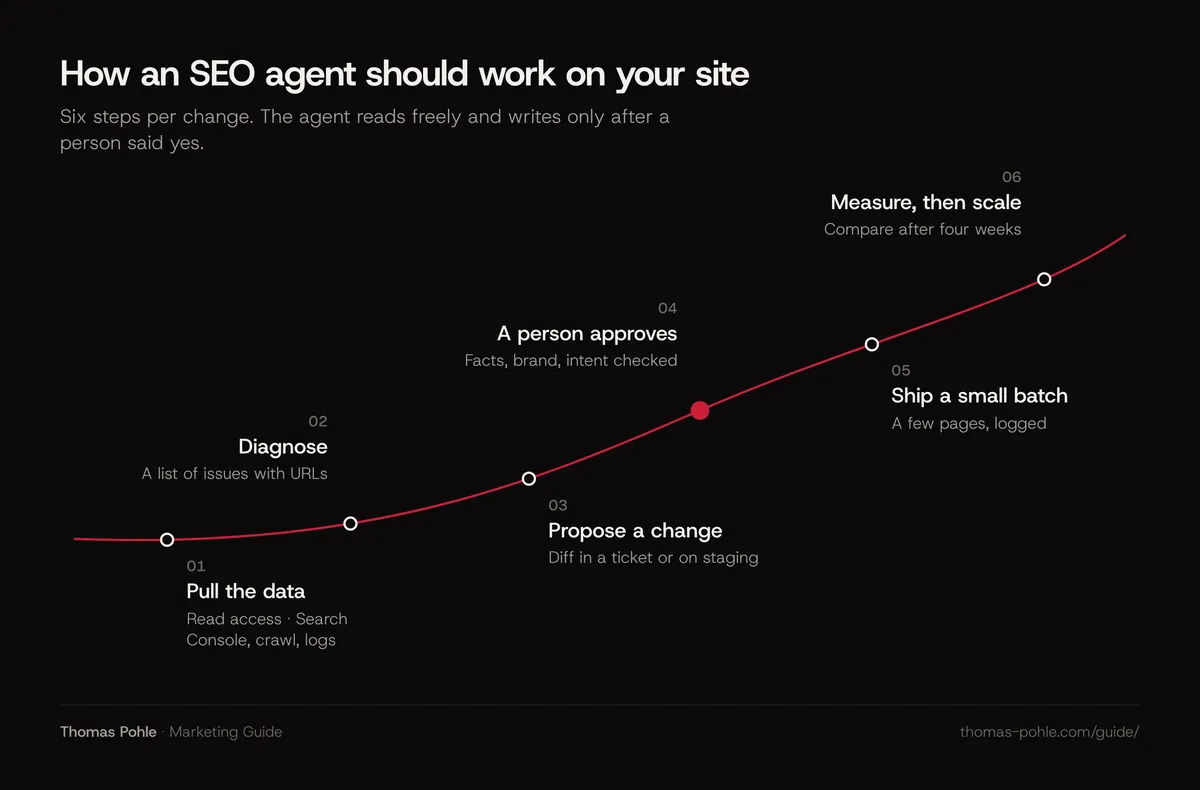
- Separate read and write. Read access to data is safe. Write access to the live CMS isn't.
- One change type per batch. Fix titles in one batch, redirects in the next. If rankings move, you know why.
- Log everything. URL, before and after, date, approver.
- Measure before you scale. Compare changed and unchanged pages over about four weeks of Search Console data, my rule of thumb.
The technical SEO checklist for B2B websites is a good baseline to give an agent as its rulebook.
Why does automated content hurt a B2B brand more than a publisher?
A B2B company often sells to a few hundred potential buyers who compare a handful of suppliers and read your pages closely before they talk to sales. One page with a wrong number or a generic claim costs trust with exactly the people you need. A publisher can absorb a weak page. A B2B brand with forty pages can't.
- Sales uses the pages. A buyer who spots an invented statistic doubts the product claims next to it.
- Commodity content doesn't win. Google's 2026 guide on generative AI features asks for content with expert or experienced takes that go beyond common knowledge. In my view, an AI draft without your input stays close to common knowledge.
My take, from designing my own logo with several AI image models: they were great for exploring directions quickly and weak at the precise final step. SEO content works the same way. The last sentence, the one only you can write, decides whether a page earns a citation. The guide on showing expertise to Google and AI covers how to make that visible.
What does the math look like for pages at scale?
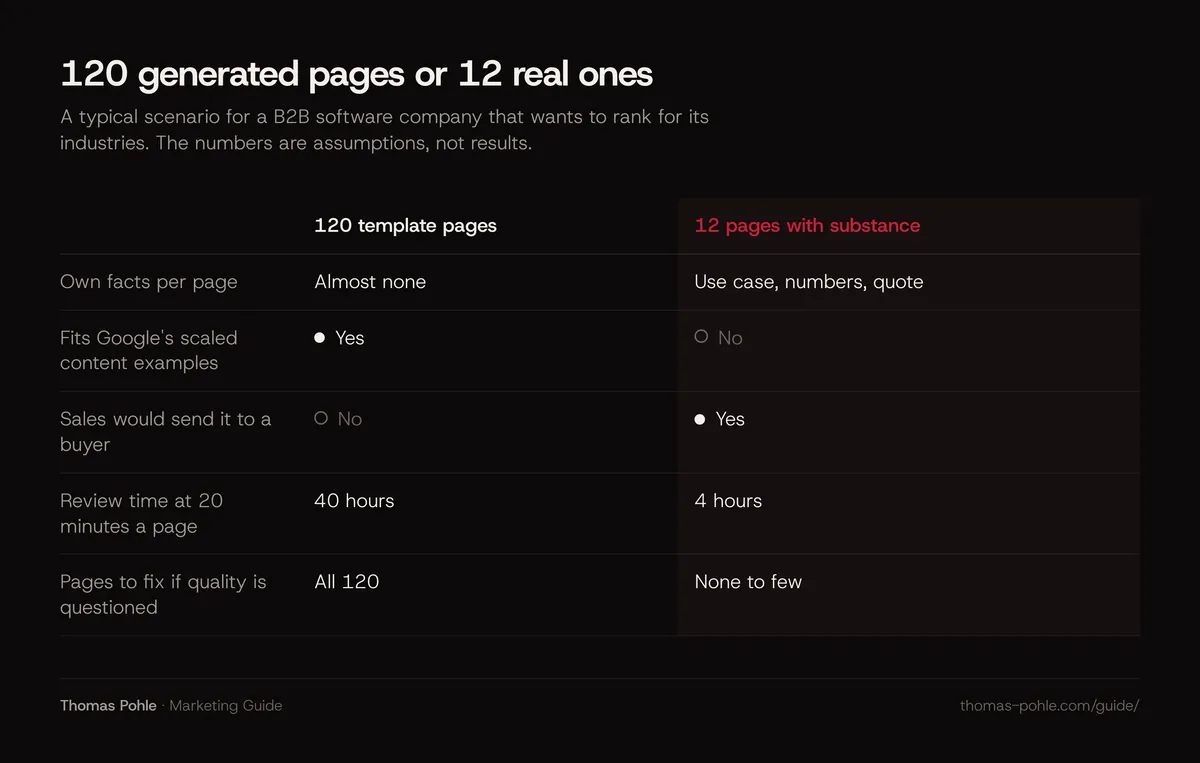
Pages at scale look cheap until you count review time and risk. A typical scenario: a B2B software company serves 12 industries in 10 cities and is offered 120 generated landing pages. Twelve industry pages with real substance would rank for fewer terms on paper, cost far less review and carry little policy risk.
The numbers are assumptions, not project results.
- Option A, 120 template pages. Generation is nearly free. A real review at 20 minutes per page takes 40 hours. Most pages differ only in the city and industry name, which matches Google's doorway and scaled content examples. If quality is ever questioned, all 120 need rework.
- Option B, 12 industry pages. Each needs about one day: a short interview with a customer or your team from that industry, one use case, one number you can source, a quote. AI drafts from the interview notes. Review at 20 minutes per page takes 4 hours.
How do you check AI-assisted SEO work before it ships?
Check AI-assisted SEO work against thresholds you set before the work starts, so nobody argues taste afterwards. Every published page needs your own text or input, at least one fact of its own, every number a source, every batch a size a person can actually read. These are my rules of thumb. Google publishes no such numbers.
| Check | Threshold | If it fails |
|---|---|---|
| Your own input | Every page starts from your own text, notes or an interview; AI edits and structures | Don't publish yet, write it or record your input first |
| Own substance per page | At least one fact, example or quote that exists nowhere else | Don't publish, merge into a stronger page |
| Numbers | 100 % with a named source in the brief | Cut the number |
| Template overlap | Two pages from one template share at most about half their text | Merge or rewrite |
| Batch size | No more pages per week than one person can read in full | Slow down |
| First batch of a new page type | At most 10 pages, then four weeks of data | Wait before the next batch |
| Agent permissions | Write access to staging only | Revoke production access |
Google's helpful content page also asks whether visitors can see how automated content was made. It's a suggestion, and in B2B I think disclosure builds more trust than it costs. If you work with an outside partner, put these thresholds in the contract; the guide on choosing an AI SEO agency lists the questions to ask first.
What to do this week
You can sort your SEO work into the four zones in an afternoon and stop the riskiest automation before it ships. Start with what's already running, then set rules for anything new.
- List your AI tasks. Write down every SEO task where AI or an agent is involved today, including anything an agency does for you.
- Sort them into zones. Let it run, draft then approve, keep it human, never. Use the table above.
- Check permissions. Which tool can publish or change your site without a person? Move it to staging or proposals.
- Audit your template pages. Open five city, industry or glossary pages side by side. If they read the same, plan a merge.
- Name the approver. One person signs off facts and claims before anything goes live.
- Write the thresholds down. Share them with everyone who produces content.
- Start a change log. URL, change, date, approver.
AI will take over more SEO hours every year, and agents will get better at proposing the right fix. The part that stays with you is small and it decides everything: what is true, what you stand for and what you sign. If you want help drawing that line for your team, a one-day Momentum Workshop is where I'd start.
Frequently asked questions
Does Google penalize AI-generated content?
No, not for being AI-generated. Google has said since February 2023 that appropriate use of AI or automation is not against its guidelines. It acts against content made primarily to manipulate rankings, whoever wrote it. Its 2026 guidance repeats that AI content must meet Search Essentials and the spam policies.
What is scaled content abuse?
Scaled content abuse is Google's spam policy against generating many pages mainly to manipulate rankings instead of helping users. Named examples include mass-produced AI pages without added value, scraped or automatically translated content and keyword pages that make little sense. Since May 2026 Google states that its spam policies also cover attempts to manipulate its generative AI responses.
Can an AI agent run my SEO on its own?
It can run most of the hours: data pulls, audits, clustering, reports and drafts. It shouldn't publish on its own. Give it read access to data and write access to staging only, and let a person approve every change to the live site. Ship in small batches and measure each one before the agent scales the fix.
Are city or industry landing pages always spam?
No. A page is fine when it carries something of its own: a real office, a customer from that industry, a use case, a number or an event. It becomes a problem when the same text repeats with only the name swapped. Google's doorway abuse examples include pages targeted at specific regions or cities that funnel users to one page.
Should I label AI-assisted content on my website?
Google doesn't require it. Its helpful content guidance asks whether the use of automation is clear to visitors where it substantially generated the content, and suggests explaining how and why. For B2B I'd add a short note on how articles are made and who checked them.
Sources
- Google Search Central: Spam policies for Google web search
- Google Search Central: Google Search's guidance on using generative AI content on your website
- Google Search Central: Optimizing your website for generative AI features on Google Search (May 2026)
- Google Search Central: Latest Google Search documentation updates (2026 changelog)
- Google Search Quality Evaluator Guidelines (September 11, 2025), sections 4.6.5 and 4.6.6
- Google Search Central Blog: Google Search's guidance about AI-generated content (February 2023)
- Google Search Central Blog: New ways we're tackling spammy, low-quality content on Search (March 2024)
- Google Search Central: Creating helpful, reliable, people-first content
- Search Console Help: Manual actions report

Thomas PohleB2B marketing advisor in Zurich. More than ten years in B2B marketing at Link11, Beekeeper and smino, most recently as Head of Marketing. CEO and co-founder of TEISENDA. Researched and drafted with AI tools, checked against the sources listed above. More about Thomas