Which marketing workflows should you automate with AI?

Automate with AI the marketing workflows that run often, are cheap to get wrong and stay away from the buyer: lead enrichment, routing, CRM hygiene and tagging. Let AI draft and a person approve wherever the output reaches a customer: newsletters, ad variants, repurposed content, replies to inbound requests. Keep manual what carries a judgment call or your name.
This guide is for B2B founders and marketing leads who want AI to take work off the team without costing trust. The bigger picture of AI and quality is in the pillar on using AI in marketing without losing quality, and the rule-based basics are in the guide on marketing automation. This one gives you a scoring model, ten workflows scored with it, and a rollout plan.
What changes when you add AI to marketing automation?
Classic marketing automation follows rules you wrote: if a form is filled, send email two. AI adds a step that reads, classifies or writes, so the workflow handles messy input without a rule for every case. The catch: AI output varies, and it can be wrong in ways no rule predicted.
Marketing leaders expect a lot more of it. A Gartner survey of 402 CMOs (August to October 2025, published May 2026) found they expect AI-driven automation of marketing work to more than double, from 16 % in 2026 to 36 % by 2028. HubSpot's State of Marketing (updated April 2026, 1,500+ marketers, vendor-funded) has 35.6 % using AI extensively for administrative task automation.
The same Gartner release advises CMOs to clarify where AI supports judgment and where humans remain accountable. That's the job of the scoring model below.
How do you score a marketing workflow before you automate it?
Score every workflow on three criteria from 1 to 3: how often it runs, how much a mistake costs, and how close the output gets to the buyer. Frequency counts for automation, risk and customer proximity count against it. The total decides whether AI runs the workflow alone, drafts for a person, or stays out.
| Criterion | 1 | 2 | 3 |
|---|---|---|---|
| Frequency | Monthly or rarer | Weekly | Daily or with every lead |
| Error risk | Internal, easy to spot and fix | Wrong data spreads to other systems or reports | Wrong promise, price or claim, legal or reputational damage |
| Customer proximity | Stays internal | Customer sees it as coming from the company | Customer reads it as a message from a named person |
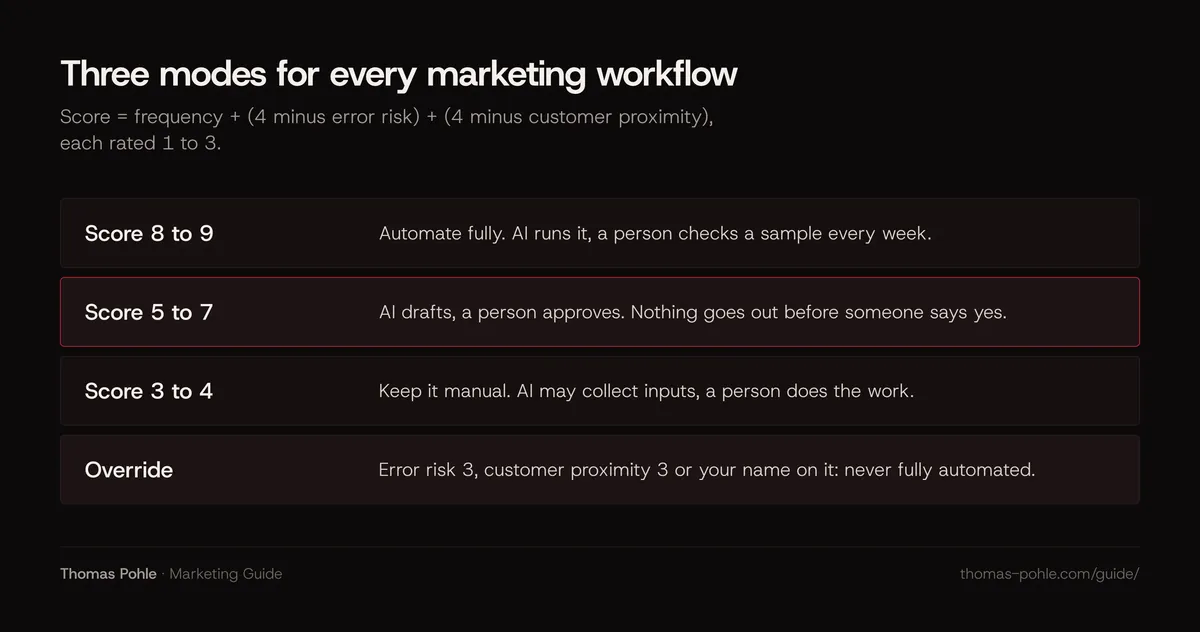
The formula: score = frequency + (4 minus error risk) + (4 minus customer proximity). The result runs from 3 to 9. My thresholds:
- 8 to 9: automate fully. AI runs the workflow. A person checks a sample every week.
- 5 to 7: AI drafts, a person approves. Nothing goes out or into the system of record before someone says yes.
- 3 to 4: keep it manual. AI may collect inputs. A person does the work.
- Two overrides. Error risk 3 or customer proximity 3 never runs fully automated, whatever the total. And anything that goes out under your name starts with your own words: you write it, or you give the model your notes, your example or your opinion first.
The override matters most. Real interaction comes from real experience, and a model can't know what you heard in last week's customer call.
How do common marketing workflows score?
Run the model on the usual B2B workflows and a pattern shows. Data work behind the scenes scores 8 or 9 and can run on its own. Anything a buyer reads lands between 5 and 7, so AI drafts and a person approves. Complaints and key-account messages score 3 and stay manual.
| Workflow | Frequency, risk, proximity | Score | Mode |
|---|---|---|---|
| Tagging inbound requests and content | 3, 1, 1 | 9 | Automate fully |
| Lead enrichment | 3, 2, 1 | 8 | Automate fully |
| Lead routing | 3, 2, 1 | 8 | Automate fully |
| CRM hygiene | 3, 2, 1 | 8 | Automate fully |
| Weekly reporting | 2, 2, 1 | 7 | AI drafts, person approves |
| Content repurposing | 2, 2, 2 | 6 | AI drafts, person approves |
| Ad variants | 2, 2, 2 | 6 | AI drafts, person approves |
| Monthly newsletter | 1, 2, 2 | 5 | AI drafts, person approves |
| Replies to inbound requests | 3, 3, 3 | 5 | AI drafts, person approves |
| Complaints and key-account messages | 1, 3, 3 | 3 | Keep manual |
Your scores will differ. Five inbound requests a month means frequency 1, not 3. In a regulated industry ad variants may carry error risk 3. Score with the workflow's owner and write the reason next to every number.
Which marketing workflows can AI run on its own?
AI can run the internal data workflows on its own: tagging, enrichment, routing and CRM hygiene. They run with every lead, mistakes stay inside your systems, and a weekly sample catches drift. Each needs a written rule, an owner and a log of what the AI changed, so a person can undo it.
- Tagging. AI assigns topic, product and intent to each request or article. Fix the tag list first, or the model invents new tags.
- Lead enrichment. AI fills company size, industry and role from public data. Store where each value came from. A wrong industry spreads into routing, which is why risk scores 2.
- Lead routing. AI classifies the lead, a rule you can read decides who gets it.
- CRM hygiene. Merge duplicates, normalize job titles, flag bounces. Apply merges automatically only above a match threshold you set, and log every one.
Which tools do this is in the AI tools a B2B marketing team really needs.
Where should AI draft and a person approve?
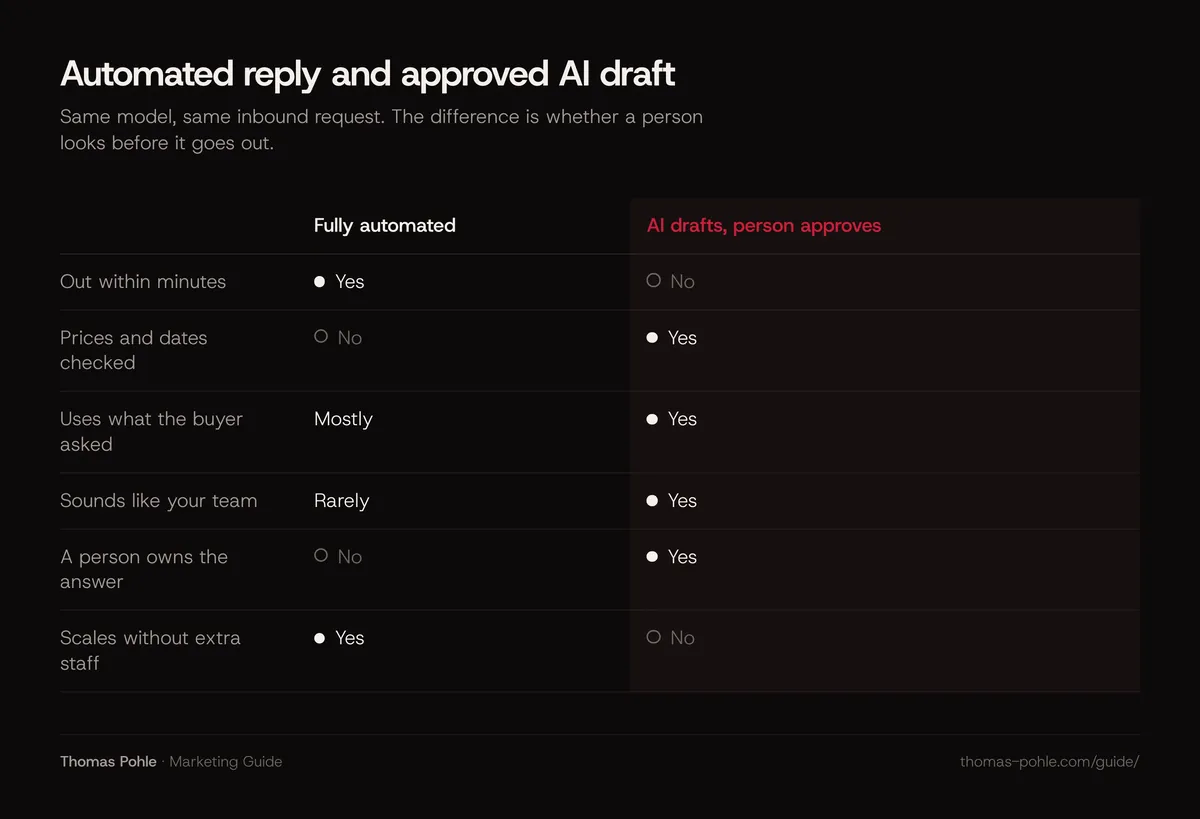
Everything a buyer sees but that comes from the company sits in the middle: newsletters, ad variants, repurposed content, weekly reports and replies to inbound requests. AI saves the most time here and does the most damage when nobody looks. A person approves every piece.
- Content repurposing. Turn a webinar or a customer call into an article, three posts and a newsletter section. Start from your own material. Google's guidance on generative AI content warns that generating many pages without adding value for users may violate its spam policy.
- Ad variants. AI writes ten headlines, a person picks three. The product owner approves the claims once, and AI only recombines approved ones.
- Newsletter. AI assembles and shortens. The opening and the opinion come from you.
- Weekly reporting. AI pulls the numbers and drafts the commentary. The person who owns the numbers checks every figure, because a model will happily invent a reason for a drop.
- Replies to inbound requests. AI drafts from the request, your FAQ and your price list. A person sends it, within a response target in hours.
How to make AI drafts sound like you is in the guide on writing marketing copy with AI that doesn't sound like AI.
Where does marketing automation cost trust in B2B?
Automation costs trust where a buyer expects a person and gets a machine, or gets a confident answer that turns out wrong. B2B buyers check what AI tells them with people. One wrong price in an automated reply or one fake personal email from the founder costs more than the hours it saved.
The numbers point the same way. A Gartner survey of 645 B2B buyers (August to September 2025, published May 2026) found that 69 % prefer to validate AI-generated insights with sales reps. 51 % say they're more likely to encounter misleading information from GenAI, 49 % from a sales rep. Salesforce's State of Marketing (February 2026, 4,450 marketers) reports that 81 % of marketers would trust AI to respond to customers. Salesforce sells AI for marketing. Side by side: marketers trust AI to answer, buyers check its answers with people.
The trust traps I'd avoid:
- Fake personal messages. An automated email signed by a founder who never saw it.
- A chatbot that passes as a person. Say it's an AI and offer a way to reach a human.
- Sequences that don't stop. A contact who replied or complained still gets email four.
- Unapproved claims. An ad variant that promises what nobody signed off.
The sales version of these traps is in where AI helps B2B sales teams sell more.
What do the EU AI Act and GDPR say about automated marketing?
The EU AI Act's transparency rules in Article 50 apply from 2 August 2026. For marketing they mean: people must be told when they chat with an AI, deepfake images, audio and video must be disclosed, and generative tools must mark their output. GDPR Article 22 only matters when a purely automated decision significantly affects a person. This isn't legal advice.
- Chatbots, Article 50(1). Providers must design AI systems that interact directly with people so they're informed it's an AI, unless that's obvious. Check your tool does this, and label it anyway.
- Marking, Article 50(2). Providers of generative systems must mark output in a machine-readable way. That duty sits with the tool vendor. The Digital Omnibus on AI, Regulation (EU) 2026/1744, in force since 27 July 2026, gives systems already on the market before 2 August 2026 until 2 December 2026 for this.
- Deepfakes and public-interest text, Article 50(4). Disclose AI images, audio or video that look like real people or events. AI text published to inform the public on matters of public interest must be disclosed too, unless it went through human review or editorial control and someone holds editorial responsibility.
- Automated decisions, GDPR Article 22. People have the right not to be subject to a decision based solely on automated processing that produces legal effects or similarly significantly affects them. In my reading, routing a lead isn't such a decision. Automatically rejecting someone from an offer based on a score comes closer. Ask your data protection advisor first.
Consent rules for email don't change because AI writes it.
How do you roll out AI automation one workflow at a time?
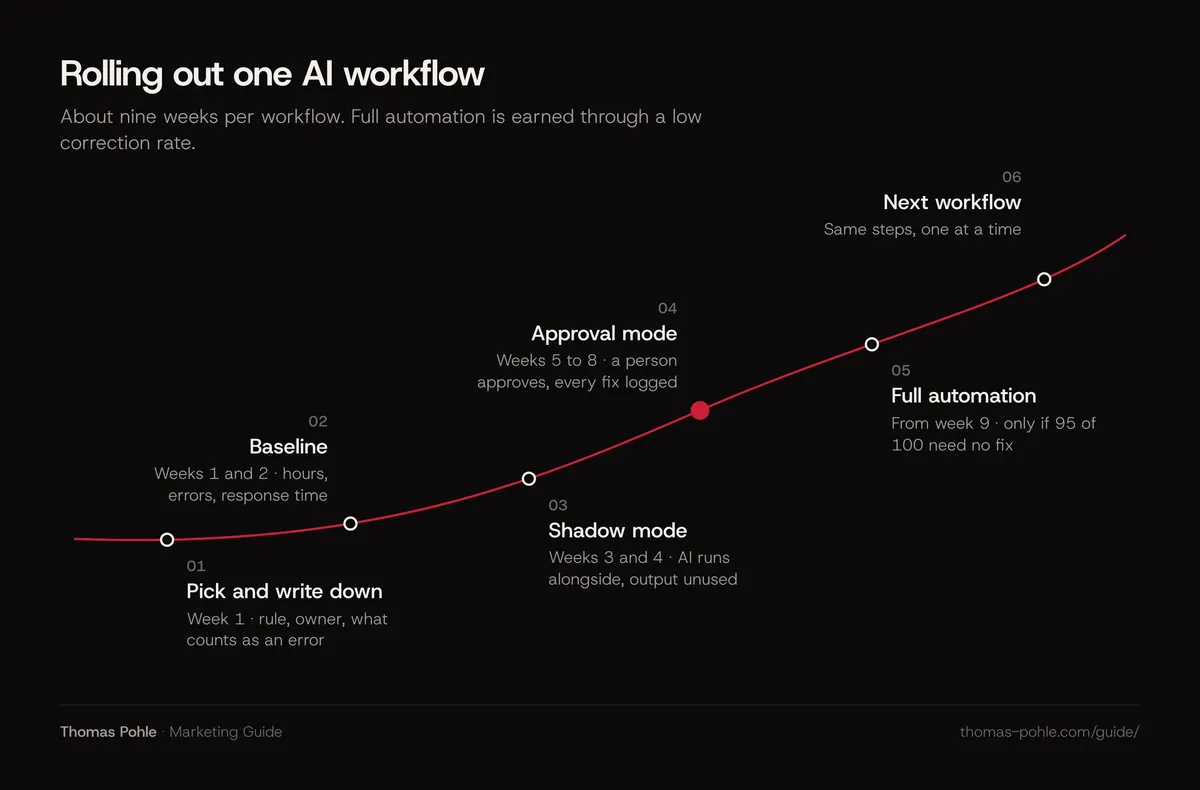
Roll out one workflow at a time: score it, measure today's baseline for two weeks, run AI in shadow mode, then with approval, and switch to full automation only when the correction rate is low. Then take the next workflow. Five pilots at once and you can't tell which one broke your data.
My plan for one workflow, about nine weeks:
- Week 1: pick and write down. The highest-scoring workflow that costs real hours. Write the rule, the owner and what counts as an error.
- Weeks 1 and 2: baseline. Hours per week, error rate, and for inbound the response time.
- Weeks 3 and 4: shadow mode. AI runs alongside, its output isn't used. The owner compares it with the manual result.
- Weeks 5 to 8: approval mode. AI output goes live after a person approves it. Log every correction.
- From week 9: full automation, if earned. My threshold: at least 95 of the last 100 outputs needed no correction, and none had an error at risk level 3. Then a weekly sample of ten.
- Then the next workflow. Same steps. Workflows with score 5 to 7 stay in approval mode for good.
Measure time saved and the downstream effect, such as meetings accepted by sales after routing or unsubscribes after newsletters. Time saved with a falling downstream number is a loss.
My view: with AI, marketing can run with far fewer people than before. I don't just use AI, I build with it. As co-founder of TEISENDA, which automates a large part of marketing for smaller companies, I'm not neutral on automation. Read the thresholds with that in mind. They're the ones I'd hold myself to.
What to do this week
- List the ten workflows that take the most hours in your marketing team.
- Score each one with its owner in the room.
- Mark every workflow that goes out under a person's name. Those start with that person's input.
- Pick the internal workflow with the highest score.
- Write its rule, owner and error definition on one page.
- Measure the baseline for two weeks before any tool runs.
- Check that your chatbot, if you have one, says it's an AI.
The winners won't have the most automated workflows. Their buyers will always get a person when it counts. If you want help picking and setting up the first workflow, that's what a one-day Momentum Workshop is for.
Frequently asked questions
What is the difference between marketing automation and AI marketing automation?
Marketing automation runs rules you wrote: a form fill triggers an email, a lead score triggers a task. AI marketing automation adds a step that reads, classifies or writes, such as tagging a request or drafting a reply. Its output varies, so it needs review rules classic automation didn't.
Which marketing workflow should you automate with AI first?
Start with an internal workflow that runs with every lead and stays away from customers: tagging inbound requests, lead enrichment or CRM hygiene. They score 8 or 9 in the model in this guide. Mistakes stay inside your systems and a weekly sample catches them.
Should AI answer inbound requests automatically?
Not without a person, in my view. Replies score high on error risk and customer proximity, so AI drafts and a person sends. A Gartner survey of 645 B2B buyers (published May 2026) found 69 % prefer to validate AI-generated insights with sales reps. A wrong price in an automated reply costs more than the time it saved.
Do you have to label AI-generated marketing content under the EU AI Act?
Article 50 of the EU AI Act, applying from 2 August 2026, requires disclosure for deepfake images, audio and video, and for AI text published to inform the public on matters of public interest unless a person reviewed it and holds editorial responsibility. Check your case with a lawyer; this isn't legal advice.
How do you know an AI workflow is ready for full automation?
Measure the correction rate in approval mode. My threshold: at least 95 of the last 100 outputs needed no correction, and none had an error that could cause legal or reputational damage. Then keep a weekly sample of ten. Anything under a person's name never switches.
Sources
- Gartner (May 11, 2026): Survey reveals marketing leaders expect AI automation of marketing work to double by 2028
- Gartner (May 20, 2026): Survey finds 69% of B2B buyers turn to sales reps to validate AI-generated insights
- Salesforce (February 19, 2026): State of Marketing 2026, key findings and methodology
- HubSpot (updated April 10, 2026): 2026 State of Marketing, data from 1,500+ global marketers
- Regulation (EU) 2024/1689 (Artificial Intelligence Act), Article 50 and Article 113, EUR-Lex
- Regulation (EU) 2016/679 (General Data Protection Regulation), Article 22, EUR-Lex
- Regulation (EU) 2026/1744 (Digital Omnibus on AI), OJ L 24 July 2026, EUR-Lex
- Google Search Central: Guidance on using generative AI content on your website

Thomas PohleB2B marketing advisor in Zurich. More than ten years in B2B marketing at Link11, Beekeeper and smino, most recently as Head of Marketing. CEO and co-founder of TEISENDA. Researched and drafted with AI tools, checked against the sources listed above. More about Thomas