Where can you cut the marketing budget without losing pipeline?

Cut the marketing budget in a fixed order. Start with software seats nobody uses and tools that overlap. Then agency work you pay for twice, advertising without a defined job and events that missed their target. Protect brand search demand, existing customers, the content that brings inbound and the people who know your customers.
This is for founders, CEOs and heads of marketing who've just been told to take 10 or 20% out of the budget. In Gartner's 2026 CMO Spend Survey, fielded from January to March 2026 among 401 marketing leaders at mostly large companies, 56% of CMOs said they lack the budget to execute their strategy, as Marketing Dive reported in May 2026.
How the role that owns these calls works is in the guide to the B2B head of marketing.
Where do you cut the marketing budget first?
Cut first where the money buys nothing a buyer would notice: software seats nobody uses, two tools that do the same job, agency tasks someone else already does. Then cut advertising without a defined job and events that missed their target twice. What feeds next year's pipeline comes last, and only if the first four steps didn't reach the number.
Cost-cutting rounds often run the other way:
- The even cut: 15% off every line feels fair. It keeps 85% of the waste and takes 15% from everything that works.
- The easy cut: ads stop in a day, contracts don't. So the flexible money goes, which is often the money that works, and the locked-in waste stays.
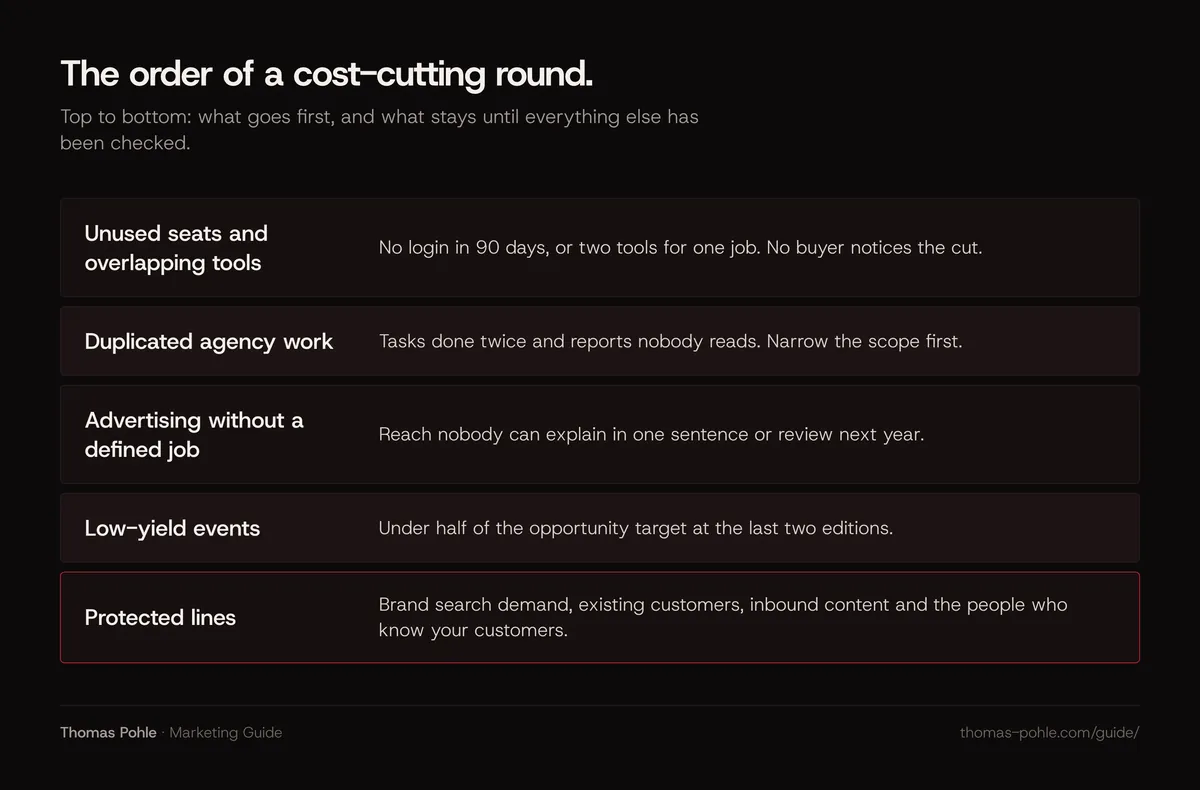
Order isn't timing. A seat ends at renewal, a retainer at its notice date, a booth under the organizer's terms. Check your contract before you count a saving in this year. How to keep committed money visible is in the guide on tracking marketing spend during the year.
What happens when you cut brand spend?
The best public evidence says sales erode slowly and keep eroding. Ehrenberg-Bass Institute researchers looked at 57 cases of consumer brands that stopped mass media advertising for a year or longer. Sales were on average 16% lower after one year and 25% lower after two. Small brands and brands already in decline fell faster. The data is B2C, and it covers full stops, which go further than a trim.
- Ehrenberg-Bass Institute (Journal of Advertising Research, online June 2021): one Australian consumer goods category over more than 20 years. After three years, sales were 36% lower on average.
- The replication (Phua and colleagues, Journal of Advertising Research, 2023): 365 brands in 22 US supermarket categories. Market share was on average 10% lower after one year, 20% after two and 28% after three.
- Binet and Field (2019), for the LinkedIn B2B Institute: in fewer than 50 B2B cases from the IPA Databank, 10 points of extra share of voice went with about 0.7 percentage points of market share growth per year. The authors call the result tentative. LinkedIn sells advertising and commissioned the work.
- Downturns: In 2020, Peter Field reviewed about 50 IPA case studies from the 2008 to 2009 recession. The IPA's summary says the brands that held their share of voice bounced back strongly. Analytic Partners, which sells marketing measurement, said in August 2022 that 60% of brands that raised media investment in the last recession saw their ROI improve. Its press release says little about the method.
What's missing: I found no study that follows mid-sized B2B companies after a brand cut. Treat the numbers as direction. The mechanism is plausible in B2B, though. The LinkedIn B2B Institute's 95-5 rule says 95% of your potential buyers aren't ready to buy today. Brand spend works on them. Cut it and this quarter's pipeline may look the same. The gap opens when they come into the market and don't think of you. Why unmeasured doesn't mean wasted is in is half of the marketing budget really wasted?
Which tools and seats can go first?
Start with software, because this saving should cost no pipeline. Export the user list with the last login date for every marketing tool. A seat without a login in 90 days goes at the next renewal. Where two tools do the same job, keep the one your team opens every week and cancel the other.
Zylo's 2026 SaaS Management Index, published in January 2026, says organizations leave an average of 36% of their SaaS licenses unused. The figure rests on more than 40 million licenses in Zylo's own platform. Zylo sells software that finds unused licenses, and the data covers all company software.
Overlaps I'd check first:
- Email: a newsletter tool next to a CRM that sends email too.
- Data: a contact or intent database nobody has exported from in a quarter.
- AI: single licenses for writing tools on top of a company-wide assistant.
My view: AI should remove complexity. It shouldn't add more tools. If a new AI tool arrived this year and no older tool left, your stack only grew.
Where does agency work duplicate what you already pay for?
Agency money is duplicated when two suppliers, or a supplier and your own team, do the same task. Two monthly reports from the same data. Social posts your team rewrites before they go out. List every recurring agency task, name who uses the result and cut the tasks without a user.
In Gartner's 2025 CMO Spend Survey of 402 marketing leaders, 39% of CMOs planned to cut agency budgets, and 22% said generative AI let them rely less on agencies for creative and strategy work, as MarTech reported in May 2025.
Three checks for every retainer:
- Reports: who read the last one, and what changed because of it?
- Rework: how much of what's delivered does your team rewrite?
- Overlap: does a second supplier, a tool or a colleague cover the same task?
Narrow the scope before you end a contract. On my own site I say you don't need another agency, you need someone who gets it moving with you. In a cost-cutting round that means: pay for execution you can't do yourself, and stop paying for coordination between suppliers.
One warning if AI takes over what the agency wrote. The input still has to come from you. In my view, visitors react to texts built on your own experience. An AI draft without it saves the fee and loses the effect.
Which advertising and events can you stop?
Stop advertising that has no defined job, and events that missed their opportunity target at the last two editions. An ad line has a job when you can name its audience, what it should change and the signal you'll review. Reach that fails this test goes before anything aimed at your target accounts.
Reach without a job
Brand advertising to the buyers of your category is reach with a job. Display ads to "decision makers in DACH", booked years ago and renewed since, aren't. The test is one sentence: who sees it, what should they remember, and how will we check next year? How to score a measure is in which B2B marketing measures are worth it.
Ads on your own brand name
In a large field experiment at eBay, published in Econometrica in 2015, Blake, Nosko and Tadelis found that brand-keyword ads had no measurable short-term benefit. eBay is a huge consumer marketplace, so run your own test. Pause the campaign for four weeks and compare total clicks on brand searches, paid plus organic, and demo requests. If both stay within 10% of the weeks before, leave it off. If competitors advertise on your name and take the clicks, switch it back on.
Events
Judge a show by the opportunities it created. My working rule: less than half of the opportunity target two times running means stop. The saving usually lands with the next edition, because a booked stand is committed under the organizer's terms.
What should you protect in a cost-cutting round?
Protect what makes buyers come to you: brand search demand, existing customers, the content that brings inbound requests and the people who know your customers. In my view, all four are slow to rebuild.
- Brand search demand: how often people search for your name is, to me, the clearest free signal that brand work lands. Google Search Console has had a branded queries filter since November 2025, and Google says it has been available to all eligible sites since March 2026. It needs a top-level property with enough search volume. On a smaller site, filter the queries by your name. Watch the trend every month.
- Existing customers: renewals, referrals and reference calls start here. In my view, cutting customer marketing saves little and risks the proof your sales team needs.
- Content that brings inbound: find the pages that led to demo requests, in Search Console and in the answers to "How did you hear about us?". Keep those pages current.
- People who know your customers: cut here last. A tool or an agency can usually be bought again within a month. A marketer who knows why your customers bought can't. With AI in production, only they can supply the input.
How do you decide between cut, pause and protect?
Give every budget line one of three decisions. Cut means the line ends and the money leaves the budget. Pause means it stops for a fixed test period, with a signal that decides whether it returns. Protect means it stays at plan through this round. Every decision gets its test or threshold in writing before the meeting.
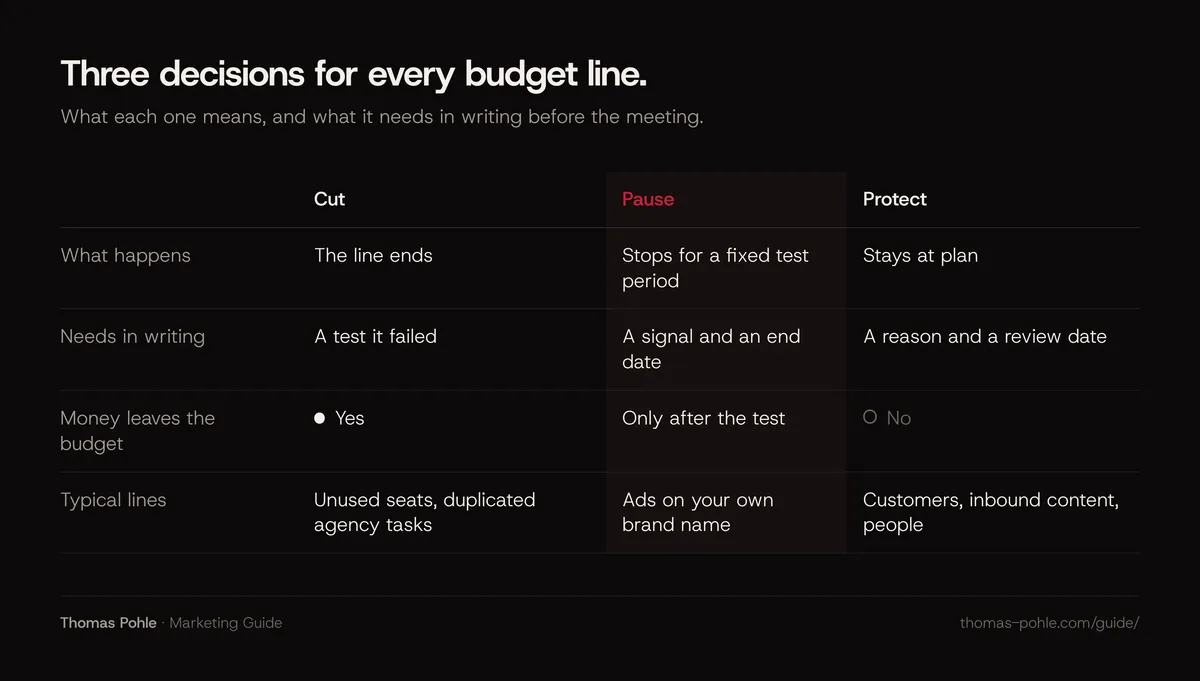
| Budget line | Decision | Test or threshold |
|---|---|---|
| Tool seats and overlapping tools | Cut | No login in 90 days, or two tools for one job |
| Agency tasks | Cut | Nobody used the result last quarter |
| Ads on your own brand name | Pause | Four weeks off: brand clicks and demo requests within 10% means it stays off |
| Broad reach ads and sponsorships | Cut or pause | No one-sentence job: cut. A job but no signal yet: pause |
| Events | Cut | Under half of the opportunity target at the last two editions |
| Ads to target accounts | Protect | Cap only if cost per opportunity runs 30% over plan for two months |
| Brand reach to category buyers | Protect | Trim last, review once a year on brand searches |
| Customers, inbound content, people | Protect | Last lines of the round |
The thresholds are my working rules, no benchmarks. Set your own before anyone looks at the lines. Otherwise every line finds a defender.
What does a cost-cutting round look like with numbers?
Here's an example for a fictional B2B software company with 60 employees and a marketing budget of EUR 500,000 a year. Leadership asks for 15% less, which is EUR 75,000. All numbers are invented for illustration.
| Budget line | Budget (EUR) | Decision and test | Saving (EUR) |
|---|---|---|---|
| Marketing team | 176,000 | Protect | 0 |
| Tools | 44,000 | Cut 14 unused seats and two overlapping tools | 12,000 |
| Agency retainer | 60,000 | Cut the second report and the rewritten social posts | 20,000 |
| Content and SEO freelancers | 28,000 | Protect | 0 |
| Search ads | 48,000 | Pause the brand-name campaign for a four-week test | 6,000 |
| LinkedIn ads to target accounts | 46,000 | Protect | 0 |
| Display and newsletter sponsorships | 22,000 | Cut: no one-sentence job | 22,000 |
| Two trade shows | 60,000 | Cut the smaller show: under half of its target twice | 15,000 |
| Customer marketing | 16,000 | Protect | 0 |
| Total | 500,000 | 75,000 |
Compare that with the even cut. 15% off every line would take EUR 26,400 from the team and EUR 6,900 from the ads to target accounts. And 85% of the display budget would keep running, although nobody can say what it's for.
The round takes four weeks: list the lines with their exit dates, run the tests, decide, give notice. The pause tests are read when they end.
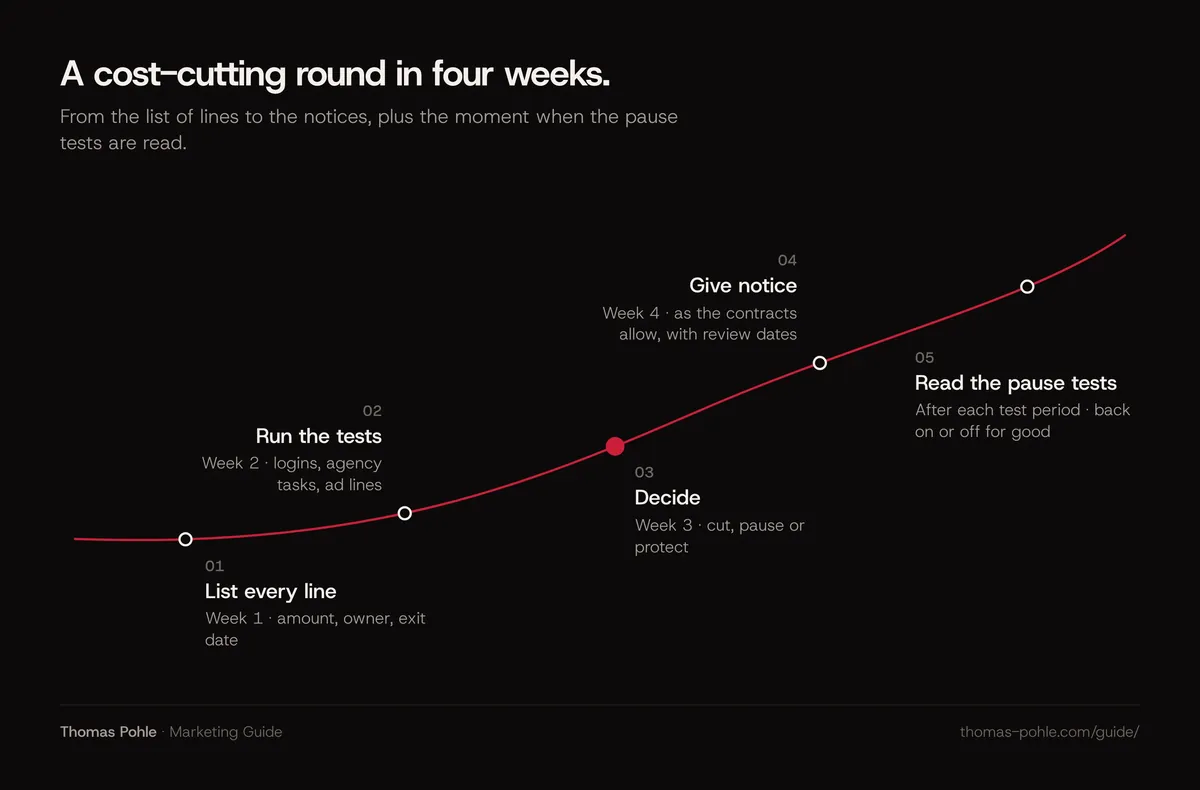
The savings land when contracts allow, so part of the EUR 75,000 will only show in next year's budget. And the EUR 6,000 from the brand-name campaign is provisional until the test is read.
What to do this week
- List every line: amount, owner and exit date. Check your contract for each.
- Pull the logins: user list and last login for every marketing tool.
- List agency tasks: one row per recurring task, with the person who uses the result.
- Run the one-sentence test: audience, job and review signal for every ad and sponsorship line.
- Mark the protected lines: and write down today's brand search trend.
- Give every pause an end date: a pause without a review turns into a cut nobody decided.
If you want a second pair of eyes on the list before notices go out, a one-day Momentum Workshop is a good place to go through it with your team.
Frequently asked questions
How much can you cut from a marketing budget without hurting pipeline?
There's no reliable benchmark. It depends on how much of the budget buys nothing a buyer would notice. In this article's fictional example, 15% comes out of tools, duplicated agency work, advertising (including a provisional brand-name pause) and one weak trade show. If such steps don't reach your number, expect the rest to cost pipeline.
Is it safe to stop bidding on your own brand name?
Test it. A large eBay field experiment, published in Econometrica in 2015, found no measurable short-term benefit from brand-keyword ads, but eBay is a huge consumer brand. Pause your campaign for four weeks and compare total brand clicks and demo requests. If competitors advertise on your name and take the clicks, switch the campaign back on.
Should you cut the agency or the in-house team first?
In my view, agency tasks go before people. You can buy an agency task or a tool again within a month. A marketer who knows why your customers bought takes much longer to replace. Narrow the agency scope to execution your team can't do, and check your contract for the notice period.
How fast do marketing budget cuts show up in the numbers?
Often slower than leadership expects. Ads stop within days. Software seats end at renewal, retainers at their notice date, and a booked trade show stand is committed under the organizer's terms. List the exit date of every line before you promise a number.
Sources
- Ehrenberg-Bass Institute: What happens when brands stop advertising? (research released 2018, published in the Journal of Advertising Research, online June 2021)
- Advertising Research Foundation: When Brands Go Dark, a replication and extension (Phua, Hartnett, Beal, Kennedy and Trinh, Journal of Advertising Research, 2023)
- Les Binet and Peter Field for LinkedIn B2B Institute: The 5 Principles of Growth in B2B Marketing (2019, PDF)
- IPA: Peter Field's seven lessons for advertising during a recession (April 2020)
- Analytic Partners: Report, cutting spend in recession risks loss (press release, August 2022)
- LinkedIn B2B Institute: The 95-5 rule
- Marketing Dive: AI remains a top priority for CMOs, but spending lags (May 11, 2026, on the Gartner 2026 CMO Spend Survey)
- MarTech: CMOs brace for cuts as marketing budgets stay flat (May 12, 2025, on the Gartner 2025 CMO Spend Survey)
- Zylo: 2026 SaaS Management Index (press release, January 29, 2026)
- Blake, Nosko and Tadelis: Consumer Heterogeneity and Paid Search Effectiveness, a Large-Scale Field Experiment (NBER Working Paper 20171; Econometrica 83, 2015)
- Google Search Central Blog: Introducing the branded queries filter in Search Console (November 20, 2025, updated March 11, 2026)

Thomas PohleB2B marketing advisor in Zurich. More than ten years in B2B marketing at Link11, Beekeeper and smino, most recently as Head of Marketing. CEO and co-founder of TEISENDA. Researched and drafted with AI tools, checked against the sources listed above. More about Thomas