Which tools measure your brand's visibility in AI assistants?

Four kinds of tools measure AI visibility: prompt trackers that run fixed prompts on a schedule, SEO suites with an AI module, your own analytics and server logs, and brand-mention monitoring. None of them shows what your own buyers ask. Every score is a sample. For most SMEs, 20 to 30 prompts checked by hand once a month are enough to start.
This is for founders and marketing leads who get offers for "LLM optimization tools" every week and want to know what the numbers are worth. Why AI answers matter is covered in the pillar on how SEO changes when AI answers the search. The free platform reports are set up in how to measure organic and AI search visibility.
Vendors appear only as examples of a category, with facts from their own documentation, checked in November 2026.
Which kinds of tools measure visibility in AI assistants?
There are four categories, and they measure different things. Prompt trackers and SEO suite modules ask AI assistants questions and read the answers. Your own analytics and logs record what reaches your website. Mention monitoring watches the open web that assistants draw on. Only the third is data from your own systems.
| Category | How it gets its number | What the number tells you | What it can't tell you |
|---|---|---|---|
| Prompt tracker | Runs your fixed prompt list in several assistants on a schedule | How often you appear for these prompts, and who else does | How often real buyers ask these prompts |
| SEO suite with AI module | Runs a large prompt set chosen by the vendor | A broad view of your category | Whether the vendor's prompts match your buyers |
| Own analytics and server logs | Counts visits and fetches from AI assistants | What actually reached your site | Mentions that led to no click |
| Brand-mention monitoring | Searches the web for your name | Where the web talks about you | What any assistant says about you |
The platforms' own reports sit beside these four and cost nothing. Google Search Console counts AI Overviews and AI Mode inside the "Web" search type of the Performance report. Its generative AI report, open to all sites since 31 August 2026, shows impressions. The help page mentions neither clicks nor queries. Bing's AI Performance report, launched as a public preview on 10 February 2026, shows citations in Copilot and Bing's AI summaries.
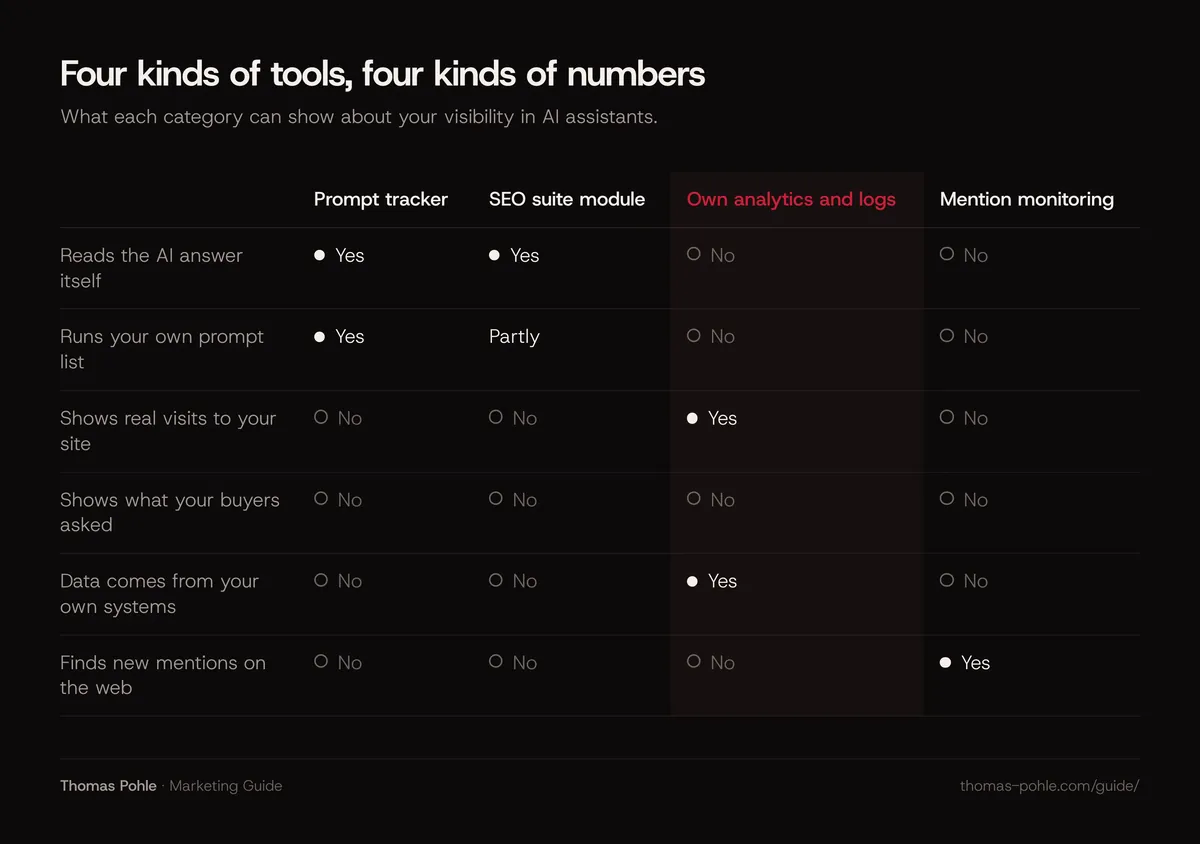
How do prompt-tracking tools get their numbers?
A prompt tracker stores a list of prompts you chose, sends them to assistants like ChatGPT, Gemini or Perplexity on a schedule, saves every answer and counts how often your brand and your competitors appear. The result is usually called visibility or share of voice. It describes your prompt list, never the whole market.
Peec AI is one example of this category. Its documentation says it runs your prompts "across AI platforms like ChatGPT, Gemini, and Copilot daily" and uses browser automation to work through the platforms' web interfaces. On most platforms, the docs add, the platform decides which model answers and whether it runs a web search. Peec's stated reason for the method: "API responses often differ from what users see in the actual interface."
Ask every vendor about that. A tool that queries a model over the API measures the model. A tool that drives the web interface measures something closer to what a buyer sees.
No tracker can count how many people ask those prompts. The assistants don't publish that, so treat any volume figure as an estimate.
What do SEO suites with an AI module add?
SEO suites add scale and context. They run prompt sets far larger than any list you'd write yourself and connect the answers to the keyword and competitor data you already have. The price is control. The vendor chose most of the prompts, so you see your category through the vendor's eyes.
Semrush's knowledge base lists daily updates for prompt tracking in its AI Visibility Toolkit, weekly updates for the brand performance reports, and a price of 99 US dollars per month that includes 25 tracked prompts (checked November 2026).
Ahrefs explains the method behind Brand Radar in a post updated on 26 February 2026. The prompts in its database start from Google's "People Also Ask" data and Ahrefs' keyword database, and they run through the free, publicly available web interfaces. Ahrefs calls the metrics "directional indicators, not exact traffic counts" and says the tool shows what appears in AI, "not who saw it".
If you already pay for a suite, open its AI module before you buy anything new. My view on tools in general: AI should remove complexity. One more dashboard rarely does.
What can your own analytics, server logs and mention monitoring show?
Your own data shows the part of AI visibility that reached you: visits with an AI referrer such as chatgpt.com or perplexity.ai, and requests from user agents like ChatGPT-User or Perplexity-User in your server logs. It's the only category that counts real visits and requests on your site. It misses every answer that named you without a click.
So your own data is a floor. The true number of buyers who met your name in an AI answer is very likely higher, and nobody can tell you by how much.
Brand-mention monitoring looks at the other end. It searches news sites, forums and review platforms for your company name. That says nothing about what an assistant answers today. It tells you whether the raw material exists, and third-party mentions are part of getting cited by ChatGPT, Perplexity and Google AI.
Why is every AI visibility number a sample?
Every AI visibility number is a sample because nobody outside the platforms sees the real prompts, and the same prompt gives different answers. OpenAI's and Perplexity's crawler documentation describes crawlers and robots.txt rules, and no report for site owners (checked November 2026). Google states that third-party tools "don't have access to our internal ranking data."
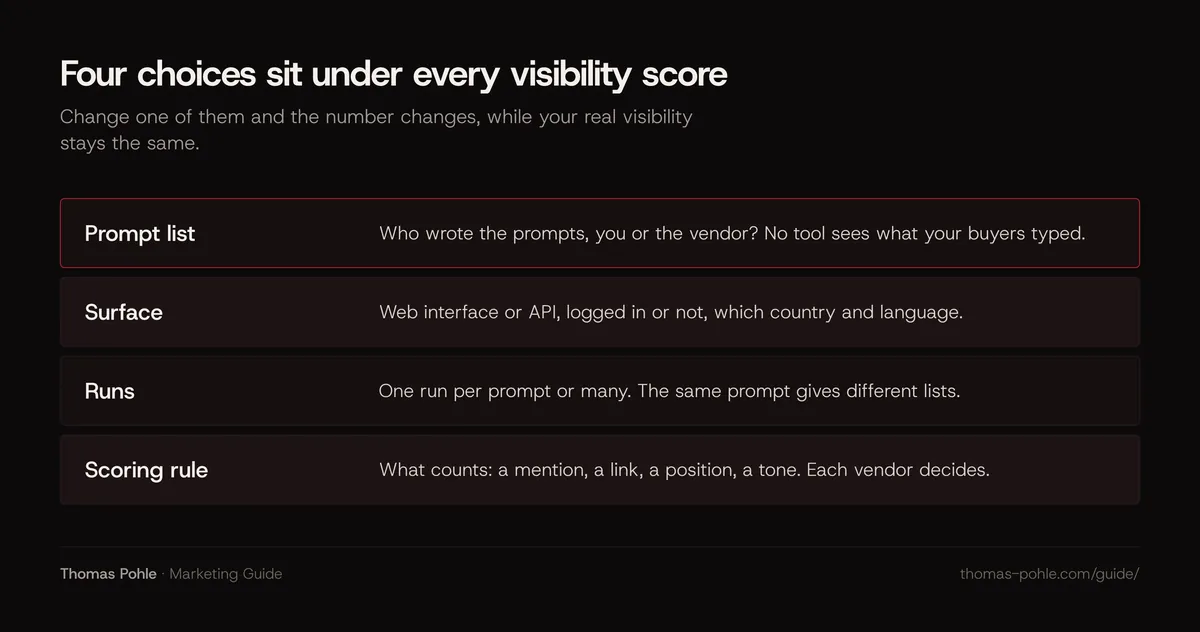
Four choices turn "visibility" into a number.
- The prompt list. Add ten prompts that contain your brand name and your score jumps.
- The surface. Web interface or API, logged in or not, which country and language.
- The runs. OpenAI's API documentation says Chat Completions "are non-deterministic by default". One run per prompt is one draw.
- The scoring rule. A mention, a link, a position or a tone. Each vendor counts differently.
How much answers vary was tested by SparkToro and the AI tracking startup Gumshoe, published on 28 January 2026. About 600 volunteers ran 12 prompts through ChatGPT, Claude and Google's AI features, 2,961 runs in total. The authors put the chance of getting the same list of brands twice at under 1 in 100 for ChatGPT and Google, and the chance of the same order at roughly 1 in 1,000. Their verdict: a ranking position in AI means little, while the share of answers that mention you, over many prompts and repeated runs, is "a reasonable metric".
Read that study with care. The co-author works for a company that sells AI tracking, which the post discloses. The authors say they aren't professional researchers, and nothing was peer reviewed. I know of no agreed number of prompts and runs that makes a score reliable.
Personalization comes on top. OpenAI's help center says that with Memory enabled, ChatGPT "may use relevant details to formulate a more useful search query." A buyer with a long chat history may not get the answer a tool gets in a fresh session.
How do you run a manual prompt sample as an SME?
Write 20 to 30 prompts your buyers would really ask, freeze the list, and run it once a month in three assistants. Score every answer the same way in one sheet. After three rounds you know where you appear, where you're missing and what assistants get wrong about you. I estimate two to three hours per round.
Write the prompts yourself. Take them from sales calls and inquiry emails, in your buyers' words. A prompt list generated by an AI sounds like an AI. Your buyers don't. Split the list in three: category questions ("Which providers of X are there in Switzerland?"), problem questions and comparison questions that name you or a competitor.
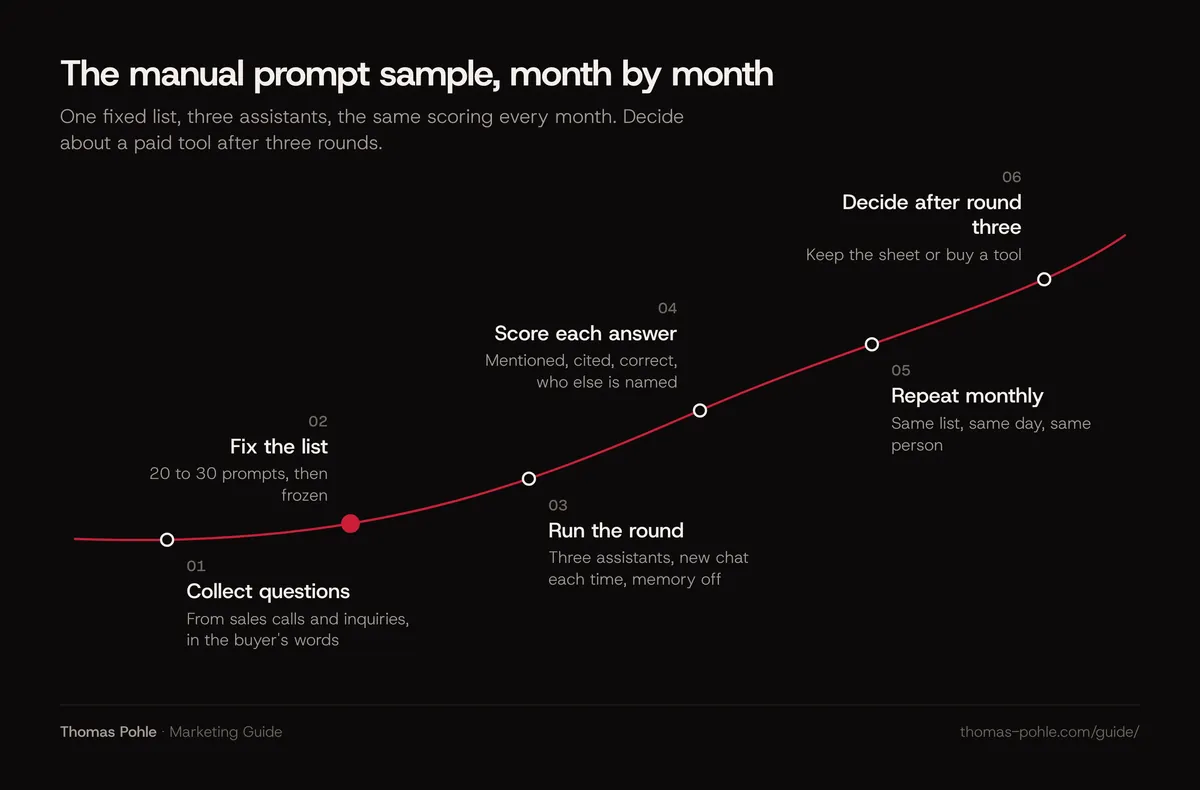
- Three assistants. Pick the ones your buyers name. If you don't know, start with ChatGPT, Google's AI Mode and Perplexity.
- Clean session. New chat for every prompt, memory off, same language and country each month.
- Same day, same person. Judgment calls stay consistent, and you keep the raw answers in one document.
| Column in the sheet | What you enter | Example entry |
|---|---|---|
| Prompt | The exact wording from your fixed list | "Which warehouse software suits a Swiss food wholesaler with 80 employees?" |
| Assistant and date | Where and when you asked | Perplexity, 3 November |
| Mentioned | 1 if your company is named, otherwise 0 | 1 |
| Cited | 1 if the answer links to your site, otherwise 0 | 0 |
| Correct | Yes, no, or what is wrong | No: says you have no cloud version |
| Others named | Competitors and linked sources | Two competitors, one trade magazine |
An example with numbers, invented to show the arithmetic: a software company runs 24 prompts in three assistants. That's 72 answers per round. In round one it's mentioned in 14 answers, which is 19 %, cited in 5, and described wrongly in 2. In round three it's mentioned in 21, which is 29 %.
Is that progress? Probably. With 72 answers, three or four more mentions can still be chance. My rule of thumb: act on a change only when it holds for three rounds or moves by more than ten answers. Wrong facts are different. Fix them today, on your own website first.
The sample also tells you what to write next. Where a competitor is cited and you aren't, read the page the assistant linked. Then write the better answer yourself, with your own numbers and cases. No tool does that for you.
When does a paid AI visibility tool pay off?
A paid tool pays off when the manual sample costs more than half a working day a month, when you need trends weekly or daily, or when you track several markets or languages. The thresholds are my rules of thumb. No study backs them.
| Your situation | Manual sample | Paid tool |
|---|---|---|
| Up to 30 prompts, one market, one language | Enough | Not yet |
| More than 50 prompts, or two or more languages or countries | Too slow | Pays off |
| You need a weekly trend, for example during a launch or a rebrand | Too coarse | Pays off |
| You already pay for an SEO suite with an AI module | Keep it as a cross-check | Use the included module first |
| Nobody owns the result or acts on it | Pointless | Pointless |
The last row matters most. Decide first who rewrites the page or corrects the wrong fact. Then decide how to measure.
What should you ask before you buy a tool?
Ask every vendor the same five questions and compare the answers, never the dashboards. A serious vendor explains its prompts, its surface, its runs and its scoring. If the answer is "our proprietary score", you've learned what you needed.
- Who writes the prompts? Can you load your own list, and can you see the vendor's?
- Web interface or API? Logged in or not, and from which country?
- How many runs per prompt? And over which period is the score averaged?
- What counts as visible? A mention, a link, a position?
- Can you export the raw answers? Without them you can't check a single number.
You won't find a ranking of the best tools here. I don't attack named vendors in public. My criticism is aimed at a pattern: scores without a disclosed method. The same questions work for an agency, see how to choose an AI SEO agency.
What to do this week
You can have a first reading of your AI visibility by Friday without buying anything. All it takes is a spreadsheet, three assistants and about half a day.
- Collect buyer questions. Ten from sales, ten from inquiry emails.
- Write 20 to 30 prompts. A third category, a third problem, a third comparison. Freeze the list.
- Run round one. Three assistants, new chat each time, memory off, six columns in the sheet.
- Fix wrong facts first. Correct them on your own pages, then on profiles you control.
- Open the free reports. Search Console and Bing Webmaster Tools.
- Put round two in the calendar. Same day next month, same person.
After round three, go back to the decision table. Want to set up the measurement and the plan behind it together? That's part of a one-day Momentum Workshop.
Frequently asked questions
What are the best LLM optimization tools for AI visibility?
There's no best tool, only a fitting category. Prompt trackers suit your own fixed questions. SEO suites with an AI module give a broad view of a category. Your own analytics and logs show real visits. Run a manual sample first.
Can a tool show how often ChatGPT recommends my company?
Not for real users. OpenAI's and Perplexity's crawler documentation describes no report for site owners, as checked in November 2026. A tool can show how often you appear when it runs a set of test prompts. That's a sample. Read it as a trend.
How many prompts do you need for a reliable AI visibility score?
Nobody knows for sure. SparkToro and Gumshoe suggested in January 2026 asking a prompt at least 60 to 100 times and averaging, and they call sample size an open question. I'd start with 20 to 30 prompts in three assistants once a month.
Can you compare AI visibility scores from two different tools?
No. Each tool uses its own prompts, its own surface, its own number of runs and its own scoring rule. A 40 in one tool and a 25 in another can describe the same reality. Compare one tool with itself over time.
Sources
- Google Search Central: AI features and your website
- Search Console Help: Generative AI performance report (Search)
- Google Search Central: Google Search's guidance on using third-party SEO tools, services, and advice
- Bing Webmaster Blog: Introducing AI Performance in Bing Webmaster Tools Public Preview (10 February 2026)
- OpenAI: Overview of OpenAI Crawlers
- OpenAI API docs: Advanced usage (reproducible outputs)
- OpenAI Help Center: Memory FAQ
- Perplexity: Perplexity Crawlers
- SparkToro and Gumshoe: AIs are highly inconsistent when recommending brands or products (28 January 2026)
- Peec AI documentation: how Peec AI collects data
- Semrush Knowledge Base: AI Visibility Toolkit
- Ahrefs: Brand Radar methodology (updated 26 February 2026)

Thomas PohleB2B marketing advisor in Zurich. More than ten years in B2B marketing at Link11, Beekeeper and smino, most recently as Head of Marketing. CEO and co-founder of TEISENDA. Researched and drafted with AI tools, checked against the sources listed above. More about Thomas