How do you train your marketing team for AI?

Train a marketing team for AI in two parts. A short course covers the basics, the risks and your approved tools. The real skills come from practice on your own work: briefing a model with your own material, checking every output against your facts and building AI into one process at a time. Plan 90 days, one owner, weekly reviews.
This guide is for founders, CEOs and marketing leads who decide what their team learns. Using AI without losing quality is covered in the pillar on AI in marketing. This one is the management view: skills by role, what a course can and can't deliver, a 90-day plan and a checklist for course offers.
Which AI skills does a marketing team need?
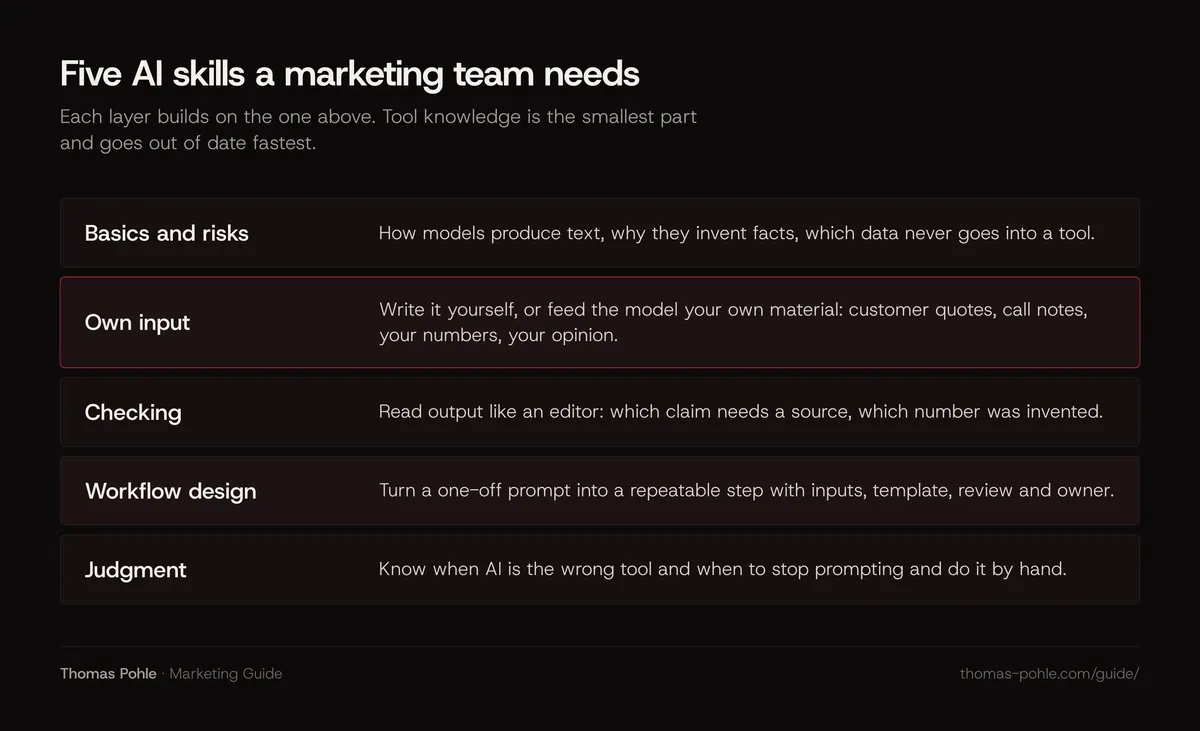
A marketing team needs five AI skills that build on each other: knowing what AI can and can't do, briefing a model with your own material, checking output against your facts, building AI into a repeatable workflow, and judging when AI is the wrong tool. Tool knowledge is the smallest part, and it goes out of date fastest.
- Basics and risks. How language models produce text, why they invent facts, which data never goes into a tool. This is roughly what the EU AI Act calls AI literacy.
- Own input. Writing it yourself, or at least feeding the model your own material: customer quotes, call notes, your numbers, your opinion. Content that buyers react to comes from real experience, and a model can't generate that for you. In my model this is the core skill. It sits above any prompt technique.
- Checking. Reading output like an editor. Which claim needs a source, which number was invented, which sentence sounds like every competitor.
- Workflow design. Turning a one-off prompt into a repeatable step with fixed inputs, a template, a review and an owner.
- Judgment. Knowing when to stop prompting and do it by hand.
Judgment is the hardest one to teach. When I designed my logo, I ran seven rounds across image models such as GPT Image, Ideogram, FLUX and Seedream. Almost everything got rejected. No model could make the one precise change I wanted to the favorite, so the final mark was rebuilt by hand as vector code. No course could have told me where that line was.
Which AI skills does each marketing role need?
Every role needs the basics, but the depth differs. The marketing lead needs judgment and the rules. Content and campaign people need own input and checking. Marketing operations needs workflow design and data protection. Train each role on the tasks it does every week, because that's where the skill gets used and kept.
| Role | Must be able to | Practice it on |
|---|---|---|
| Marketing lead or CEO | Set the rules for data, review and disclosure. Decide which process changes first. Judge quality. | The monthly report, the plan, one customer-facing text a week |
| Content and campaigns | Brief with own material, edit drafts into the brand voice, check every claim | Live articles, emails, LinkedIn posts, case studies |
| Demand and sales support | Research accounts, personalize outreach without inventing facts, respect email and data rules | The next 20 to 30 target accounts |
| Marketing operations | Connect tools, automate reports, check data processing agreements, keep the prompt library | CRM cleanup, the weekly dashboard |
How these roles fit into a team of one, three or eight people is in the guide on B2B marketing team structure. Tools per role are in the guide to AI tools for B2B marketing.
What does an AI course or bootcamp deliver, and what doesn't it?
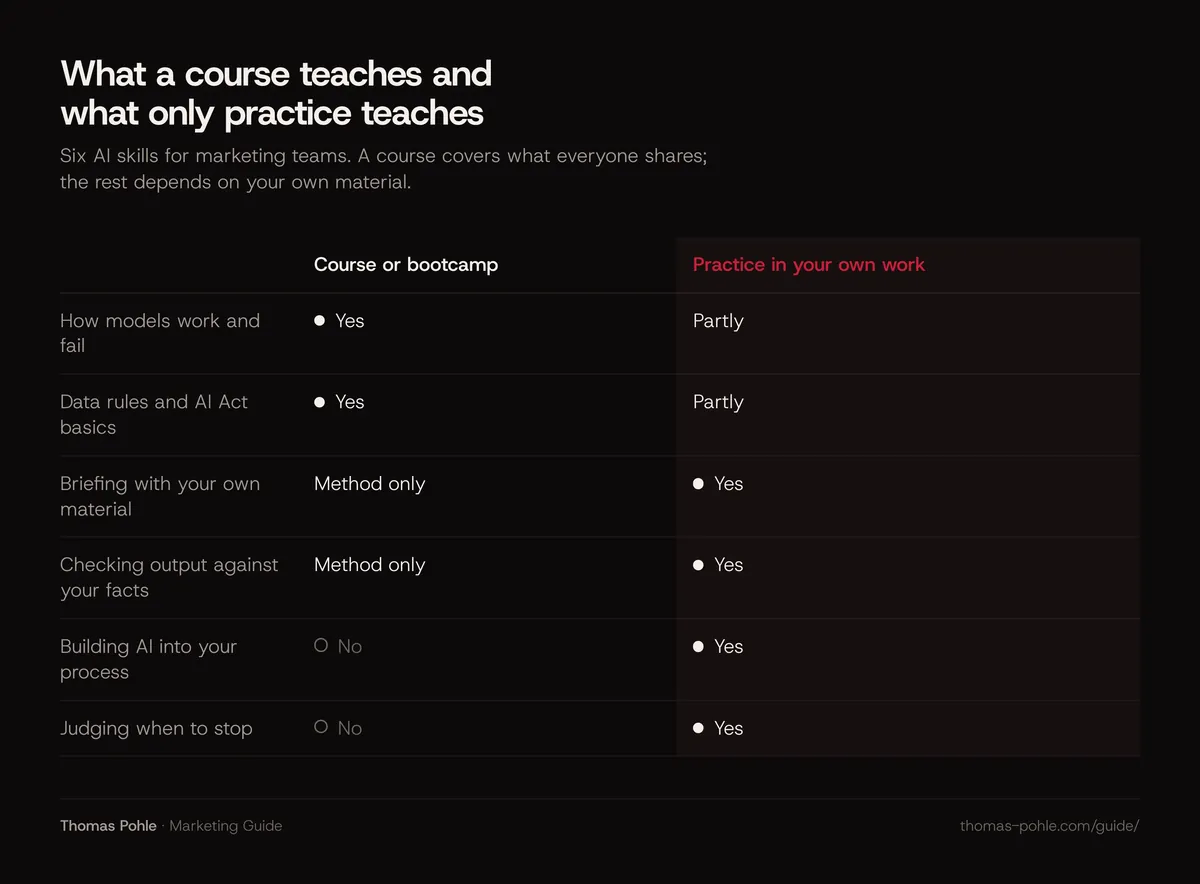
A good course delivers the shared basics in a few hours: how models work, where they fail, the tools you've approved and a common vocabulary. It can't deliver the skills that depend on your material, your customers and your process. Those come only from practice in the team's own daily work, with feedback from someone who knows what good looks like.
In BCG's AI at Work 2025 survey of more than 10,600 workers in 11 countries, people who got five or more hours of training, especially in person and with coaching, were more likely to become regular AI users. Only 36% felt adequately trained. The 2026 edition, published in June 2026 and based on 11,749 workers in 14 markets, found that 72% say AI has already considerably changed the skills expected in their role. Among regular AI users in roles without management responsibility, 66% say they get limited or no guidance on what to do with the time AI saves them.
The strongest evidence that skills travel through daily work comes from outside marketing. Brynjolfsson, Li and Raymond studied 5,179 customer support agents (NBER working paper 31161). An AI assistant raised issues resolved per hour by 14% on average and by 34% for novice and low-skilled workers, with suggestive evidence that it spread the practices of the best agents. Support isn't marketing, but the skill moved through the work itself.
I've played piano since I was four and taught it during university. A lesson shows you what to practice. The piece gets learned at the keyboard between lessons. In my view, AI skills work the same way.
What does the EU AI Act require for AI training in marketing?
Article 4 of the EU AI Act, in application since 2 February 2025, requires companies that provide or deploy AI systems to take measures to support the AI literacy of their staff and of others who use AI on their behalf. It doesn't prescribe a course, a certificate or a minimum level per person. What follows is a summary of the legal text. It isn't legal advice.
- The current wording. The original Article 4 asked for measures to ensure a sufficient level of AI literacy. The Digital Omnibus, Regulation (EU) 2026/1744 of 8 July 2026, published in the Official Journal on 24 July 2026, replaced it. Companies now take measures to support the development of AI literacy, and the obligation doesn't require them to guarantee a specific level for any individual.
- Marketing use counts. The European Commission's AI literacy Q&A answers the case directly: a company whose staff use ChatGPT to write advertising text or translate needs to comply, and staff should be informed about specific risks such as hallucination.
- Agencies and freelancers. According to the Q&A, the other persons in Article 4 are people under your organisational remit who aren't employees, for example a contractor or a service provider.
- No certificate. The Commission says there is no need for a certificate. Organisations can keep an internal record of trainings and other guiding initiatives. No training format is mandatory, but in many cases relying only on the tools' instructions for use might be ineffective.
- Enforcement. National market surveillance authorities supervise Article 4 from 2 August 2026, with penalties set by national law and applied proportionately.
- Swiss companies. According to the Q&A, Article 4 also applies outside the EU when an AI system is used in the Union or its use affects people there. Selling from Zurich into Germany? Ask counsel.
My practical reading: a basics session per role, an attendance list, a one-page AI rulebook and the review notes from the 90-day plan below give you a record of the measures you took. Whether that is enough for your case is a question for your lawyer. The rest of the AI Act for smaller companies is in the guide on where a mid-sized company should start with AI.
What does a 90-day plan for AI skills look like?
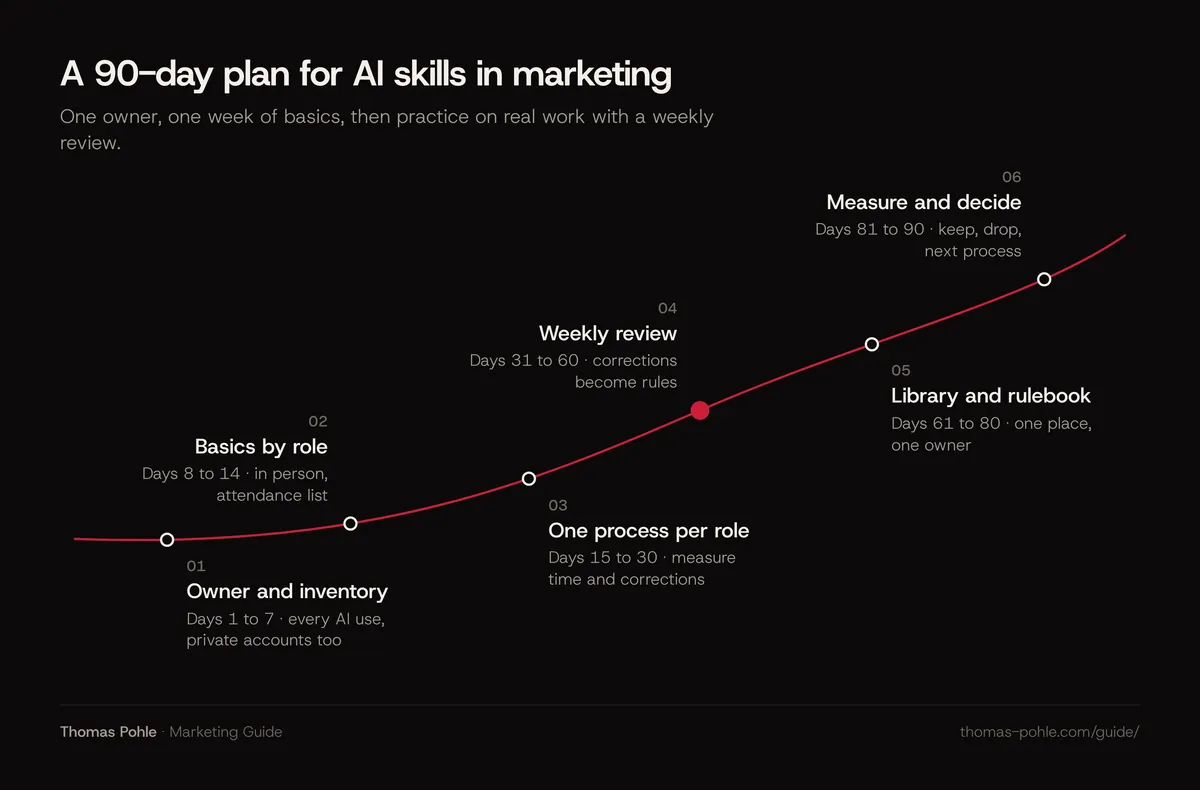
A 90-day plan for AI skills starts with one owner and an inventory, puts a short basics course in week two, then spends ten weeks on practice in real work: one process per role, a weekly review of corrections and a shared library of what worked. On day 90 you compare time and corrections with your starting point.
- Days 1 to 7, owner and inventory. Name one person who owns AI in marketing. List every AI use in the team, including private accounts.
- Days 8 to 14, basics by role. Run a basics session per role, in person if you can, and keep the attendance list. BCG's five-hour finding is a correlation, so treat it as a floor for planning, never as a target.
- Days 15 to 30, one process per role. Each role picks one weekly task from the table above. Measure the baseline before AI touches it: time per task and corrections per draft.
- Days 31 to 60, practice with weekly review. Thirty minutes a week. Each person shows one output, the reviewer explains every correction, and repeated corrections become rules. The craft behind it is in the guide on AI copy that doesn't sound like AI.
- Days 61 to 80, library and rulebook. Prompts, examples of your own material, voice rules and data rules go into one shared place with one owner.
- Days 81 to 90, measure and decide. Keep what saved time without adding corrections. Drop the rest, pick the next process.
How do you judge an AI course offer for your team?
Judge an AI course by how much of it runs on your own material. A good offer asks for your texts, data and processes before it starts, trains by role, ends with a workflow your team runs on Monday and comes back a few weeks later. A generic tool tour with a certificate is the weakest thing you can buy.
| Criterion | Good sign | Red flag |
|---|---|---|
| Own material | At least half the time on your texts, data and processes | Only demo examples from other industries |
| By role | Separate exercises for lead, content and operations | One session for everyone, intern to CEO |
| Group size | Everyone works hands-on, about 12 people at most | A webinar with a chat window |
| Follow-up | A second session four to six weeks later on real results | Ends on the last day |
| Tools | Your approved tools, under your data rules | The trainer's favorite tools you have no contract for |
| Outcome | One written workflow per role | A certificate and a slide deck |
| Legal part | Data protection and AI Act basics, marked as no legal advice | A promise that the certificate makes you compliant |
Ask three questions before you sign. How much time runs on our material? What will each role run on Monday? When do you come back? Vague answers mean a vague course.
On a tight budget, look at the European Digital Innovation Hubs. According to the Commission, more than 200 hubs across Europe, with Switzerland among the associated countries, support SMEs, and nine in ten already offer AI services such as trainings, workshops and bootcamps.
How do you know whether AI training worked?
AI training worked when the team's work changed. Attendance says nothing about that. Measure time per task, corrections per draft and errors that reached a customer, each against the baseline from the plan. Then add one human check on every customer-facing piece: is your own experience in it, and does it still sound like you?
- Corrections per draft. Falling numbers mean the rules work. Rising ones usually mean AI is doing tasks it shouldn't.
- Errors that reached customers. Wrong facts, invented numbers, broken promises. The target is zero.
- Own input. My rule: every customer-facing piece names its source of own experience, a customer quote, a number from your data or a call. If that line is empty, the piece goes back.
- Use of approved tools. In BCG's 2025 survey, 54% said they would use AI tools even without authorization. A falling share of private accounts is a sign the approved setup works.
What to do this week
- Name one owner for AI in marketing and block two hours a week in their calendar for the next 90 days.
- List every AI use in the team, including private accounts.
- Pick one weekly task per role and measure how long it takes and how many corrections it gets.
- Write down the data that never goes into an AI tool, and share it.
- Collect five pieces of your own material per role: customer quotes, call notes, numbers.
- Book a basics session per role and keep the attendance list.
- Send every course provider the three questions above before you compare prices.
Models will keep changing every few months. The skills that matter won't: your own input, careful checking and the judgment to stop. Teams that practice those on their real work every week stay ahead of any course syllabus. Want help choosing the first process your team should practice on? A one-day Momentum Workshop is built for that decision.
Frequently asked questions
How long does it take to train a marketing team for AI?
Plan 90 days. The basics fit into a session of a few hours per role in the second week. The rest is practice: one process per role, a weekly 30-minute review of real outputs and a shared library of prompts, examples and rules.
Do we need an AI certificate to comply with the EU AI Act?
No. The European Commission's AI literacy Q&A says there is no need for a certificate and that organisations can keep an internal record of trainings and other initiatives. Article 4 asks for measures that support AI literacy, tailored to people's knowledge and the context of use. This is a summary of the official texts, not legal advice.
Do agencies and freelancers fall under the AI literacy rule?
They can. Article 4 covers staff and other persons who deal with AI systems on your behalf, and the Commission names contractors and service providers as examples. In practice, ask your agencies which AI tools they use on your work, what data goes in and who checks the output, and write the answers into the contract.
Can AI write our content once the team is trained?
AI can draft, research and repurpose. The best content still comes from writing it yourself, or at least from your own input: customer quotes, call notes, your numbers and your opinion. Real experience is what buyers react to, and a model can't invent it. Training should make your team better at feeding and checking AI, never at skipping their own part.
Sources
- Regulation (EU) 2024/1689 (Artificial Intelligence Act), Article 3(56), Article 4 and Article 113, EUR-Lex
- Regulation (EU) 2026/1744 (Digital Omnibus on AI), amending Article 4, EUR-Lex
- European Commission: AI Literacy, Questions and Answers (last update 20 October 2026)
- BCG (June 2026): AI is reshaping jobs faster than companies are reshaping work (AI at Work, fourth edition)
- BCG (June 2025): Companies must go beyond AI adoption to realize its full potential (AI at Work 2025)
- Brynjolfsson, Li, Raymond: Generative AI at Work, NBER Working Paper 31161

Thomas PohleB2B marketing advisor in Zurich. More than ten years in B2B marketing at Link11, Beekeeper and smino, most recently as Head of Marketing. CEO and co-founder of TEISENDA. Researched and drafted with AI tools, checked against the sources listed above. More about Thomas